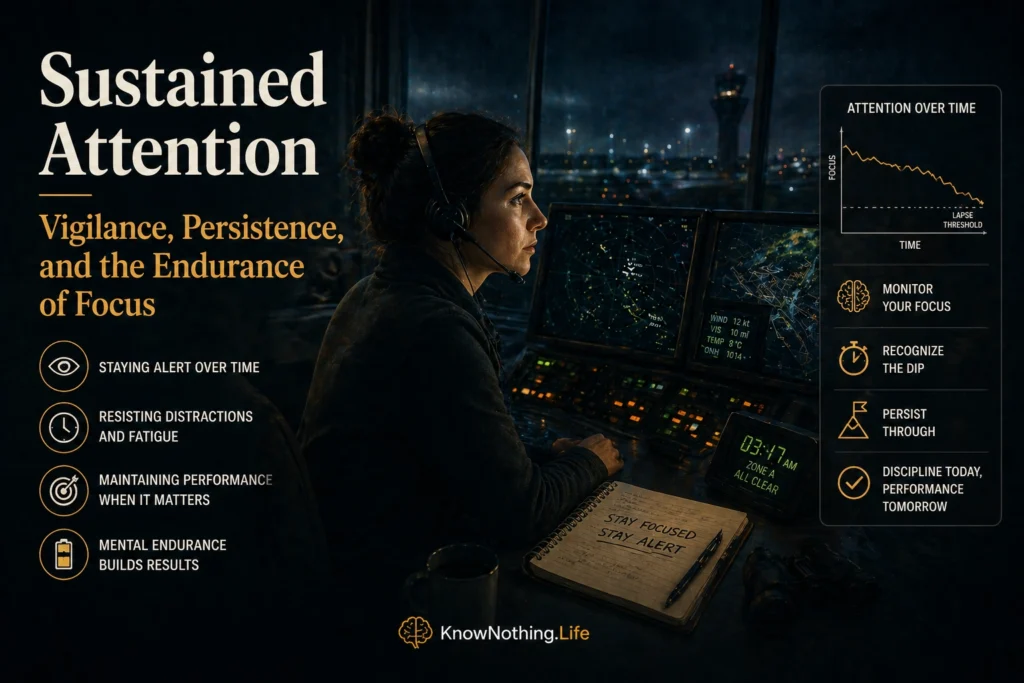
Sustained attention refers to the ability to maintain consistent focus on a task or stimulus over an extended period of time. Often described as vigilance, it is essential for activities that require continuous monitoring, such as driving, studying, air traffic control, or quality inspection. Unlike selective attention, which filters competing stimuli, or divided attention, which distributes resources across tasks, sustained attention emphasizes endurance—the capacity to remain engaged despite monotony, fatigue, or distraction. It reflects not only cognitive control but also the stability of that control over time.
At its core, sustained attention reveals a central limitation of the human cognitive system: attention is not only finite in capacity but also fragile in duration. Performance on vigilance tasks typically declines over time, a phenomenon known as the vigilance decrement. This decline illustrates that maintaining attention is not a passive state but an active process requiring continuous effort and resource allocation. Understanding sustained attention therefore provides insight into the temporal dynamics of cognition—how focus is maintained, lost, and restored across time.
Historical Foundations and the Study of Vigilance
The scientific study of sustained attention gained prominence during the mid-20th century, particularly in response to practical demands in military and industrial contexts. One of the earliest systematic investigations was conducted by Norman Mackworth, whose work during World War II examined how radar operators monitored screens for rare signals over long periods. His “clock test” demonstrated that detection performance declined significantly after prolonged observation, providing empirical evidence for the vigilance decrement.
Mackworth’s findings challenged the assumption that attention could be maintained indefinitely with sufficient motivation. Instead, they revealed that sustained attention is subject to intrinsic limitations that cannot be entirely overcome by effort alone. This insight led to the development of theories aimed at explaining why vigilance declines and how it might be mitigated. Early explanations focused on factors such as fatigue and boredom, while later models incorporated more complex accounts of cognitive resource depletion and task demands.
Subsequent research expanded the study of sustained attention beyond laboratory tasks to real-world settings, highlighting its importance in safety-critical domains. From monitoring medical equipment to overseeing automated systems, sustained attention is crucial wherever continuous observation is required. The historical development of vigilance research underscores the interplay between theoretical inquiry and practical necessity, illustrating how cognitive psychology responds to real-world challenges.
The Vigilance Decrement and Cognitive Resource Theories
The vigilance decrement remains one of the most robust findings in the study of sustained attention. Over time, individuals become less accurate and slower in detecting relevant signals, even when those signals are simple and well-defined. This decline occurs across a wide range of tasks and conditions, suggesting that it reflects fundamental properties of the cognitive system rather than specific task characteristics.
One influential explanation for the vigilance decrement is resource theory, which posits that sustained attention depends on a limited pool of cognitive resources that are gradually depleted over time. As resources diminish, the ability to maintain focus declines, leading to reduced performance. This perspective aligns with broader theories of attention that emphasize capacity limitations and the need for efficient resource allocation.
Alternative accounts emphasize the role of under-stimulation and mind-wandering. According to these views, tasks that are monotonous or lack variability fail to engage the cognitive system fully, leading to disengagement and lapses in attention. Rather than being overtaxed, the system becomes underutilized, drifting away from the task. These competing explanations highlight the complexity of sustained attention, suggesting that both overload and underload can contribute to performance decline depending on the context.
Neural Mechanisms of Sustained Attention
Advances in neuroscience have provided important insights into the brain systems that support sustained attention. Rather than relying on a single region, vigilance is maintained by a network of areas that coordinate alertness, control, and sensory processing. The prefrontal cortex plays a central role in maintaining goal-directed focus, while the parietal cortex contributes to the allocation of attentional resources across time.
Subcortical structures, particularly those involved in arousal and alertness, are also critical. The locus coeruleus, a small nucleus in the brainstem, regulates the release of norepinephrine, a neurotransmitter associated with alertness and vigilance. Fluctuations in this system can influence the stability of attention, contributing to lapses or sustained focus. Similarly, the thalamus acts as a relay center, modulating the flow of sensory information to the cortex.
Neuroimaging studies have shown that sustained attention involves continuous activation of these networks, with performance declines associated with reduced or fluctuating activity. These findings suggest that vigilance is not a static state but a dynamic process that requires ongoing neural coordination. Understanding the neural basis of sustained attention provides a foundation for exploring how it can be enhanced or disrupted in different contexts.
Factors Influencing Sustained Attention
Sustained attention is influenced by a wide range of factors, including task characteristics, individual differences, and environmental conditions. Task complexity plays a significant role; tasks that are too simple may lead to boredom and disengagement, while overly complex tasks can result in cognitive overload. An optimal level of challenge appears to support sustained engagement by balancing stimulation and effort.
Individual differences also affect the ability to maintain attention over time. Factors such as age, cognitive capacity, and personality traits can influence vigilance. For example, younger individuals and those with higher working memory capacity often demonstrate better sustained attention. Conversely, conditions such as fatigue, stress, and sleep deprivation can impair performance, highlighting the importance of physiological and psychological states.
Environmental factors, including noise, lighting, and interruptions, further shape sustained attention. While some level of stimulation can enhance alertness, excessive distractions can disrupt focus and accelerate the vigilance decrement. Understanding these influences is essential for designing environments and tasks that support sustained attention, particularly in settings where performance is critical.
Sustained Attention and Everyday Functioning
Sustained attention is integral to many aspects of everyday life, from academic learning to professional performance. In educational settings, the ability to maintain focus over extended periods is essential for comprehension and retention. Students who struggle with sustained attention may find it difficult to follow lectures, complete assignments, or engage deeply with material.
In occupational contexts, sustained attention is particularly important in roles that require continuous monitoring or precision. Professions such as healthcare, transportation, and manufacturing depend on the ability to detect rare but critical events. Failures of sustained attention in these settings can have serious consequences, underscoring the need for strategies that support vigilance.
The increasing prevalence of digital technology has introduced new challenges for sustained attention. Constant notifications, multitasking, and information overload can fragment focus, making it more difficult to maintain prolonged engagement. This has led to growing concern about the impact of modern environments on attentional capacity and the potential need for deliberate practices to preserve and strengthen sustained attention.
Sustained Attention and Clinical Perspectives
Difficulties with sustained attention are a hallmark of several clinical conditions, most notably attention deficit hyperactivity disorder (ADHD). Individuals with ADHD often experience challenges in maintaining focus over time, leading to difficulties in academic, occupational, and social contexts. Understanding the mechanisms underlying these difficulties has been a major focus of research, informing both diagnosis and treatment.
Other conditions, such as depression and anxiety, can also affect sustained attention. In depression, reduced motivation and cognitive slowing may impair the ability to maintain focus, while anxiety can lead to hypervigilance and difficulty sustaining attention on a single task. These effects highlight the interplay between attention and emotional states, suggesting that sustained attention is influenced by both cognitive and affective factors.
Interventions aimed at improving sustained attention include pharmacological treatments, cognitive training, and behavioral strategies. Techniques such as mindfulness meditation have been shown to enhance attentional stability by training individuals to maintain focus and reduce mind-wandering. These approaches reflect a growing recognition of the importance of sustained attention for mental health and well-being.
Future Directions and the Science of Enduring Focus
The study of sustained attention continues to evolve, driven by advances in technology and interdisciplinary research. New methods, such as real-time monitoring of neural activity and wearable devices, are providing more detailed insights into how attention fluctuates in natural environments. These tools allow researchers to move beyond controlled laboratory settings and examine vigilance in real-world contexts.
Emerging research is also exploring the interaction between sustained attention and other cognitive processes, including memory, decision-making, and emotion. Understanding how these processes influence one another may lead to more comprehensive models of cognition. Additionally, the integration of cognitive psychology with fields such as artificial intelligence and human-computer interaction is opening new avenues for applying insights about sustained attention to the design of systems and technologies.
As the demands on human attention continue to grow, the importance of sustained attention is becoming increasingly evident. Cognitive psychology provides a framework for understanding how focus is maintained over time and how it can be supported in an ever-changing world. Sustained attention, as a cornerstone of cognitive function, remains central to the pursuit of knowledge, performance, and well-being.