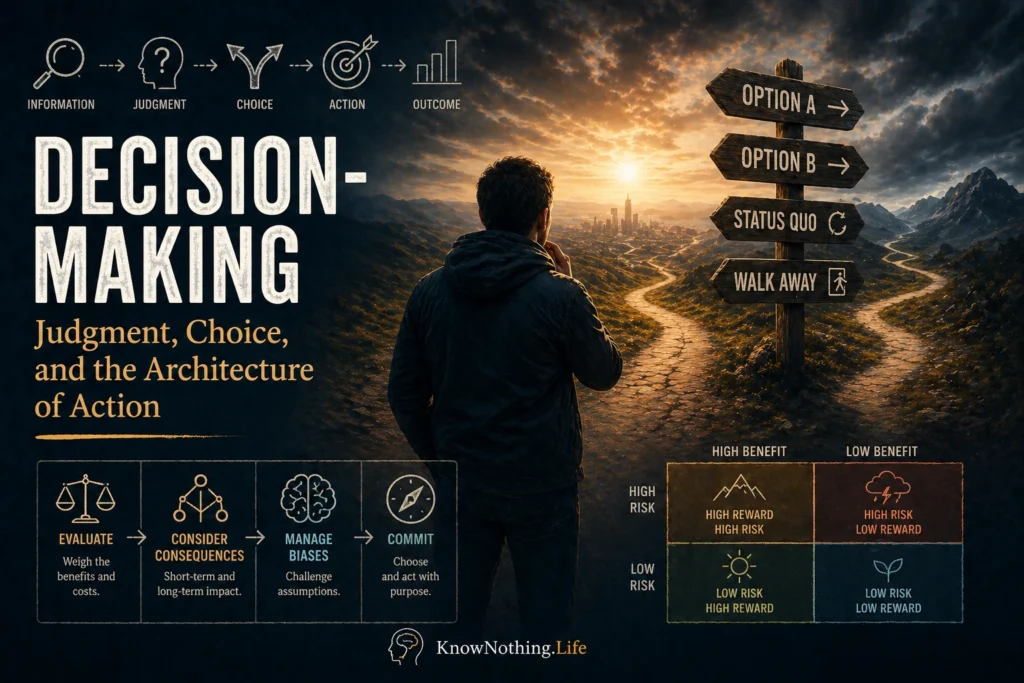
Decision-making is the cognitive process through which individuals evaluate options and select a course of action. It lies at the center of human behavior, guiding everything from everyday choices to complex strategic planning. Whether deciding what to eat, how to respond in a social situation, or which long-term goals to pursue, decision-making reflects the integration of perception, memory, reasoning, and emotion. It transforms information into action, linking thought to behavior in a direct and consequential way.
At its core, decision-making involves navigating uncertainty. Rarely do individuals have complete information or perfect foresight; instead, they must weigh probabilities, assess risks, and consider potential outcomes. This process is shaped by both rational analysis and intuitive judgment, reflecting the dual nature of human cognition. Understanding decision-making therefore requires examining not only logical reasoning but also the psychological factors that influence how choices are made.
Historical Foundations and Theoretical Perspectives
The study of decision-making has evolved through multiple disciplines, including psychology, economics, and philosophy. Early models were grounded in rational choice theory, which assumed that individuals make decisions by systematically evaluating options and selecting the one that maximizes utility. This framework emphasized logical consistency and optimal outcomes, portraying decision-makers as rational agents.
However, empirical research revealed that real-world decisions often deviate from these idealized models. The work of Daniel Kahneman and Amos Tversky demonstrated that individuals frequently rely on heuristics and are subject to cognitive biases. Their development of prospect theory showed that people evaluate outcomes relative to a reference point and are more sensitive to losses than to equivalent gains, challenging the assumptions of rational choice theory.
These findings led to the emergence of behavioral decision theory, which integrates psychological insights into models of decision-making. Contemporary approaches recognize that decisions are influenced by a combination of rational analysis, intuitive processes, and contextual factors. This shift reflects a more realistic understanding of how choices are made in complex and uncertain environments.
Rational and Intuitive Processes
Decision-making involves the interaction of two broad types of cognitive processes: analytical and intuitive. Analytical processes are deliberate, slow, and systematic, involving careful evaluation of evidence and logical reasoning. These processes are essential for complex decisions that require detailed analysis and consideration of multiple factors.
In contrast, intuitive processes are fast, automatic, and often unconscious. They rely on heuristics, patterns, and past experiences to generate quick judgments. Intuition can be highly effective in familiar situations where patterns are well understood, allowing for rapid and efficient decision-making. However, it can also lead to errors when applied in unfamiliar or complex contexts.
The balance between these processes depends on factors such as time pressure, cognitive load, and the nature of the decision. Skilled decision-makers are often able to integrate both approaches, using intuition for initial judgments and analysis for refinement. This interplay highlights the flexibility of human cognition and the importance of adapting strategies to different situations.
Risk, Uncertainty, and Probability
A central challenge in decision-making is dealing with risk and uncertainty. Risk involves situations where probabilities are known or can be estimated, while uncertainty refers to situations where probabilities are unclear or unknown. Both require individuals to make judgments about potential outcomes and their likelihood.
Humans often struggle with probabilistic reasoning, relying on heuristics rather than formal calculations. For example, individuals may overestimate the likelihood of rare but vivid events or underestimate more common risks. These tendencies reflect the influence of cognitive biases, which can distort perception of probability and impact decision-making.
Effective decision-making under risk involves understanding probabilities, evaluating potential outcomes, and considering trade-offs. Tools such as decision trees and cost-benefit analysis can support this process, but they require cognitive effort and may not always be practical. Understanding how individuals perceive and respond to risk is essential for improving decision-making in both personal and professional contexts.
Cognitive Biases and Errors in Judgment
Cognitive biases are systematic patterns of deviation from rational judgment that influence decision-making. These biases often arise from the use of heuristics, which simplify complex decisions but can lead to errors. For example, confirmation bias leads individuals to seek information that supports their existing beliefs, while ignoring contradictory evidence.
Another common bias is the framing effect, where the way information is presented influences decisions. For instance, individuals may respond differently to a choice depending on whether it is framed in terms of gains or losses, even if the underlying information is the same. This demonstrates how context and presentation can shape judgment.
Overconfidence is another significant bias, where individuals overestimate their knowledge or ability to predict outcomes. This can lead to risky decisions and poor outcomes, particularly in uncertain environments. Recognizing and addressing these biases is critical for improving decision-making, as it allows individuals to approach choices more objectively.
Emotion and Decision-Making
Emotion plays a crucial role in decision-making, influencing both the evaluation of options and the selection of actions. While traditional models emphasized rational analysis, contemporary research shows that emotions are integral to effective decision-making. They provide signals about value, risk, and relevance, guiding attention and prioritization.
For example, fear can highlight potential dangers, prompting caution, while positive emotions can encourage exploration and risk-taking. Emotional responses are often rapid and automatic, shaping decisions before conscious reasoning occurs. This can be beneficial in situations that require quick reactions, but it can also lead to impulsive or biased choices.
The interaction between emotion and cognition is complex, with each influencing the other. Effective decision-making involves regulating emotional responses and integrating them with rational analysis. This balance allows individuals to make choices that are both informed and aligned with their goals and values.
Neural Mechanisms of Decision-Making
The neural basis of decision-making involves a network of brain regions that support evaluation, control, and reward processing. The prefrontal cortex plays a central role in planning, reasoning, and the regulation of behavior. It enables individuals to consider future consequences, weigh options, and inhibit impulsive responses.
The limbic system, including structures such as the amygdala and nucleus accumbens, is involved in emotional processing and reward evaluation. These regions contribute to the assessment of value and motivation, influencing the attractiveness of different options. The interaction between these systems reflects the integration of emotion and cognition in decision-making.
Neuroscientific research has also identified the role of dopamine in signaling reward and prediction errors, guiding learning and adaptation. These mechanisms allow individuals to update their expectations based on outcomes, improving future decisions. Understanding the neural basis of decision-making provides insight into how cognitive and emotional processes are coordinated within the brain.
Decision-Making in Everyday Life
Decision-making is a pervasive aspect of everyday life, influencing actions across personal, social, and professional domains. From routine choices to significant life decisions, individuals continuously evaluate options and make judgments. The quality of these decisions can have far-reaching consequences, affecting well-being, relationships, and success.
In everyday contexts, individuals often rely on heuristics and intuition to make decisions quickly. While this can be efficient, it also increases the risk of bias and error. Developing awareness of these processes can help individuals make more informed choices, particularly in situations that require careful consideration.
In professional settings, decision-making is often supported by structured approaches, such as data analysis and strategic planning. These methods aim to reduce uncertainty and improve outcomes, but they also require time and resources. Balancing efficiency and accuracy is a key challenge in both personal and professional decision-making.
Applications and Future Directions
The study of decision-making has important applications across fields such as economics, healthcare, and public policy. In healthcare, understanding decision-making can improve patient outcomes by supporting better choices and communication. In business, it informs strategies for risk management, leadership, and innovation.
Behavioral insights have also been used to design interventions that guide decision-making, such as nudges that encourage beneficial behaviors. These approaches leverage an understanding of cognitive biases and heuristics to influence choices in subtle but effective ways.
Future research is likely to focus on integrating cognitive, emotional, and social factors in decision-making. Advances in technology and data analysis are providing new tools for studying decisions in real-world contexts. As our understanding continues to evolve, decision-making remains a central topic in cognitive psychology, offering insights into how individuals navigate complexity and uncertainty.
Conclusion: Choosing in a Complex World
Decision-making is a complex and multifaceted process that lies at the heart of human cognition. It involves the integration of reasoning, emotion, and experience, allowing individuals to navigate uncertainty and select actions. While often guided by heuristics and subject to bias, decision-making reflects the adaptability and flexibility of the human mind.
By understanding the mechanisms and influences that shape decisions, cognitive psychology provides valuable tools for improving judgment and outcomes. These insights have practical implications for individuals and society, highlighting the importance of informed and reflective choice in a complex world.