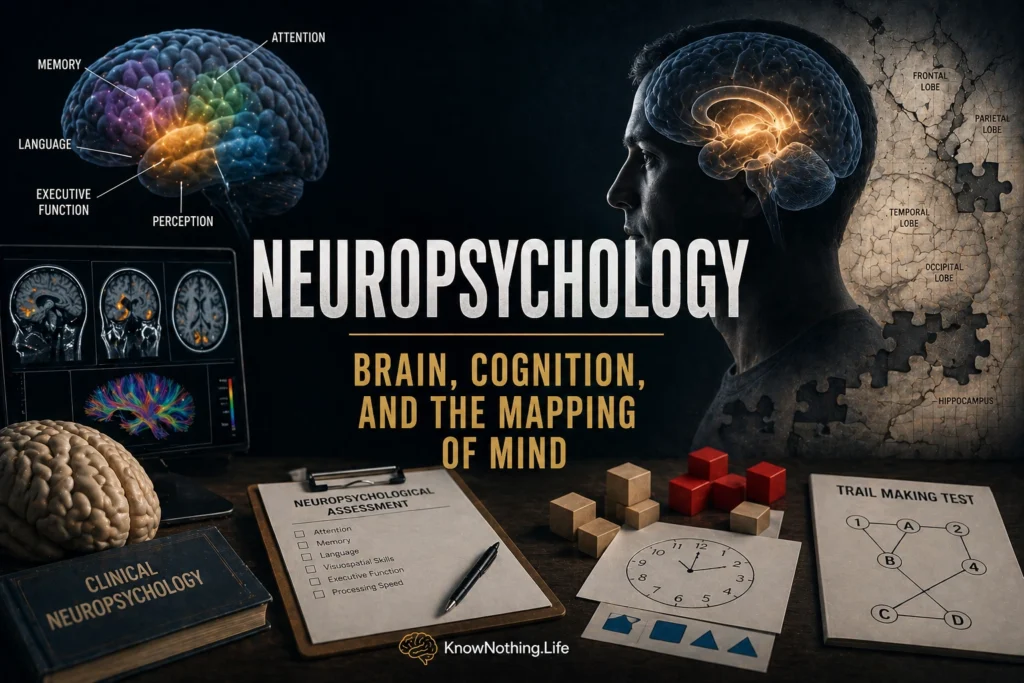
Neuropsychology is the scientific study of how brain structure and function relate to cognition, emotion, and behavior. Positioned at the intersection of psychology and neuroscience, it seeks to understand how specific neural systems give rise to mental processes such as memory, language, attention, and decision-making. Unlike broader biological psychology, neuropsychology often focuses on how damage or dysfunction in particular brain regions affects behavior, using these disruptions as a window into the organization of the mind.
The field has deep historical roots, emerging from attempts to link localized brain lesions to specific cognitive deficits. Early work by neurologists and psychologists laid the foundation for modern neuropsychology, demonstrating that mental functions are not abstract entities but are grounded in physical structures. As neuropsychologist Alexander R. Luria wrote in Higher Cortical Functions in Man, “Mental activity is not the result of isolated centers but of the integrated work of complex systems.” This systems-based view remains central to contemporary neuropsychology, emphasizing that cognition arises from networks rather than single regions.
Historical Foundations
The origins of neuropsychology can be traced to the 19th century, when researchers began systematically studying the effects of brain injury. Paul Broca’s work with patients who had lost the ability to speak led to the identification of Broca’s area in the left frontal lobe, demonstrating the localization of language production. Similarly, Carl Wernicke identified a region in the temporal lobe associated with language comprehension, further supporting the idea that specific cognitive functions are tied to distinct brain areas.
Another pivotal figure was Phineas Gage, whose personality changes following a traumatic brain injury provided early evidence of the role of the frontal lobes in personality and executive function. Although not a scientist himself, Gage’s case became one of the most cited examples in neuroscience, illustrating how brain damage can alter behavior and identity.
In the 20th century, Luria expanded these insights into a comprehensive framework, integrating clinical observation with experimental methods. His approach emphasized qualitative analysis of cognitive deficits, focusing on how patterns of impairment reflect underlying neural systems. This holistic perspective helped establish neuropsychology as a distinct discipline, bridging neurology and psychology.
Brain–Behavior Relationships
Central to neuropsychology is the concept of brain–behavior relationships—the idea that specific patterns of neural activity correspond to particular cognitive and behavioral functions. The brain is organized into regions that specialize in different tasks, but these regions operate within interconnected networks that allow for complex and flexible behavior.
The frontal lobes, for example, are involved in executive functions such as planning, decision-making, and impulse control. Damage to these areas can result in difficulties with organization, judgment, and social behavior. The temporal lobes play a key role in memory and language, while the parietal lobes are associated with spatial processing and attention. The occipital lobes are primarily responsible for visual perception, highlighting the specialization of sensory processing.
Despite this localization, neuropsychology emphasizes that functions are distributed across networks rather than confined to single areas. As Luria noted, cognitive processes are “functional systems” that involve multiple regions working together. This network perspective has been reinforced by modern neuroimaging studies, which show that even simple tasks engage widespread neural circuits.
Assessment and Methods
Neuropsychological assessment is a core component of the field, involving the systematic evaluation of cognitive functioning through standardized tests and clinical observation. These assessments are used to identify patterns of strengths and weaknesses, providing insight into underlying brain function and guiding diagnosis and treatment.
Common domains assessed include memory, attention, language, executive function, and visuospatial abilities. Tests are designed to isolate specific cognitive processes, allowing clinicians to infer which brain regions may be affected. For example, difficulties with verbal memory may suggest involvement of the left temporal lobe, while impairments in planning and problem-solving may point to frontal lobe dysfunction.
Psychologist Brenda Milner made significant contributions to the study of memory through her work with patient H.M., who underwent surgery that resulted in profound amnesia. Milner’s research demonstrated that different types of memory—such as short-term and long-term memory—are supported by distinct neural systems. Her findings revolutionized the understanding of memory and highlighted the importance of neuropsychological methods in uncovering brain–behavior relationships.
Cognitive Functions and Neural Systems
Neuropsychology provides detailed insights into specific cognitive functions and their neural underpinnings. Memory, for instance, is not a single process but a collection of systems, including working memory, episodic memory, and procedural memory. The hippocampus is critical for the formation of new episodic memories, while other regions support different aspects of memory processing.
Language is another key area of study, involving a network of regions in the left hemisphere for most individuals. Broca’s area is associated with speech production, while Wernicke’s area is involved in comprehension. Damage to these areas can result in different types of aphasia, illustrating the specificity of brain–language relationships.
Attention and executive function are supported by distributed networks involving the frontal and parietal lobes. These functions enable individuals to focus, switch between tasks, and regulate behavior. Impairments in these systems can have widespread effects on daily functioning, highlighting their central role in cognition.
Neuropsychology of Brain Injury and Disorders
One of the primary applications of neuropsychology is the study and treatment of brain injuries and neurological disorders. Conditions such as traumatic brain injury (TBI), stroke, and neurodegenerative diseases can result in significant cognitive and behavioral changes, providing opportunities to study the effects of neural disruption.
Stroke, for example, can lead to localized damage that affects specific functions, depending on the area involved. Neurodegenerative diseases such as Alzheimer’s disease involve progressive loss of neurons, leading to gradual decline in memory and other cognitive abilities. Neuropsychological assessment plays a crucial role in diagnosing these conditions and tracking their progression.
Psychiatrist and neurologist Oliver Sacks brought attention to the human dimension of neurological disorders through works such as The Man Who Mistook His Wife for a Hat. Sacks emphasized that neurological conditions are not merely clinical phenomena but lived experiences that affect identity and perception. He wrote, “Every act of perception is to some degree an act of creation,” highlighting the interpretive nature of cognition and the profound impact of its disruption.
Contemporary Developments
Advances in technology have transformed neuropsychology, providing new tools for studying the brain and its functions. Neuroimaging techniques such as functional magnetic resonance imaging (fMRI) and diffusion tensor imaging (DTI) allow researchers to visualize brain activity and connectivity, offering insights into the neural basis of cognition.
The integration of cognitive neuroscience has further expanded the field, combining experimental methods with clinical observations. This interdisciplinary approach has led to more precise models of brain function, as well as improved diagnostic and therapeutic strategies. For example, computer-based cognitive training programs and neurorehabilitation techniques are increasingly used to support recovery following brain injury.
There is also growing interest in the concept of neuroplasticity—the brain’s ability to reorganize and adapt. Research shows that targeted interventions can promote recovery by strengthening alternative neural pathways, offering hope for individuals with brain injuries or neurological disorders.
Conclusion
Neuropsychology provides a powerful framework for understanding the relationship between brain and mind. By examining how neural systems give rise to cognitive and behavioral functions, it offers insights into both normal and impaired functioning. Its methods and findings have transformed the study of cognition, bridging the gap between biological mechanisms and psychological experience.
At the same time, neuropsychology highlights the complexity and individuality of the human brain. Each person’s cognitive profile reflects a unique combination of neural structures, experiences, and adaptations. As research continues to advance, the field will play a central role in unraveling the mysteries of the mind, offering new possibilities for diagnosis, treatment, and understanding.