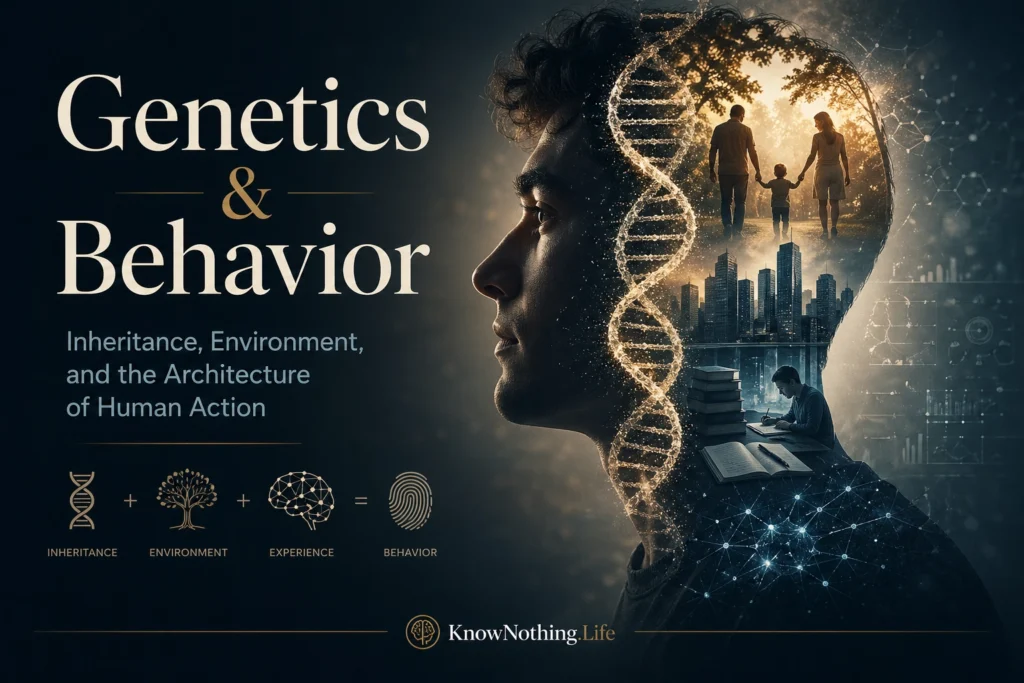
The relationship between genetics and behavior lies at the heart of one of psychology’s most enduring questions: to what extent are we shaped by biology versus experience? Modern science has moved beyond this simple dichotomy, recognizing that genes and environment are deeply intertwined in shaping who we are. Genetics provides the blueprint for the development of the nervous system, influencing traits such as temperament, intelligence, and vulnerability to mental disorders, while environmental factors determine how and whether these genetic potentials are expressed.
The scientific study of genetics began with the work of Gregor Mendel, whose experiments with pea plants revealed the basic principles of inheritance. Although Mendel’s work focused on physical traits, it laid the foundation for understanding how characteristics are passed from one generation to the next. In the context of behavior, this framework has been expanded to include complex interactions between multiple genes and environmental influences. As geneticist Theodosius Dobzhansky famously stated, “Nothing in biology makes sense except in the light of evolution,” highlighting the broader context in which genetic influences must be understood.
Foundations of Behavioral Genetics
Behavioral genetics is the field that examines how genetic variation contributes to differences in behavior. Unlike simple traits such as eye color, most behaviors are influenced by many genes, each contributing a small effect. This polygenic nature of behavior makes it difficult to identify direct causal relationships, requiring sophisticated statistical methods and large datasets.
One of the primary tools of behavioral genetics is the twin study, which compares identical (monozygotic) twins, who share nearly all their genes, with fraternal (dizygotic) twins, who share about half. By examining similarities and differences between these groups, researchers can estimate the heritability of traits—the proportion of variation attributable to genetic factors. Adoption studies provide a complementary approach, comparing individuals with their biological and adoptive families to disentangle genetic and environmental influences.
Psychologist Thomas J. Bouchard Jr. conducted influential twin studies that demonstrated substantial genetic contributions to traits such as intelligence and personality. However, these findings do not imply determinism; heritability estimates apply to populations, not individuals, and they do not specify how genes exert their influence. As Bouchard noted, genetic predispositions operate within environmental contexts, shaping but not dictating behavior.
Gene–Environment Interaction
The interaction between genes and environment is a central concept in understanding behavior. Rather than acting independently, genetic and environmental factors influence each other in dynamic ways. Gene–environment interaction occurs when the effect of an environmental factor depends on an individual’s genetic makeup, or when genetic predispositions influence how individuals respond to their environment.
One well-known example involves the interaction between stress and genetic vulnerability in the development of depression. Research has shown that individuals with certain genetic variants are more likely to develop depression in response to stressful life events, illustrating how genes can moderate the impact of experience. This perspective moves beyond simple cause-and-effect models, emphasizing the complexity of behavioral development.
Geneticist Robert Plomin has been a leading advocate for this integrative approach. In Blueprint, he argues that DNA differences are a major source of psychological differences, but he also emphasizes that “genetic influence is probabilistic, not deterministic.” This distinction underscores that genes set tendencies, not fixed outcomes, leaving room for variability and change.
Epigenetics and Gene Expression
Epigenetics has emerged as a critical area of research, revealing how environmental factors can influence gene expression without altering the underlying DNA sequence. Chemical modifications, such as DNA methylation, can turn genes on or off, affecting how they are expressed in the body and brain. These changes can be influenced by factors such as stress, nutrition, and early life experiences.
This field has profound implications for understanding behavior, as it demonstrates that the environment can shape biological processes at the molecular level. For example, studies have shown that early caregiving experiences can influence stress-related gene expression, affecting emotional regulation later in life. These findings highlight the importance of early environment in shaping developmental trajectories.
Biologist Conrad Waddington introduced the concept of the “epigenetic landscape,” illustrating how development is guided by both genetic and environmental factors. His metaphor of a ball rolling down a landscape of branching pathways captures the idea that while genes provide the structure, environmental influences determine the path taken.
Evolutionary Perspectives
Evolutionary theory provides a broader framework for understanding the relationship between genetics and behavior. Traits that enhance survival and reproduction are more likely to be passed on to future generations, shaping the genetic basis of behavior over time. This perspective helps explain why certain behavioral tendencies, such as fear responses or social bonding, are widespread across cultures.
Evolutionary psychologists argue that many aspects of human behavior reflect adaptations to ancestral environments. For example, preferences for certain foods, sensitivity to social cues, and patterns of mating behavior can be understood in terms of their evolutionary advantages. However, these adaptations may not always align with modern environments, leading to mismatches that contribute to contemporary challenges.
Charles Darwin’s work on natural selection remains foundational in this area. In The Descent of Man, he explored the evolution of human behavior and sociality, suggesting that traits such as cooperation and empathy have biological roots. This evolutionary perspective highlights the continuity between human and animal behavior, as well as the role of genetics in shaping behavioral tendencies.
Genetics and Mental Health
Genetic factors play a significant role in the development of mental health conditions. Disorders such as schizophrenia, bipolar disorder, and depression have substantial heritability, indicating that genetic variation contributes to vulnerability. However, these conditions are not caused by single genes but by complex interactions among multiple genetic and environmental factors.
Advances in molecular genetics have led to the identification of specific genetic variants associated with mental disorders. Genome-wide association studies (GWAS) have revealed numerous loci that contribute to risk, though each has a small effect. These findings highlight the polygenic nature of mental health, where many genes contribute to overall vulnerability.
Neuroscientist Eric R. Kandel emphasized the importance of integrating genetic and environmental perspectives, noting that “genes do not determine behavior; they set the stage for it.” This view reflects the consensus that understanding mental health requires a comprehensive approach that considers both biological and experiential factors.
Ethical and Social Implications
The study of genetics and behavior raises important ethical questions. One concern is the potential for genetic determinism, the belief that behavior is fixed by genetic factors. This perspective can lead to fatalism and reduce the perceived importance of environmental influences and personal responsibility.
There are also concerns about the misuse of genetic information, particularly in areas such as employment, insurance, and criminal justice. Advances in genetic testing have made it possible to identify predispositions to certain traits or conditions, raising questions about privacy and discrimination. Ensuring that genetic information is used responsibly is a key challenge for society.
Philosopher Daniel Dennett has argued that understanding the biological basis of behavior does not eliminate the concept of free will but rather reframes it within a naturalistic context. This perspective suggests that while behavior is influenced by biological factors, individuals retain the capacity for reflection and choice.
Conclusion
The study of genetics and behavior reveals the intricate interplay between biological inheritance and environmental experience. Genes provide the foundation for the development of the nervous system and influence a wide range of behavioral traits, but they do not act in isolation. Instead, behavior emerges from the dynamic interaction of genetic, environmental, and developmental factors.
As research continues to advance, the integration of genetics with neuroscience, psychology, and social science offers new insights into the nature of human behavior. By moving beyond simplistic dichotomies, the field highlights the complexity and adaptability of the human organism. Ultimately, understanding genetics and behavior deepens our appreciation of both the constraints and possibilities that shape human life.