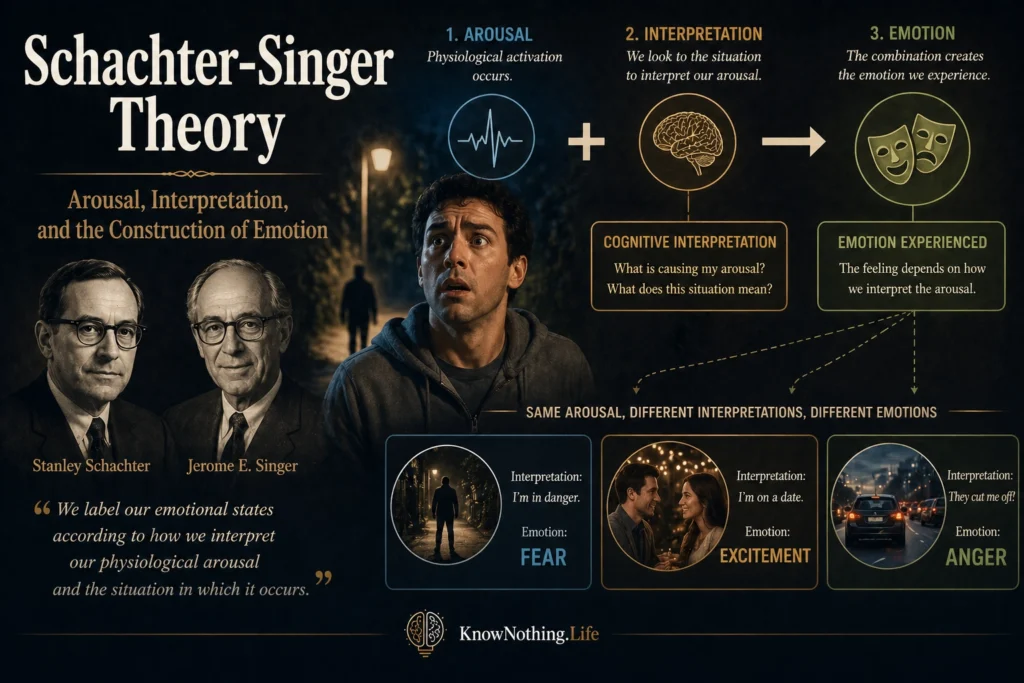
The Schachter-Singer theory of emotion—often called the two-factor theory—represents a pivotal moment in the scientific understanding of feeling. Developed by Stanley Schachter and Jerome E. Singer in the 1960s, it proposed that emotions arise from a combination of physiological arousal and cognitive interpretation. In contrast to earlier theories that privileged either the body or the brain, the Schachter-Singer model integrates both, arguing that neither alone is sufficient to produce a specific emotional experience.
At its core, the theory suggests that the body provides a general state of activation, while the mind interprets that activation based on context. This framework captures a central feature of emotional life: the same physiological state can feel like fear, excitement, or anger depending on how it is understood. In their influential 1962 paper, Schachter and Singer argued that “given a state of physiological arousal for which an individual has no immediate explanation, he will ‘label’ this state and describe his feelings in terms of the cognitions available to him.” This insight reframed emotion as a dynamic process of meaning-making rather than a fixed reaction.
Historical Context and Theoretical Foundations
The Schachter-Singer theory emerged in response to earlier debates about the origins of emotion. The James-Lange theory emphasized bodily feedback as the basis of emotion, while the Cannon-Bard theory highlighted simultaneous activation of emotional experience and physiological response in the brain. Both approaches contributed important insights but left unresolved questions about how specific emotions are differentiated.
Schachter and Singer sought to bridge this divide by incorporating cognitive processes into the equation. Their work was influenced by developments in social psychology and cognitive science, which emphasized the role of interpretation and context in shaping behavior. Emotion, in this framework, becomes a product of both internal states and external cues, reflecting the interaction between organism and environment.
This integrative approach also aligns with broader philosophical traditions that emphasize the interpretive nature of experience. Emotions are not simply reactions but are constructed through the interplay of perception, bodily sensation, and meaning. The Schachter-Singer theory thus represents a shift toward a more complex and multidimensional understanding of emotion.
The Two Factors: Arousal and Cognition
The central premise of the Schachter-Singer theory is that emotion consists of two components: physiological arousal and cognitive labeling. Arousal refers to the body’s general state of activation, which can be triggered by a variety of stimuli. This activation is relatively undifferentiated, meaning that it does not inherently specify a particular emotion.
Cognitive labeling, on the other hand, involves interpreting the source and significance of this arousal. Individuals use contextual information, past experience, and situational cues to assign meaning to their physiological state. For example, a racing heart might be interpreted as fear in a dangerous situation or excitement at a social event. The emotion experienced depends on this interpretation.
This model highlights the flexibility of emotional experience. It suggests that emotions are not fixed responses but are shaped by how individuals understand their internal and external environments. As Schachter and Singer demonstrated, the same physiological state can lead to different emotional outcomes depending on the available cognitive framework.
Experimental Evidence
The Schachter-Singer theory is closely associated with a series of experiments designed to test its central claims. In their most famous study, participants were injected with epinephrine, a hormone that induces physiological arousal, and then placed in situations that provided different emotional cues. Some participants were informed about the effects of the injection, while others were not.
The results showed that participants who lacked an explanation for their arousal were more likely to interpret their feelings based on the behavior of others in the environment. For example, when placed with a confederate who acted euphorically, they reported feeling happy; when placed with an angry confederate, they reported feeling anger. These findings supported the idea that cognitive interpretation plays a crucial role in shaping emotional experience.
While later researchers have debated the methodological details of these experiments, they remain influential in demonstrating the interaction between physiological and cognitive factors. The study illustrates how emotion can be influenced by context, highlighting the constructed nature of feeling.
Cognitive Appraisal and Interpretation
The emphasis on cognitive interpretation in the Schachter-Singer theory paved the way for later developments in appraisal theories of emotion. Psychologist Richard Lazarus expanded on this idea, arguing that emotions arise from evaluations of events in relation to personal goals and well-being. According to Lazarus, appraisal processes determine not only the type of emotion experienced but also its intensity.
This perspective underscores that emotions are not merely reactions to stimuli but involve active interpretation. Individuals assess whether a situation is relevant, threatening, or beneficial, and these assessments shape their emotional responses. The Schachter-Singer theory can be seen as an early formulation of this broader cognitive approach, emphasizing the role of meaning in emotion.
At the same time, the theory acknowledges that cognition operates within the constraints of physiological states. Arousal provides the energy and urgency of emotion, while cognition provides its direction and content. This interaction reflects the complexity of emotional processes, which cannot be reduced to a single factor.
Neurobiological Perspectives
Modern neuroscience has provided additional insights into the mechanisms underlying the Schachter-Singer theory. Brain regions such as the amygdala, prefrontal cortex, and insula are involved in processing emotional stimuli, regulating arousal, and integrating cognitive information. These systems work together to produce the experience of emotion.
Neuroscientist Antonio Damasio has emphasized the role of bodily states in emotion through his somatic marker hypothesis, which suggests that physiological signals guide decision-making and emotional experience. His work supports the idea that emotion involves both bodily and cognitive components, aligning with the two-factor framework.
Research on interoception—the perception of internal bodily states—also highlights the importance of integrating physiological and cognitive processes. The brain continuously monitors signals from the body, using them to inform emotional and cognitive responses. This integration reflects the core insight of the Schachter-Singer theory: that emotion arises from the interaction of multiple systems.
Criticisms and Limitations
Despite its influence, the Schachter-Singer theory has faced criticism. One major concern is the assumption that physiological arousal is relatively undifferentiated. Subsequent research has shown that different emotions can involve distinct physiological patterns, suggesting that arousal may carry more specific information than the theory originally proposed.
Another limitation is the reliance on conscious cognitive labeling. Some emotions appear to occur automatically, without deliberate interpretation, particularly in response to immediate threats. This has led researchers such as Joseph LeDoux to propose dual-pathway models of emotion, in which rapid, unconscious processing can generate emotional responses independently of higher cognitive functions.
Additionally, the experimental methods used to support the theory have been subject to critique, with questions raised about ecological validity and replicability. Nevertheless, the central idea that cognition influences emotion remains widely accepted, even as the details of the model have been refined.
Influence and Contemporary Relevance
The Schachter-Singer theory has had a lasting impact on psychology, shaping research on emotion, cognition, and social behavior. Its emphasis on interpretation and context has influenced fields ranging from clinical psychology to marketing, where understanding emotional responses is crucial.
In clinical settings, the theory informs approaches that focus on reinterpreting emotional experiences. Cognitive-behavioral therapy, for example, often involves identifying and modifying the interpretations that contribute to distress, reflecting the idea that changing cognition can alter emotion.
Contemporary theories, including constructivist models such as those proposed by Lisa Feldman Barrett, build on the Schachter-Singer framework by emphasizing the role of prediction and conceptual knowledge in constructing emotion. These approaches extend the two-factor model, integrating it with advances in neuroscience and cognitive science.
Conclusion
The Schachter-Singer theory represents a crucial step in the evolution of emotion theory, integrating physiological and cognitive perspectives into a unified framework. By emphasizing the role of interpretation in shaping emotional experience, it highlights the dynamic and context-dependent nature of feeling.
Although subsequent research has refined and expanded its claims, the core insight of the theory remains influential: emotions are not simply reactions but are constructed through the interaction of body and mind. This perspective continues to inform both scientific inquiry and practical applications, offering a nuanced understanding of how emotions arise and how they can be understood and regulated.