The distinction between mood and emotion is central to understanding human affective experience. While both involve feelings and influence behavior, they differ in duration, intensity, specificity, and underlying mechanisms. Emotions are typically short-lived, directed responses to identifiable stimuli, whereas moods are more diffuse, enduring states that may not have a clear cause. Clarifying this distinction allows psychologists to better understand how affect shapes cognition, decision-making, and mental health.
Historically, the terms “mood” and “emotion” were often used interchangeably, but modern research has emphasized their differences. Psychologist Robert E. Thayer described mood as a background state of feeling that fluctuates over time, influencing energy and arousal levels. In contrast, emotions are more acute and event-driven. Understanding how these two forms of affect interact provides insight into the complexity of human experience and the ways in which feelings shape perception and action.
Defining Emotion
Emotions are complex, coordinated responses to significant events, involving physiological arousal, cognitive appraisal, and behavioral expression. They are typically triggered by specific stimuli and are relatively brief in duration, though their effects can persist. Emotions such as fear, anger, joy, and sadness are often considered fundamental, reflecting adaptive responses to environmental challenges.
Psychologist Paul Ekman identified a set of basic emotions associated with universal facial expressions, suggesting that certain emotional responses are biologically innate. These emotions serve important survival functions; for example, fear prepares the body to respond to threats, while anger can mobilize action in the face of obstacles.
The structure of emotion has been further elaborated by appraisal theories, particularly those of Richard Lazarus, who argued that emotions arise from evaluations of events in relation to personal goals. This perspective emphasizes that emotions are not merely reactions but involve interpretation, linking them to cognitive processes.
Defining Mood
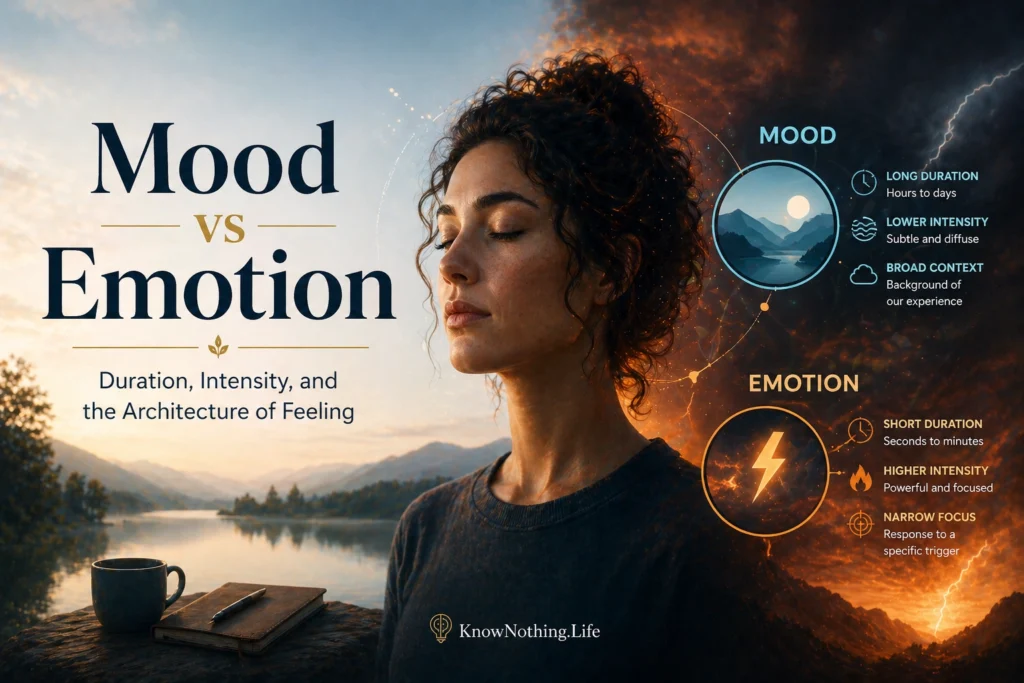
Moods, unlike emotions, are more diffuse and less tied to specific events. They tend to last longer—ranging from hours to days—and are often described in general terms such as “good mood” or “bad mood.” Moods influence how individuals perceive and interpret their environment, acting as a background context for emotional and cognitive processes.
Robert Thayer’s work on mood emphasized its dimensions of energy and tension, suggesting that mood can be understood as a combination of physiological and psychological states. High-energy positive moods, for example, are associated with enthusiasm and motivation, while low-energy negative moods may involve fatigue and sadness.
Because moods are less specific than emotions, they can be more difficult to regulate and identify. Individuals may be aware of feeling “off” without being able to pinpoint a cause. This diffuse quality distinguishes mood from emotion and highlights its role as a broader affective state that shapes ongoing experience.
Key Differences Between Mood and Emotion
The distinction between mood and emotion can be understood along several dimensions. Emotions are typically short-lived, intense, and directed at specific objects or events, while moods are longer-lasting, less intense, and not tied to a particular cause. This difference in duration and specificity is one of the most important distinctions between the two.
Another key difference lies in their function. Emotions are often action-oriented, preparing the individual to respond to immediate challenges. Moods, by contrast, influence general patterns of thought and behavior over time. For example, a person in a positive mood may be more likely to engage in creative thinking, while a negative mood may lead to more cautious and analytical processing.
Psychologist Alice M. Isen demonstrated that mood can significantly affect cognitive processes, including decision-making and problem-solving. Her research showed that individuals in positive moods tend to think more flexibly and creatively, highlighting the broader influence of mood on cognition compared to the more immediate effects of emotion.
Interaction Between Mood and Emotion
Although mood and emotion are distinct, they are closely interconnected. Emotions can influence mood, and moods can shape emotional responses. For example, experiencing a series of negative emotions may lead to a persistent negative mood, while a positive mood can increase the likelihood of experiencing positive emotions.
This interaction is bidirectional and dynamic. A person in a negative mood may interpret ambiguous situations as threatening, leading to emotions such as anxiety or anger. Conversely, a positive mood can buffer against negative emotional reactions, promoting resilience and well-being.
Neuroscientist Antonio Damasio has emphasized the integration of affective processes, arguing that emotions and moods are part of a continuous system that guides behavior. In Descartes’ Error, he suggested that feelings provide essential information for decision-making, highlighting the interplay between immediate emotional responses and longer-term mood states.
Biological Foundations
The biological mechanisms underlying mood and emotion involve overlapping but distinct systems. Emotions are often associated with rapid activation of the limbic system, particularly the amygdala, which processes emotional stimuli and initiates responses. These processes are typically fast and automatic, reflecting the need for immediate action.
Moods, on the other hand, are linked to more sustained patterns of neural activity and neurochemical regulation. Neurotransmitters such as serotonin, dopamine, and norepinephrine play key roles in mood regulation, influencing overall levels of well-being and emotional stability. Hormonal systems, including cortisol, also contribute to mood by affecting stress responses.
The distinction between these systems reflects the different temporal scales of mood and emotion. Emotions involve rapid, transient changes, while moods reflect more stable, ongoing patterns of activity. Understanding these biological foundations helps explain why moods can persist even in the absence of clear external triggers.
Mood, Emotion, and Mental Health
The relationship between mood and emotion is particularly important in the context of mental health. Many psychological disorders involve disruptions in mood, emotion, or both. Depression, for example, is characterized by persistent negative mood, while anxiety disorders involve heightened emotional responses to perceived threats.
Understanding the distinction between mood and emotion can inform treatment approaches. Interventions for mood disorders often focus on long-term regulation, such as through medication or psychotherapy, while strategies for managing emotions may involve immediate techniques such as relaxation or cognitive reappraisal.
Clinical psychologist Aaron T. Beck emphasized the role of cognition in mood disorders, arguing that negative thought patterns contribute to persistent negative mood. His work laid the foundation for cognitive-behavioral therapy, which aims to modify these patterns and improve emotional and mood regulation.
Philosophical and Experiential Perspectives
From a philosophical perspective, the distinction between mood and emotion raises questions about the nature of subjective experience. Emotions are often seen as responses to the world, while moods reflect a more general orientation toward it. A mood can color perception, influencing how events are interpreted and experienced.
Philosopher Martin Heidegger described mood as a fundamental way of being in the world, suggesting that it shapes how reality is disclosed to us. In this view, mood is not merely a psychological state but a lens through which experience is filtered, influencing perception at a deep level.
This perspective highlights the pervasive influence of mood, extending beyond specific emotional episodes to shape the overall tone of experience. It suggests that understanding mood and emotion requires not only scientific analysis but also reflection on the nature of human existence.
Conclusion
The distinction between mood and emotion provides a framework for understanding the complexity of human affect. While emotions are immediate, specific responses to events, moods are broader, more enduring states that influence how those events are perceived and interpreted. Together, they form an integrated system that shapes behavior, cognition, and experience.
By examining their differences and interactions, researchers and clinicians can gain deeper insight into the mechanisms of feeling and the factors that contribute to well-being. Ultimately, understanding mood and emotion reveals the richness of human experience, highlighting the ways in which our inner states shape our engagement with the world.