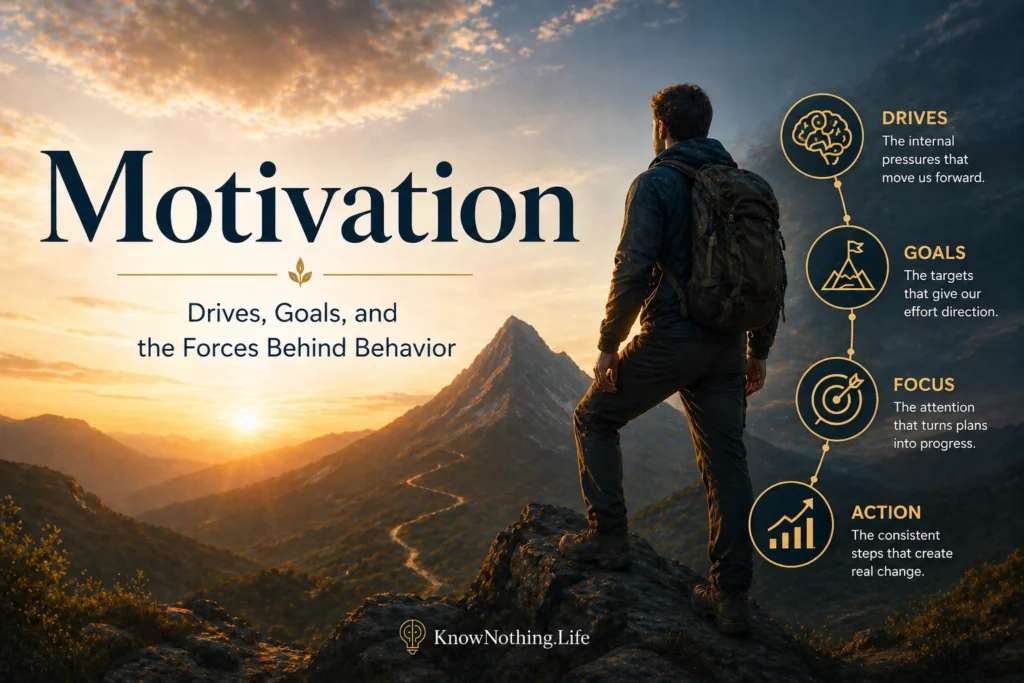
Motivation is the set of processes that initiate, guide, and sustain behavior toward goals. It explains why individuals act, persist, and change course, linking internal states such as needs and desires with external opportunities and constraints. From basic survival behaviors to complex achievements, motivation underlies the direction and intensity of human action, shaping both everyday choices and long-term pursuits.
The scientific study of motivation has evolved from simple drive-based models to more nuanced frameworks that incorporate cognition, emotion, and social context. Psychologist Clark L. Hull once emphasized the role of biological drives, suggesting that behavior is energized by the need to reduce internal tension. While this view captured important aspects of motivation, later theories expanded the concept to include intrinsic goals, personal meaning, and self-determination. Today, motivation is understood as a multifaceted system that integrates biological, psychological, and environmental factors.
Biological Foundations of Motivation
Early theories of motivation focused on biological drives—internal states that arise from physiological needs such as hunger, thirst, and the need for warmth. These drives create tension that motivates behavior aimed at restoring balance. This perspective aligns with the concept of homeostasis, introduced by Walter Cannon, which describes the body’s tendency to maintain internal stability.
The brain plays a central role in regulating these drives. Structures such as the hypothalamus monitor physiological states and trigger motivational responses when imbalances are detected. For example, low blood sugar levels activate hunger signals, prompting food-seeking behavior. Similarly, the brain’s reward system, involving dopamine pathways, reinforces behaviors that satisfy needs or provide pleasure.
Neuroscientist Jaak Panksepp identified basic emotional systems in the brain that underlie motivational processes, including seeking, fear, and care systems. His work suggests that motivation is deeply rooted in evolutionary mechanisms that promote survival and reproduction, providing a biological foundation for understanding behavior.
Drive Theory and Early Models
Drive theory, associated with Clark Hull, proposed that behavior is motivated by the desire to reduce physiological tension. According to this model, organisms are driven to act in ways that restore equilibrium, with reinforcement occurring when a behavior successfully reduces a drive. This framework was influential in early behaviorist psychology, providing a quantitative approach to motivation.
However, drive theory has limitations. It struggles to explain behaviors that do not involve the reduction of biological needs, such as curiosity, exploration, or the pursuit of knowledge. These activities suggest that motivation can arise from factors beyond physiological drives, leading to the development of more comprehensive models.
Behaviorist B. F. Skinner expanded on these ideas through his theory of operant conditioning, emphasizing the role of reinforcement and punishment in shaping behavior. While Skinner focused on external factors, his work highlighted the importance of consequences in maintaining motivation, bridging the gap between biological drives and environmental influences.
Intrinsic and Extrinsic Motivation
One of the most important distinctions in modern motivation theory is between intrinsic and extrinsic motivation. Intrinsic motivation refers to engaging in an activity for its own sake, driven by interest, enjoyment, or personal satisfaction. Extrinsic motivation, in contrast, involves performing an activity to achieve an external reward or avoid punishment.
Psychologists Edward L. Deci and Richard M. Ryan developed self-determination theory (SDT), which emphasizes the importance of intrinsic motivation and the conditions that support it. According to SDT, intrinsic motivation is enhanced when three basic psychological needs are met: autonomy, competence, and relatedness.
Deci and Ryan argued that external rewards can sometimes undermine intrinsic motivation, a phenomenon known as the overjustification effect. This insight has significant implications for education, work, and personal development, suggesting that fostering internal motivation is more effective than relying solely on external incentives.
Cognitive Theories of Motivation
Cognitive approaches to motivation focus on the role of beliefs, expectations, and goals in guiding behavior. Expectancy-value theory, for example, proposes that motivation depends on the expectation of success and the value placed on the outcome. Individuals are more likely to pursue goals they believe they can achieve and that they consider worthwhile.
Goal-setting theory, developed by Edwin A. Locke, emphasizes the importance of clear, specific, and challenging goals in enhancing motivation. Locke found that well-defined goals increase effort and persistence, particularly when individuals receive feedback on their progress.
These cognitive models highlight that motivation is not only about internal drives or external rewards but also about how individuals think about their actions and outcomes. They underscore the importance of perception, planning, and self-regulation in sustaining motivated behavior.
Motivation and Emotion
Motivation and emotion are closely interconnected, each influencing the other in complex ways. Emotions can energize and direct behavior, while motivational processes shape emotional responses. For example, the anticipation of achieving a goal can generate excitement, while failure may lead to frustration or disappointment.
Neuroscientist Antonio Damasio has argued that emotions play a crucial role in decision-making, providing signals that guide choices. In Descartes’ Error, he wrote, “emotion is integral to the processes of reasoning,” highlighting that motivation cannot be fully understood without considering its emotional components.
The interaction between motivation and emotion is evident in everyday life, where feelings of interest, fear, or satisfaction influence the pursuit of goals. This integration reflects the broader principle that psychological processes are interconnected, shaping behavior through multiple pathways.
Social and Cultural Influences
Motivation does not occur in isolation but is embedded within social and cultural contexts. Social norms, expectations, and relationships influence what individuals strive for and how they pursue their goals. For example, cultural values may emphasize individual achievement or collective success, shaping motivational priorities.
Social comparison also plays a role in motivation. Individuals often evaluate their performance relative to others, which can either enhance or undermine motivation. Psychologist Leon Festinger introduced social comparison theory, suggesting that individuals seek to understand themselves by comparing with others, influencing both motivation and self-concept.
In addition, social support can enhance motivation by providing encouragement, resources, and feedback. This highlights that motivation is not solely an internal process but is influenced by interactions with others and the broader social environment.
Motivation and Well-Being
Motivation is closely linked to well-being, as the pursuit and attainment of goals contribute to a sense of purpose and fulfillment. Intrinsic motivation, in particular, is associated with greater satisfaction and psychological health, as it reflects engagement in activities that are inherently meaningful.
Conversely, a lack of motivation, often referred to as amotivation, can be associated with depression and other mental health challenges. Understanding the factors that support or undermine motivation is therefore important for promoting well-being and addressing psychological difficulties.
Positive psychologist Martin E. P. Seligman has emphasized the role of meaning and engagement in well-being, suggesting that motivation toward meaningful goals is a key component of a fulfilling life. His work highlights the importance of aligning motivation with values and purpose.
Conclusion
Motivation is a complex and multifaceted process that drives behavior, shapes goals, and influences well-being. From biological drives to cognitive appraisals and social influences, it encompasses a wide range of factors that interact to produce action. Understanding these processes provides insight into why individuals behave as they do and how they can be supported in achieving their goals.
As research continues to evolve, the study of motivation offers valuable tools for enhancing performance, fostering well-being, and addressing challenges in education, work, and mental health. Ultimately, motivation reflects the dynamic interplay between internal states and external conditions, revealing the forces that propel human life forward.