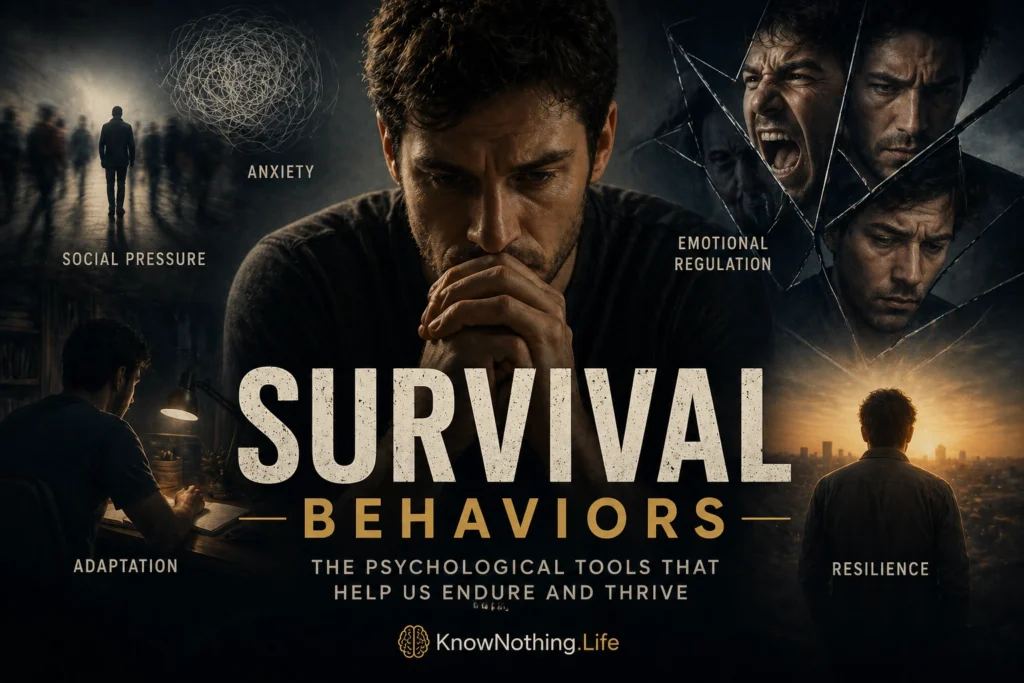
Survival behaviors are the biological, psychological, and social actions that enable organisms to preserve life, avoid danger, and maintain well-being in changing environments. In humans, these behaviors extend far beyond basic reflexes, encompassing complex cognitive strategies, emotional responses, and social cooperation. From the immediate instinct to withdraw from a threat to long-term planning for safety and resource stability, survival behaviors reflect the integration of evolutionary adaptation and learned experience.
At their core, survival behaviors are shaped by the pressures of natural selection, favoring traits that increase the likelihood of persistence and reproduction. As Charles Darwin observed, “It is not the strongest of the species that survives, nor the most intelligent, but the one most responsive to change.” This insight highlights that survival depends not only on strength or intelligence but on flexibility and responsiveness. Human survival behaviors, therefore, are characterized by both instinctive reactions and adaptive learning processes that allow individuals to navigate complex and unpredictable environments.
Evolutionary Foundations of Survival
The origins of survival behaviors can be traced to evolutionary processes that shaped the nervous system and behavioral repertoires of organisms. Early humans faced a wide range of threats, including predators, environmental hazards, and resource scarcity. Over time, natural selection favored individuals who could detect danger quickly, respond effectively, and learn from experience.
Evolutionary psychologists such as John Tooby and Leda Cosmides have argued that the human mind consists of specialized mechanisms designed to solve survival-related problems. These mechanisms include threat detection systems, social reasoning abilities, and decision-making processes that prioritize safety. The concept of the “environment of evolutionary adaptedness” suggests that many modern behaviors are rooted in ancestral conditions, even if they are not always perfectly suited to contemporary life. Understanding these evolutionary foundations provides insight into why certain behaviors, such as fear responses, are so deeply ingrained.
The Fight-or-Flight Response
One of the most well-known survival behaviors is the fight-or-flight response, a physiological reaction that prepares the body to confront or escape from danger. This response involves the activation of the sympathetic nervous system, leading to increased heart rate, heightened alertness, and the release of stress hormones such as adrenaline and cortisol. These changes enable rapid and effective action in the face of threat.
The concept was first described by Walter Cannon, who emphasized its role in maintaining homeostasis during stress. Cannon noted that “the organism is prepared for action,” highlighting the adaptive nature of this response. While the fight-or-flight mechanism is essential for immediate survival, it can become maladaptive when activated in non-threatening situations, contributing to chronic stress and anxiety. This illustrates the complexity of survival behaviors, which must balance responsiveness with regulation.
Fear, Anxiety, and Threat Perception
Fear and anxiety are central components of survival behavior, functioning as warning systems that alert individuals to potential danger. Fear is typically a response to immediate threats, while anxiety involves anticipation of future risks. Both emotions play a critical role in guiding behavior, helping individuals avoid harm and prepare for challenges.
Research by Joseph LeDoux has identified neural pathways involved in fear processing, particularly the role of the amygdala in detecting and responding to threats. LeDoux argues that “fear is not a feeling; it is a system,” emphasizing its biological basis. However, the perception of threat is not purely objective; it is influenced by experience, cognition, and cultural context. This means that survival behaviors can vary widely among individuals, reflecting differences in how threats are interpreted and managed.
Learning and Adaptive Behavior
While many survival behaviors are instinctive, learning plays a crucial role in shaping how individuals respond to their environment. Through experience, individuals can modify their behavior to improve their chances of survival. This process involves both classical and operant conditioning, as well as more complex forms of cognitive learning.
The work of Ivan Pavlov on classical conditioning demonstrated how associations between stimuli can influence behavior, while B. F. Skinner’s research on operant conditioning highlighted the role of reinforcement in shaping actions. These principles are evident in survival behaviors, such as learning to avoid dangerous situations or adopting strategies that increase safety. Learning allows individuals to adapt to changing environments, making survival behaviors more flexible and effective.
Social Cooperation and Group Survival
Human survival is deeply intertwined with social behavior, as cooperation and group living have been essential for overcoming environmental challenges. Early human societies relied on collective efforts for hunting, protection, and resource sharing, making social bonds a critical component of survival.
The theory of reciprocal altruism, proposed by Robert Trivers, explains how cooperation can evolve even among non-relatives. Trivers argued that individuals may help others with the expectation of future reciprocation, creating mutually beneficial relationships. Social behaviors such as trust, empathy, and communication are therefore integral to survival, enabling individuals to navigate complex social environments. As evolutionary biologist Edward O. Wilson noted, “The real problem of humanity is the following: we have Paleolithic emotions, medieval institutions, and god-like technology,” highlighting the tension between evolved social instincts and modern contexts.
Cognitive Strategies and Decision-Making
Survival behaviors in humans are not limited to immediate reactions; they also involve higher-level cognitive processes such as planning, problem-solving, and decision-making. These abilities allow individuals to anticipate risks, evaluate options, and develop strategies for long-term survival.
Research by Daniel Kahneman on decision-making has shown that humans rely on both intuitive and analytical processes when responding to threats. Kahneman distinguishes between fast, automatic thinking (System 1) and slower, deliberate thinking (System 2), both of which play roles in survival. While intuitive responses are crucial for immediate action, analytical thinking enables more complex planning and risk assessment. This dual-process framework highlights the interplay between instinct and reasoning in survival behavior.
Modern Survival Challenges
In contemporary society, survival behaviors have adapted to new types of challenges, including technological, social, and environmental risks. While physical threats such as predators are less common, modern dangers include stress, disease, and environmental hazards. These challenges require different forms of adaptation, often involving psychological and social strategies rather than purely physical responses.
For example, chronic stress in modern life can trigger the same physiological responses as immediate threats, leading to health problems if not managed effectively. Psychologist Hans Selye introduced the concept of the general adaptation syndrome, describing how the body responds to prolonged stress. Selye noted that “stress is the nonspecific response of the body to any demand,” highlighting its broad impact on health and behavior. Understanding modern survival challenges requires integrating biological, psychological, and social perspectives.
Resilience and Coping Mechanisms
Resilience is a key aspect of survival behavior, reflecting the ability to adapt to adversity and recover from challenges. Coping mechanisms, both cognitive and behavioral, play a crucial role in maintaining well-being and managing stress. These mechanisms include problem-focused coping, which addresses the source of stress, and emotion-focused coping, which regulates emotional responses.
Research by Ann Masten has described resilience as “ordinary magic,” emphasizing that it arises from common human capacities rather than extraordinary traits. Social support, positive relationships, and adaptive thinking are among the factors that contribute to resilience. By fostering these qualities, individuals can enhance their ability to navigate challenges and maintain stability in the face of adversity.
Future Directions in Survival Behavior Research
The study of survival behaviors continues to evolve, with advances in neuroscience, genetics, and environmental science providing new insights into how humans adapt to their surroundings. Research on brain function is revealing the neural mechanisms underlying threat detection and decision-making, while studies on climate change and global health are highlighting new survival challenges.
There is also growing interest in the role of technology in shaping survival behaviors, as digital tools influence how individuals perceive and respond to risks. Understanding these changes requires an interdisciplinary approach that integrates biological, psychological, and social perspectives. As the world continues to change, the study of survival behaviors will remain essential for understanding how humans adapt and thrive.
Conclusion
Survival behaviors are fundamental to human existence, encompassing a wide range of actions and processes that enable individuals to navigate their environment and maintain well-being. From instinctive responses to complex cognitive strategies, these behaviors reflect the interplay of evolution, learning, and social interaction.
By understanding the mechanisms underlying survival behaviors, researchers can gain insight into both the strengths and vulnerabilities of human nature. This knowledge has important implications for health, education, and society, highlighting the importance of adaptability and resilience in an ever-changing world.