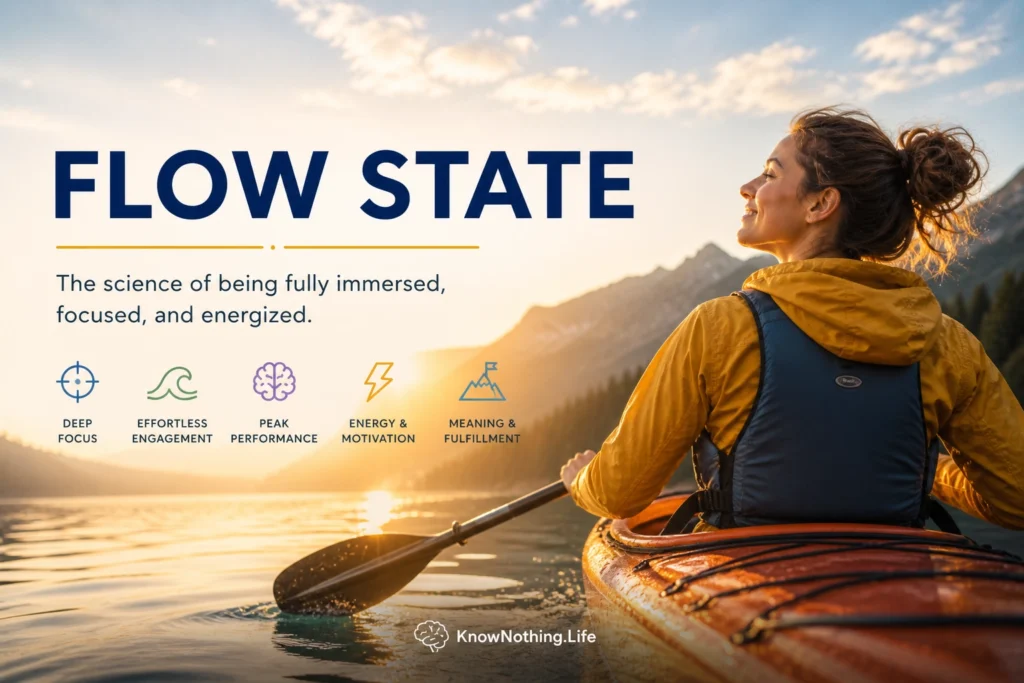
The concept of flow state describes a condition of deep absorption in an activity, where attention is fully focused, self-consciousness fades, and time seems to distort. People often report entering this state while engaged in challenging yet rewarding tasks—writing, playing music, coding, competing in sports, or solving complex problems. In these moments, action and awareness merge, creating an experience that feels both effortless and intensely concentrated. Flow is widely regarded as one of the most optimal psychological states for performance and well-being.
The scientific study of flow was pioneered by Mihaly Csikszentmihalyi, whose work in Flow: The Psychology of Optimal Experience (1990) transformed how psychologists understand engagement and motivation. Csikszentmihalyi described flow as “being completely involved in an activity for its own sake,” emphasizing that the reward lies in the experience itself rather than in external outcomes. This intrinsic quality distinguishes flow from other forms of motivation, where rewards or pressures drive behavior.
Flow state has become a central concept in psychology, education, performance science, and even business. It offers insight into how individuals can achieve peak performance while also experiencing deep satisfaction. By examining the conditions that produce flow and the mechanisms that sustain it, researchers have uncovered a powerful framework for understanding human potential. This article explores the nature of flow, its psychological and neurological foundations, and its applications in everyday life.
The Characteristics of Flow
Flow is defined by a set of distinctive psychological characteristics that together create a unique experiential state. One of the most important features is intense concentration. When individuals are in flow, their attention is fully directed toward the task at hand, leaving little room for distractions or irrelevant thoughts. This focused attention allows for efficient processing of information and seamless execution of actions.
Another defining characteristic is the merging of action and awareness. In flow, individuals often feel as though they are not consciously controlling their actions; instead, behavior unfolds naturally and spontaneously. This sense of automaticity is accompanied by a loss of self-consciousness, where concerns about evaluation or failure temporarily disappear. As Csikszentmihalyi noted, “The best moments in our lives are not the passive, receptive, relaxing times… the best moments usually occur when a person’s body or mind is stretched to its limits in a voluntary effort to accomplish something difficult and worthwhile.”
Time distortion is also commonly reported during flow experiences. Individuals may lose track of time, feeling as though hours have passed in minutes or vice versa. This altered perception reflects the deep immersion that characterizes flow. Additionally, flow is associated with a sense of control and clarity of goals, where individuals know exactly what needs to be done and receive immediate feedback on their progress. These elements combine to create a state that is both highly productive and deeply rewarding.
The Balance Between Challenge and Skill
A central principle of flow theory is the balance between challenge and skill. Flow occurs when the difficulty of a task is well matched to the individual’s abilities. If a task is too easy, it leads to boredom; if it is too difficult, it results in anxiety. Flow emerges in the optimal zone where challenge and skill are in equilibrium, pushing individuals to stretch their capabilities without overwhelming them.
This balance is dynamic and context-dependent. As individuals develop their skills, they require increasingly complex challenges to maintain flow. This process of continuous growth aligns with the idea of mastery, where individuals seek to improve their abilities through practice and engagement. The challenge-skill balance explains why activities such as sports, music, and creative work are particularly conducive to flow—they provide clear opportunities for progression and feedback.
The importance of this balance has practical implications for education and work environments. Tasks that are appropriately challenging can enhance motivation, engagement, and performance. Conversely, environments that fail to provide meaningful challenges may lead to disengagement and dissatisfaction. By designing activities that align with individuals’ skill levels, it is possible to create conditions that foster flow and maximize potential.
Intrinsic Motivation and Autotelic Experience
Flow is closely linked to intrinsic motivation—the drive to engage in an activity for its own sake. Unlike extrinsic motivation, which is driven by external rewards or pressures, intrinsic motivation arises from the inherent enjoyment and satisfaction of the activity itself. Flow represents the highest expression of intrinsic motivation, where the process becomes its own reward.
Csikszentmihalyi introduced the concept of the “autotelic” experience to describe activities that are pursued for their intrinsic value. Individuals with autotelic personalities are more likely to seek out and sustain flow experiences, as they are naturally inclined toward curiosity, persistence, and engagement. These individuals tend to find enjoyment in a wide range of activities, transforming even routine tasks into opportunities for flow.
The relationship between flow and intrinsic motivation has important implications for well-being. Activities that promote flow contribute to a sense of fulfillment and meaning, as they align with individuals’ interests and values. This contrasts with activities driven solely by external rewards, which may provide short-term satisfaction but lack deeper engagement. By cultivating intrinsic motivation, individuals can enhance both performance and quality of life.
The Neuroscience of Flow
Recent advances in neuroscience have provided insights into the biological mechanisms underlying flow. Studies suggest that flow involves changes in brain activity, particularly in regions associated with attention, self-awareness, and reward. One key concept is “transient hypofrontality,” a temporary reduction in activity in the prefrontal cortex, which is responsible for self-monitoring and critical evaluation. This reduction may explain the loss of self-consciousness and the sense of effortless action experienced during flow.
Neurochemical processes also play a role in flow. The release of neurotransmitters such as dopamine, norepinephrine, and endorphins contributes to heightened focus, motivation, and pleasure. These chemicals enhance pattern recognition, increase energy, and create a sense of reward, reinforcing the flow experience. Research by neuroscientists such as Arne Dietrich has explored these mechanisms, suggesting that flow represents a unique state of brain function optimized for performance.
The concept of neuroplasticity further highlights the impact of flow on the brain. Repeated experiences of flow can strengthen neural pathways associated with attention, skill development, and emotional regulation. This suggests that engaging in flow-inducing activities not only enhances immediate performance but also contributes to long-term cognitive and psychological growth. The integration of neuroscience and psychology provides a deeper understanding of how flow operates at both experiential and biological levels.
Applications of Flow in Life and Work
Flow has wide-ranging applications across various domains, including education, sports, creativity, and the workplace. In educational settings, fostering flow can enhance learning by increasing engagement and motivation. When students are challenged at an appropriate level and receive immediate feedback, they are more likely to become deeply involved in their work, leading to improved understanding and retention.
In professional contexts, flow is associated with higher productivity, creativity, and job satisfaction. Work environments that provide clear goals, autonomy, and opportunities for skill development are more likely to facilitate flow experiences. This has led to the adoption of flow-based approaches in organizational design, where tasks are structured to maximize engagement and performance.
Athletes and performers often rely on flow to achieve peak performance. The ability to enter a state of deep focus and automatic execution is critical in high-pressure situations. Training techniques that emphasize mindfulness, visualization, and skill mastery can increase the likelihood of experiencing flow. By understanding the conditions that promote flow, individuals and organizations can create environments that support optimal performance and well-being.
Challenges and Misconceptions
Despite its benefits, flow is not always easy to achieve. It requires a combination of skill, challenge, and environmental conditions that may not always be present. Modern life, with its constant distractions and interruptions, can make sustained concentration difficult. Digital technologies, while offering many advantages, often fragment attention, reducing the likelihood of entering flow.
There are also misconceptions about flow, particularly the idea that it is a purely effortless state. While flow feels effortless, it is typically the result of significant preparation and skill development. Achieving flow often requires discipline, practice, and the willingness to engage with challenging tasks. It is not a shortcut to success but a byproduct of sustained effort and engagement.
Additionally, an excessive focus on flow can lead to neglect of other important aspects of life, such as rest and social connection. While flow is highly rewarding, it is one component of a balanced life. Recognizing its role within a broader context of well-being is essential for maintaining overall health and fulfillment.
Conclusion
Flow state represents one of the most compelling insights into human performance and well-being. By describing a condition of deep engagement and intrinsic motivation, it offers a framework for understanding how individuals can achieve both excellence and fulfillment. The work of Mihaly Csikszentmihalyi has illuminated the conditions that give rise to flow, revealing its importance across diverse domains of life.
At its core, flow is about alignment—between challenge and skill, effort and enjoyment, action and awareness. By cultivating the conditions that support this alignment, individuals can enhance their ability to focus, create, and perform. The study of flow underscores a broader principle: that the most rewarding experiences often arise not from passive consumption, but from active engagement with meaningful challenges.
As research continues to evolve, flow remains a powerful concept for understanding the dynamics of human potential. It reminds us that optimal experience is not a matter of chance, but something that can be intentionally cultivated through practice, design, and awareness.