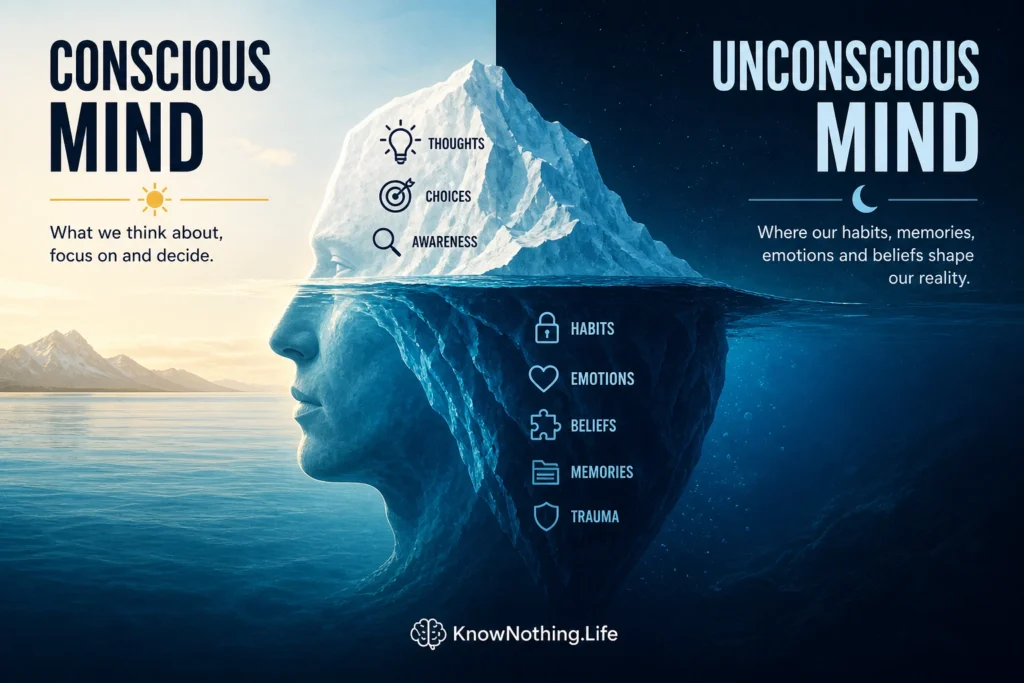
The distinction between the conscious and unconscious mind stands as one of the most enduring and influential ideas in psychology and philosophy. At its simplest, the conscious mind encompasses the thoughts, perceptions, and intentions of which we are aware in any given moment, while the unconscious mind operates beneath the surface, shaping behavior, emotion, and cognition without entering awareness. Yet this binary framing conceals a far more complex relationship—one in which hidden processes continuously inform, guide, and sometimes override conscious deliberation.
The modern understanding of this dual structure owes much to the work of Sigmund Freud, whose writings such as The Interpretation of Dreams proposed that unconscious desires and conflicts exert a powerful influence on behavior. Freud famously compared the mind to an iceberg, with only a small portion visible above the surface. While many of his specific theories remain controversial, the broader insight—that much of mental life occurs outside conscious awareness—has been repeatedly confirmed by contemporary research.
Today, the conscious–unconscious distinction is explored across disciplines, from cognitive psychology to neuroscience. Thinkers like Daniel Kahneman have reframed the idea in terms of dual-process theories, distinguishing between fast, automatic processes and slow, deliberate reasoning. The study of these two modes of mind reveals not a simple opposition, but an intricate partnership—one that defines how humans think, decide, and experience the world.
The Nature of the Conscious Mind
The conscious mind represents the domain of awareness—the mental space in which thoughts, sensations, and decisions become accessible to reflection. It is closely associated with attention, language, and intentional action. When individuals solve a problem, plan for the future, or reflect on their experiences, they are engaging the conscious mind. This aspect of cognition is often experienced as deliberate and effortful, requiring focus and mental energy.
Philosophically, the conscious mind has long been considered the foundation of knowledge and identity. René Descartes famously grounded certainty in conscious thought with the declaration “Cogito, ergo sum.” In this view, awareness is not merely a feature of the mind but its defining characteristic. Similarly, William James described consciousness as a continuous stream, emphasizing its fluid and dynamic nature rather than a static collection of ideas.
Despite its central role, the conscious mind is limited in capacity. Cognitive psychologists have demonstrated that attention can only process a small amount of information at any given time. This limitation necessitates selectivity, meaning that much of the information we encounter is filtered out before it reaches awareness. As a result, the conscious mind often operates with incomplete data, relying on the unconscious mind to fill in the gaps.
The Unconscious Mind and Hidden Processes
The unconscious mind encompasses mental processes that occur outside awareness yet significantly influence behavior and experience. These processes include automatic skills, implicit memories, emotional reactions, and ingrained habits. Unlike the conscious mind, which is slow and deliberate, the unconscious operates rapidly and effortlessly, often producing responses before conscious thought has time to intervene.
Freud’s early conception of the unconscious emphasized repressed desires and conflicts, suggesting that unacceptable thoughts are pushed out of awareness but continue to shape behavior. While modern psychology has moved beyond many of Freud’s specific claims, the existence of unconscious processing is well established. Research on implicit memory, for example, shows that individuals can be influenced by past experiences they do not consciously recall.
Contemporary theories have expanded the understanding of the unconscious beyond repression. Carl Jung introduced the idea of a collective unconscious—shared structures of thought and symbolism across humanity. Although this concept remains debated, it highlights the possibility that unconscious processes may extend beyond individual experience. More empirically grounded research, such as studies on priming, demonstrates how subtle cues can influence perception and behavior without conscious awareness, reinforcing the idea that much of cognition operates beneath the surface.
Dual-Process Theories and Modern Perspectives
In modern psychology, the distinction between conscious and unconscious processes is often framed in terms of dual-process theories. Daniel Kahneman, in Thinking, Fast and Slow, describes two systems of thought: System 1, which is fast, automatic, and largely unconscious, and System 2, which is slow, deliberate, and conscious. This framework provides a practical way of understanding how the two aspects of the mind interact in everyday decision-making.
System 1 enables rapid responses to familiar situations, drawing on patterns and associations formed through experience. It allows individuals to recognize faces, interpret emotions, and navigate complex environments with minimal effort. However, its speed comes at a cost: it is prone to biases and errors. System 2, by contrast, can override these automatic responses, but it requires effort and is limited in capacity. As Kahneman notes, “System 1 operates automatically and quickly, with little or no effort… System 2 allocates attention to the effortful mental activities that demand it.”
This interplay between automatic and controlled processes highlights the complementary nature of the conscious and unconscious mind. Rather than functioning independently, they work together to produce behavior. The unconscious provides efficiency and speed, while the conscious offers flexibility and control. Understanding this balance is essential for explaining both the strengths and vulnerabilities of human cognition.
Interaction Between Conscious and Unconscious Processes
The relationship between the conscious and unconscious mind is dynamic and bidirectional. Unconscious processes often shape conscious experience, influencing what we notice, how we interpret information, and what decisions we make. At the same time, conscious thought can modify unconscious patterns through learning, reflection, and intentional practice.
One clear example of this interaction is skill acquisition. When learning a new skill, such as driving or playing an instrument, individuals rely heavily on conscious attention. Over time, as the skill becomes practiced, it is transferred to the unconscious, allowing it to be performed automatically. This shift frees up conscious resources for other tasks, demonstrating how the two systems collaborate to optimize performance.
Emotional processing provides another illustration. Many emotional responses originate in unconscious systems, particularly those associated with survival and threat detection. Yet conscious awareness can reinterpret and regulate these responses, a process explored in research on cognitive reappraisal. As Joseph LeDoux has shown in his work on emotion, the brain can generate rapid emotional reactions before conscious awareness catches up, underscoring the primacy of unconscious processing in certain contexts.
Implications for Behavior and Decision-Making
The interplay between conscious and unconscious processes has profound implications for behavior and decision-making. Much of what individuals do on a daily basis is guided by habits and automatic responses rather than deliberate thought. This efficiency allows for smooth functioning but also opens the door to systematic errors and biases.
Behavioral research has shown that unconscious influences can shape preferences, judgments, and actions in subtle ways. For example, individuals may form impressions of others within seconds, based on minimal information, and these impressions can persist even in the face of contradictory evidence. Such findings highlight the power of unconscious processing and its potential to bypass rational deliberation.
At the same time, the conscious mind provides a mechanism for reflection and change. By becoming aware of biases and automatic tendencies, individuals can attempt to correct them, although this process is neither simple nor guaranteed. The challenge lies in recognizing when unconscious processes are leading us astray and engaging conscious thought to reassess our judgments. This capacity for self-regulation is central to critical thinking and personal development.
Conclusion
The distinction between the conscious and unconscious mind reveals a fundamental aspect of human cognition: much of what shapes our thoughts, feelings, and actions occurs outside our awareness. From the early insights of Sigmund Freud to the dual-process theories of Daniel Kahneman, the study of these two dimensions of mind has deepened our understanding of how humans think and behave.
Rather than existing in opposition, the conscious and unconscious mind function as complementary systems. The unconscious provides speed, efficiency, and automaticity, while the conscious offers reflection, control, and flexibility. Together, they form a complex cognitive architecture that enables both routine functioning and creative problem-solving.
Ultimately, exploring the relationship between these two aspects of mind invites a broader reflection on self-awareness. To understand oneself fully is not merely to examine conscious thoughts but to recognize the hidden processes that shape them. In this sense, the study of the conscious and unconscious mind is not only a scientific endeavor but also a philosophical one—an inquiry into the nature of human experience and the limits of self-knowledge.