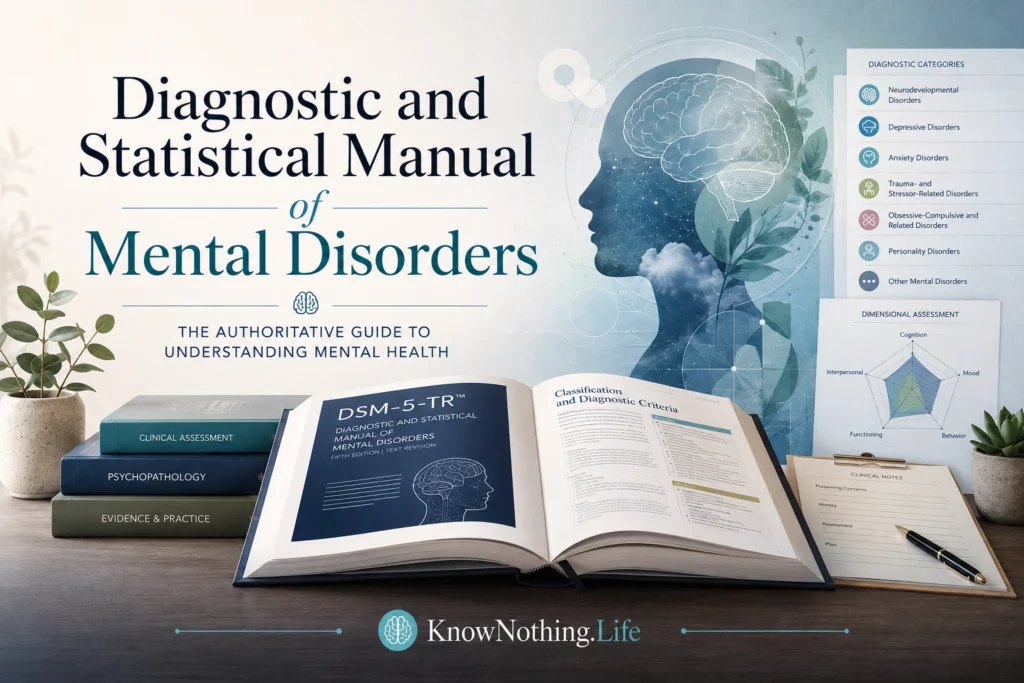
The Diagnostic and Statistical Manual of Mental Disorders, commonly known as the DSM, is the main diagnostic handbook used by psychiatrists, psychologists, therapists, researchers, hospitals, insurers, schools, and courts in the United States. Published by the American Psychiatric Association, the DSM provides standardized names, descriptions, and diagnostic criteria for mental disorders. Its purpose is not to explain every cause of psychological suffering, but to give clinicians a shared language for identifying patterns of symptoms, distress, impairment, and risk. The current edition, DSM-5-TR, was published in 2022 as a text revision of DSM-5.
The DSM is powerful because diagnosis affects treatment, insurance coverage, research studies, disability claims, school accommodations, legal decisions, and public understanding of mental illness. A diagnosis can help people name their suffering and access care, but it can also oversimplify complex lives. For that reason, the DSM is both a medical tool and a cultural document. It reflects scientific research, but it also reflects changing social values, professional debates, and historical assumptions about what counts as normal or disordered behavior.
Origins and Early Development
The first DSM, DSM-I, appeared in 1952. It was short compared with later editions and strongly influenced by psychodynamic psychiatry. Many disorders were described as “reactions,” meaning that symptoms were understood as the personality’s response to psychological, social, or biological stress. This reflected the dominance of psychoanalysis and psychosocial theory in mid-twentieth-century American psychiatry. DSM-II, published in 1968, continued much of this style, using broad descriptions rather than strict symptom checklists.
The major turning point came with DSM-III in 1980. Under the leadership of psychiatrist Robert Spitzer, DSM-III shifted psychiatry away from psychoanalytic explanation and toward descriptive diagnostic criteria. Instead of relying mainly on theoretical interpretation, clinicians were given symptom lists, duration requirements, and exclusion rules. This made diagnosis more reliable, meaning different clinicians were more likely to reach the same diagnosis when evaluating similar patients. DSM-III did not settle every scientific question, but it changed the DSM into a more systematic and research-oriented manual.
The DSM as a Common Language
The DSM’s greatest strength is standardization. Mental suffering can be difficult to describe because it involves mood, thought, memory, perception, behavior, body symptoms, relationships, and culture. The DSM organizes this complexity into categories such as major depressive disorder, bipolar disorder, schizophrenia, obsessive-compulsive disorder, posttraumatic stress disorder, autism spectrum disorder, and attention-deficit/hyperactivity disorder. These labels do not capture the whole person, but they help clinicians communicate, researchers define study groups, and health systems organize care.
Former National Institute of Mental Health director Thomas Insel summarized both the usefulness and limitation of the DSM when he wrote that it provides “a common language for describing psychopathology,” but is “at best, a dictionary.” That distinction matters. A dictionary organizes words; it does not fully explain reality. In the same way, the DSM organizes symptoms into recognizable patterns, but most DSM diagnoses are not confirmed by a simple blood test, brain scan, or single biological marker. A careful clinician uses the DSM as a guide, not as a substitute for judgment.
Major Editions and Changes
Each DSM edition reflects its historical moment. DSM-I and DSM-II belonged to a period when psychoanalytic ideas were central to psychiatry. DSM-III reflected the desire for clearer criteria, greater reliability, and stronger scientific credibility. DSM-III-R appeared in 1987, followed by DSM-IV in 1994 under the leadership of Allen Frances. DSM-IV placed greater emphasis on literature reviews, field trials, and empirical caution. DSM-IV-TR, published in 2000, updated the text while leaving most diagnostic criteria largely unchanged.
DSM-5, published in 2013, introduced several important changes. It removed the old multiaxial system, reorganized chapters, and revised several diagnostic categories. Asperger’s disorder, autistic disorder, and related diagnoses were combined under autism spectrum disorder. Obsessive-compulsive disorder and posttraumatic stress disorder were moved out of the anxiety disorders chapter into new groupings. DSM-5 also introduced or revised diagnoses such as binge-eating disorder and disruptive mood dysregulation disorder. DSM-5-TR later updated text, references, coding, and diagnostic discussion, including the addition of prolonged grief disorder.
Reliability, Validity, and Scientific Limits
The DSM’s central scientific challenge is the difference between reliability and validity. Reliability means clinicians can agree on a diagnosis. Validity means the diagnosis represents a real and distinct condition with clear boundaries, causes, mechanisms, and treatment implications. DSM-III greatly improved reliability by giving clinicians more explicit criteria, but validity remains difficult in psychiatry because many disorders overlap. Depression and anxiety commonly appear together. Trauma can resemble mood disorders, personality disorders, or psychosis. Substance use, medical illness, sleep problems, and social stress can all produce psychiatric symptoms.
This does not make DSM diagnosis useless, but it does make humility necessary. Human mental life is dimensional, layered, and deeply shaped by context. A person may meet criteria for several disorders, not because they have entirely separate diseases, but because diagnostic categories divide interconnected suffering into different boxes. The DSM is useful for clinical organization, but it should not be mistaken for a perfect map of the mind. As psychiatrist Allen Frances warned in his criticism of diagnostic inflation, psychiatry must be careful not to turn ordinary distress, grief, shyness, or childhood variation into disorder too quickly.
Culture and Controversy
The DSM has always been shaped by cultural change. One of the most important examples is the removal of homosexuality as a mental disorder. Earlier editions reflected the prejudices of their time, but activism, research, and professional debate forced psychiatry to reconsider whether same-sex attraction was inherently pathological. This change showed that diagnostic manuals are not purely scientific documents isolated from culture. They classify suffering, but they can also mistakenly classify difference as disorder when social bias influences clinical judgment.
Culture remains central to diagnosis. Symptoms are expressed through language, religion, family expectations, gender roles, poverty, trauma, discrimination, and social meaning. What appears unusual in one context may be understandable in another. DSM-5 and DSM-5-TR include cultural formulation concepts to help clinicians consider a patient’s background, explanatory model, stressors, supports, and relationship to the clinician. This is important because diagnosis is never just a checklist. It is an interpretation of symptoms within a life.
DSM and ICD
Although the DSM is especially influential in the United States, it is not the only major diagnostic system. The International Classification of Diseases, or ICD, is published by the World Health Organization and used globally for health statistics, billing, mortality reporting, and disease classification. Unlike the DSM, the ICD covers all medical conditions, not only mental disorders. Its mental and behavioral disorder sections overlap with the DSM but are not identical.
The DSM and ICD serve related but different purposes. The DSM provides detailed psychiatric criteria used heavily in American clinical practice, research, and insurance systems. The ICD functions as the global health classification standard. Differences between the two systems can affect diagnosis, prevalence rates, research comparisons, and policy. Their coexistence shows that psychiatric diagnosis is not only scientific; it is also practical, administrative, and institutional.
Final Thoughts
The Diagnostic and Statistical Manual of Mental Disorders is one of the most influential books in modern mental health. It has standardized psychiatric language, supported research, guided treatment planning, and helped many people understand forms of suffering that once felt nameless or morally shameful. At its best, a DSM diagnosis can be the beginning of care, explanation, and relief.
Yet the DSM is not a final theory of the mind. It is a changing manual built from research, clinical experience, professional consensus, and cultural debate. Its categories are useful, but imperfect; necessary, but not sacred. The best use of the DSM is neither blind acceptance nor total rejection. It should be used with scientific caution, cultural awareness, and compassion. Mental disorders are not merely labels in a book. They are lived experiences in real people, and any diagnostic system is only as valuable as the wisdom with which it is applied.