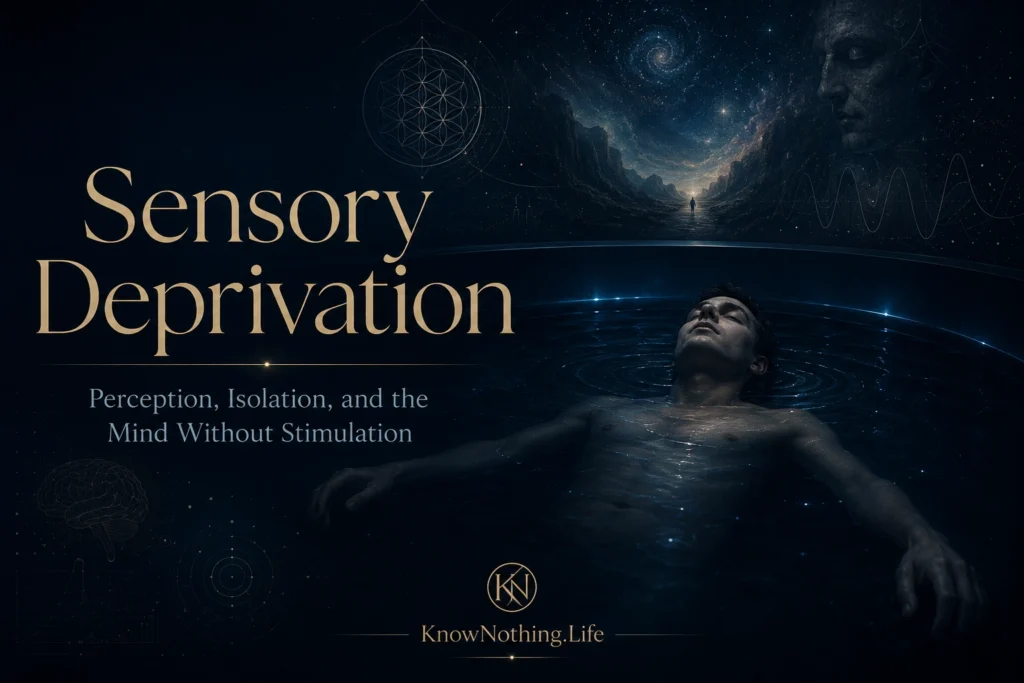
Sensory deprivation is the deliberate reduction of ordinary sensory input: sight, sound, touch, movement, social contact, and environmental variation. In its mild forms, it can mean silence, darkness, solitude, or flotation in warm saltwater. In its extreme forms, it can mean forced isolation, restricted movement, monotonous surroundings, and the removal of normal cues that keep a person oriented in time and place. The subject has always carried a double meaning. On one side, sensory deprivation has been studied as a tool for understanding attention, perception, consciousness, and stress. On the other, it has raised serious ethical concerns because prolonged deprivation can disorganize thought, intensify anxiety, produce hallucinations, and become psychologically harmful.
The central lesson of sensory deprivation research is that the mind is not a passive receiver of information. The brain depends on stimulation not only to know the outside world, but to organize itself. When ordinary input disappears, consciousness does not simply become blank. It often turns inward. Memories, bodily sensations, fantasies, emotions, and spontaneous imagery become more vivid. This is why sensory deprivation can feel peaceful in one setting and frightening in another. A person who enters a float tank voluntarily for relaxation is having a very different experience from someone held in isolation without control, consent, or a clear endpoint. The psychology of sensory deprivation cannot be separated from choice, safety, duration, expectation, and context.
Early Research and the McGill Experiments
Modern scientific interest in sensory deprivation became especially prominent in the 1950s through research at McGill University associated with Donald Hebb and his students. W. H. Bexton, W. Heron, and T. H. Scott published the influential 1954 paper “Effects of Decreased Variation in the Sensory Environment.” Their study began with a practical question about attention: what happens when a person must monitor an environment in which little changes? The authors connected this problem to vigilance tasks such as watching a radar screen for long periods, where “when at last something does happen,” the watcher may fail to respond.
The McGill studies placed participants in conditions designed to reduce sensory variation. They lay in beds, wore translucent goggles, had their hearing muffled, and had their hands covered to reduce touch. Many participants found the experience difficult to tolerate. They reported boredom, irritability, trouble thinking clearly, and unusual imagery. Some experienced hallucination-like phenomena. A 1963 review in JAMA Psychiatry noted that within about a decade of the original McGill experiments, sensory deprivation had generated major scientific attention, with more than 125 papers appearing by July 1961.
The Brain’s Need for Input
Sensory deprivation reveals how much the brain depends on contrast, novelty, rhythm, and feedback. Ordinary life constantly supplies orientation: light tells us time of day, sound tells us where we are, touch tells us the body’s boundaries, and social interaction confirms our sense of reality. Remove these cues, and the nervous system begins searching for structure. The mind may amplify weak sensations, generate internal images, distort time, or become absorbed in thought loops. In this sense, sensory deprivation shows that perception is active construction, not simple recording.
Psychologist Donald Hebb’s broader work on learning and neural organization helps explain why deprivation matters. Hebb is famous for the principle often summarized as “cells that fire together wire together,” a simplified version of his theory in The Organization of Behavior (1949). The mind develops through patterned activity. Stimulation is not mental decoration; it is part of how the brain maintains attention, meaning, and coherence. When stimulation becomes too monotonous or too absent, thought can lose its ordinary anchors. The same silence that feels restful for an hour may become destabilizing when prolonged, forced, or combined with stress.
John C. Lilly and the Isolation Tank
Neurophysiologist John C. Lilly brought sensory deprivation into a different cultural and experimental space through his development of the isolation tank. Lilly was interested in consciousness, the brain, communication, and altered states. Rather than only studying deprivation as stress, he explored what happens when the body is supported in warm water, light and sound are reduced, and the person is free to observe inner experience. The float tank became a symbol of both scientific curiosity and countercultural exploration.
Lilly’s work helped shift attention from “deprivation” to “restricted environmental stimulation.” The difference matters. A float tank does not remove all sensation. It reduces external distraction while often increasing awareness of breathing, heartbeat, muscle tension, imagery, and thought. Lilly described the tank as a place where he could think deeply without disturbing others, saying he could float and work out an idea “at great length and in fine detail.” This points to a paradox: when the outer world quiets down, the inner world may become louder, more organized, or more strange.
Effects on Attention, Time, and Perception
One of the most common effects of sensory deprivation is altered time perception. Without ordinary events marking time, minutes can stretch or collapse. A person may lose the usual sequence of before and after. This happens because time is partly built from change. Clocks measure time externally, but consciousness often feels time through transitions: footsteps, conversations, meals, light shifts, tasks, and bodily movement. In deprivation, those markers disappear, and subjective time becomes unstable.
Perception may also become more internally generated. People may see colors, patterns, faces, lights, or scenes in darkness. They may hear faint sounds, feel bodily distortions, or sense floating, expansion, or boundary loss. These experiences do not always indicate mental illness. Under low stimulation, the brain may increase sensitivity and fill gaps with internally produced material. A 2024 study in Scientific Reports found that floatation-REST produced greater relaxation and stronger altered-state effects than an active control condition, including changes in body-boundary perception and subjective time.
Sensory Deprivation, Stress, and Ethics
The ethical meaning of sensory deprivation depends heavily on whether it is chosen or imposed. Voluntary silence, meditation, retreat, or flotation may allow rest, reflection, and relief from overstimulation. Forced isolation, sleep disruption, monotony, and social deprivation can become psychologically damaging. This distinction is essential because sensory deprivation has a troubling history in relation to coercive interrogation, institutional abuse, and unethical experimentation. The same basic principle—the mind’s dependence on stimulation—can be studied scientifically, used therapeutically, or exploited harmfully.
The Cold War intensified interest in isolation, brainwashing, and psychological control. Historical scholarship has examined how public fear about mind control shaped sensory deprivation research and its interpretation. This history warns against romanticizing the field. Sensory deprivation is not automatically healing or enlightening. In unsafe contexts, it can increase anxiety, confusion, helplessness, and suggestibility. The loss of control is especially important. A person who can leave a float tank at any moment remains psychologically anchored by choice. A person who cannot leave may experience the same reduction of stimulation as threat.
Flotation-REST and Modern Therapeutic Interest
Modern researchers often use the term flotation-REST, meaning flotation restricted environmental stimulation therapy. This approach usually involves floating in warm, highly buoyant saltwater in a quiet, dark environment. The goal is not absolute deprivation but reduction of external demand. Contemporary studies and reviews suggest that flotation-REST may reduce stress, anxiety, pain, and fatigue for some people, though research quality, sample size, and clinical applications vary. A 2025 systematic review described REST as a therapeutic technique involving minimal sensory input and reported evidence for possible benefits in anxiety, chronic pain, sleep, creativity, and cognitive function.
The modern therapeutic interest in floatation is partly a response to overstimulation. Many people live in environments saturated with screens, noise, alerts, artificial light, and social pressure. In that context, reduced stimulation may feel restorative because it gives the nervous system permission to downshift. Still, the practice should not be treated as a cure-all. People with certain psychiatric conditions, trauma histories, panic symptoms, or discomfort in enclosed spaces may respond negatively. The broader lesson is that the nervous system needs both stimulation and rest. Health is not maximum input or total silence, but flexible regulation between engagement and withdrawal.
Sensory Deprivation and Solitude
Sensory deprivation also helps clarify the difference between solitude and isolation. Solitude is chosen separation that allows reflection, creativity, prayer, meditation, or recovery. Isolation is unwanted separation that can produce distress, loneliness, and disorientation. Philosophers, mystics, and writers have long valued silence as a path to self-knowledge. William James, in The Principles of Psychology, emphasized the stream-like nature of consciousness, writing that thought “does not appear to itself chopped up in bits.” Sensory deprivation makes this stream more visible because fewer external interruptions divide it.
But solitude works best when the self remains connected to meaning. Silence with purpose is different from emptiness without orientation. A retreat, meditation room, or float session usually includes a frame: the person knows why they are there, how long it will last, and that ordinary life is waiting outside. Extreme deprivation removes those frames. The mind then has to supply its own structure, and not every mind can do so safely under pressure.
Final Thoughts on Sensory Deprivation
Sensory deprivation is powerful because it exposes a basic truth about human consciousness: the mind needs the world. Sight, sound, touch, movement, and social feedback help stabilize identity, time, attention, and reality testing. When those inputs are reduced, consciousness does not disappear. It reorganizes. Sometimes it relaxes. Sometimes it dreams while awake. Sometimes it becomes anxious, distorted, or overwhelmed. The result depends on duration, consent, expectation, personality, mental health, and environment.
The work of Hebb, Bexton, Heron, Scott, Lilly, and later REST researchers shows that sensory deprivation is neither simply dangerous nor simply therapeutic. It is a psychological amplifier. In safe, voluntary, time-limited settings, reduced stimulation may support relaxation, introspection, and altered awareness. In forced or prolonged settings, it can become disorienting and harmful. The deepest lesson is balance. Human beings need quiet, but not emptiness; stimulation, but not overload; solitude, but not abandonment. Sensory deprivation matters because it reveals how consciousness is held together by the living conversation between the body, the world, and the mind.