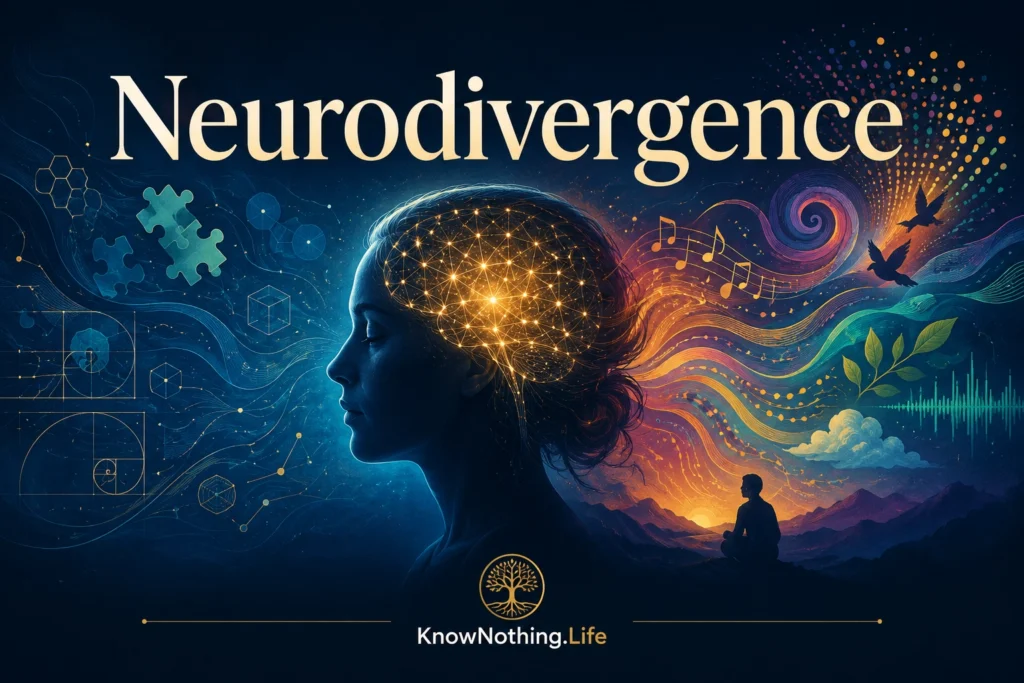
Neurodivergence refers to the idea that some minds develop, process, learn, communicate, sense, and regulate differently from what society considers typical. The term is often used for autism, ADHD, dyslexia, dyspraxia, Tourette syndrome, sensory processing differences, learning disabilities, and other forms of cognitive or neurological difference. It does not mean that every difference is easy, harmless, or merely a personality trait. Many neurodivergent people experience real disability, distress, exclusion, exhaustion, or support needs. But the concept challenges the assumption that there is only one correct way for a brain to function.
The word neurodivergent is closely connected to the broader idea of neurodiversity. Neurodiversity means that human nervous systems naturally vary, just as bodies, personalities, temperaments, and talents vary. Australian sociologist Judy Singer helped popularize the term neurodiversity in the late 1990s, especially in relation to autism and disability rights. The writer Harvey Blume also helped bring the word into wider public discussion. The central insight is simple but powerful: neurological difference should not automatically be treated as defect, failure, or brokenness. Some differences create impairments because of the brain itself; others become disabling because schools, workplaces, and social expectations are designed too narrowly.
What Neurodivergence Means
Neurodivergence is not a formal medical diagnosis. It is an umbrella term. A person is not diagnosed with “neurodivergence” in the same way they may be diagnosed with autism spectrum disorder, ADHD, dyslexia, or Tourette syndrome. Instead, neurodivergence describes a relationship to the norm. A neurotypical person has cognitive and neurological patterns that broadly fit dominant social expectations. A neurodivergent person has patterns that differ significantly from those expectations.
This distinction matters because neurodivergence is both biological and social. A dyslexic person may process written language differently, but the difficulty becomes more visible in a culture built around print-heavy schooling. An autistic person may experience sensory overload, but the distress may be intensified by fluorescent lights, crowded classrooms, unpredictable schedules, and social rules that are never explained directly. A person with ADHD may struggle with executive function, but rigid workplaces and punishment-based systems can turn those struggles into shame. Neurodivergence is therefore not only about the brain. It is also about the fit between a person and their environment.
The Neurodiversity Movement
The neurodiversity movement emerged partly from autistic self-advocacy. It argued that people with neurological differences should not be discussed only as patients, burdens, or collections of symptoms. They should be listened to as full human beings with their own accounts of experience. Steve Silberman’s NeuroTribes helped popularize this history, arguing that autism had long been misunderstood through narrow clinical stories and that society needed a broader view of cognitive difference. Silberman describes neurodiversity as the idea that conditions such as autism, ADHD, and dyslexia are part of natural human variation rather than merely lists of deficits.
The movement does not deny disability, though critics sometimes misunderstand it that way. A serious neurodiversity perspective can recognize both difference and impairment. An autistic person may value autistic identity while still needing communication support, sensory accommodations, or help with daily living. A person with ADHD may reject shame while still wanting medication, coaching, structure, or therapy. The point is not that every trait is good. The point is that support should not require humiliation, and difference should not erase dignity.
Autism, ADHD, Dyslexia, and Other Differences
Autism is one of the most visible forms of neurodivergence. It may involve differences in social communication, sensory processing, routines, interests, movement, attention, and perception. Some autistic people are nonspeaking and need substantial support. Others speak fluently but struggle with social inference, sensory overload, masking, or burnout. The spectrum is broad, which is why stereotypes are so misleading. Autism is not simply genius, awkwardness, silence, or lack of empathy. It is a complex developmental pattern that affects how the world is experienced.
ADHD is another common form of neurodivergence, involving attention regulation, impulsivity, motivation, time perception, emotional reactivity, and executive function. Russell Barkley has argued that ADHD is better understood as a disorder of self-regulation and executive function than as a simple lack of attention. Dyslexia involves differences in reading, spelling, phonological processing, and language-based learning, but many dyslexic people also show strengths in visual reasoning, problem-solving, creativity, or big-picture thinking. Tourette syndrome involves motor and vocal tics, while dyspraxia may affect coordination, planning, and motor control. These conditions differ greatly, but they share a common theme: the mind or nervous system does not move through the world in the expected way.
Strengths and Struggles
One mistake is to romanticize neurodivergence as a “superpower.” Another mistake is to frame it only as tragedy. Both approaches flatten real lives. Neurodivergent people may have remarkable strengths: intense focus, original thinking, pattern recognition, honesty, creativity, persistence, visual imagination, sensitivity, verbal skill, technical ability, or unusual memory. Many fields benefit from minds that notice what others miss, question assumed rules, or approach problems from unexpected angles.
At the same time, neurodivergence can involve serious challenges. These may include sensory overload, executive dysfunction, social confusion, anxiety, depression, burnout, learning barriers, sleep problems, emotional dysregulation, coordination difficulties, stigma, and isolation. A person may be gifted in one area and deeply impaired in another. This uneven profile is one of the most important features of neurodivergence. Someone may write brilliantly but struggle to answer emails. They may solve complex problems but forget appointments. They may speak eloquently but collapse after social events. Intelligence does not cancel disability.
Masking and Burnout
Many neurodivergent people learn to mask, meaning they hide or suppress natural behaviors to appear more typical. An autistic person may force eye contact, rehearse facial expressions, imitate social scripts, suppress stimming, or pretend not to be overwhelmed by noise. A person with ADHD may cover disorganization through overwork, humor, apology, or last-minute panic. Masking can help someone survive socially, but it often comes at a high psychological cost.
Over time, masking may lead to exhaustion, anxiety, identity confusion, and burnout. The person is not merely working or socializing; they are performing normality. This can make diagnosis difficult, especially for women, girls, and people who learned early that their differences were unacceptable. Late diagnosis can bring grief, relief, anger, and self-understanding. Many people look back and realize that what they called laziness, sensitivity, weirdness, or failure was actually unsupported neurodivergence.
The Social Model of Disability
The social model of disability is important for understanding neurodivergence. It does not claim that impairments are imaginary. Instead, it distinguishes between impairment and disability. An impairment may be a real difference in body or brain. Disability often emerges when the environment fails to accommodate that difference. A wheelchair user is disabled not only by paralysis but by stairs without ramps. A neurodivergent student may be disabled not only by attention, sensory, or reading differences but by teaching methods that allow only one path to success.
This model does not erase medical needs. Medication, therapy, speech support, occupational therapy, assistive technology, and specialized instruction can be life-changing. But the social model asks society to share responsibility. Instead of asking only, “How do we make this person more normal?” it asks, “How do we build environments where more kinds of minds can function?” That shift is ethical as well as practical.
Education, Work, and Accommodation
Schools often reveal neurodivergence because they demand sitting still, reading quickly, following group instructions, tolerating noise, shifting tasks, and demonstrating knowledge in standardized ways. A neurodivergent child may be mislabeled as lazy, disruptive, careless, defiant, or unmotivated when the real issue is mismatch. Good education recognizes that equal treatment is not always fair treatment. Some students need visual supports, movement breaks, direct instructions, quiet spaces, assistive technology, extra time, or alternative ways to show understanding.
Workplaces face a similar challenge. Many jobs reward networking, multitasking, quick switching, open offices, constant meetings, and unspoken social expectations. Neurodivergent workers may thrive when tasks are clear, communication is direct, sensory conditions are manageable, and outcomes matter more than performance of normality. Accommodations are not special favors. They are tools that allow ability to become visible. A workplace that supports neurodivergence often becomes better for everyone because clarity, flexibility, and humane design help many different people.
Neurodivergence and Identity
For some people, neurodivergence is primarily a medical fact. For others, it becomes part of identity, culture, and community. This is especially true for autistic and ADHD communities where shared language helps people name experiences that once felt private and shameful. Terms like masking, stimming, executive dysfunction, sensory overload, hyperfocus, rejection sensitivity, and burnout can give people tools for understanding themselves. Naming can be liberating because it turns confusion into pattern.
Still, identity should not become a prison. No person is only neurodivergent. A person is also shaped by culture, family, class, gender, education, trauma, personality, values, and choice. Neurodivergence may explain many things, but it does not explain everything. The goal is not to replace one stereotype with another. It is to see the whole person more clearly.
Final Thoughts on Neurodivergence
Neurodivergence invites a broader understanding of human minds. It asks society to stop confusing difference with defect and to stop measuring every person by one narrow standard of normality. At the same time, it asks advocates to remain honest about disability, support needs, suffering, and impairment. The strongest view holds both truths: neurodivergent people may have valuable differences, and they may also need real help.
The future of neurodivergence depends on humility. Science must keep studying the brain. Schools and workplaces must become more flexible. Clinicians must listen more carefully to lived experience. Families must learn the difference between support and pressure to conform. Neurodivergent people deserve more than pity, romanticization, or forced normality. They deserve understanding, accommodation, dignity, and the freedom to build lives that fit the minds they actually have.