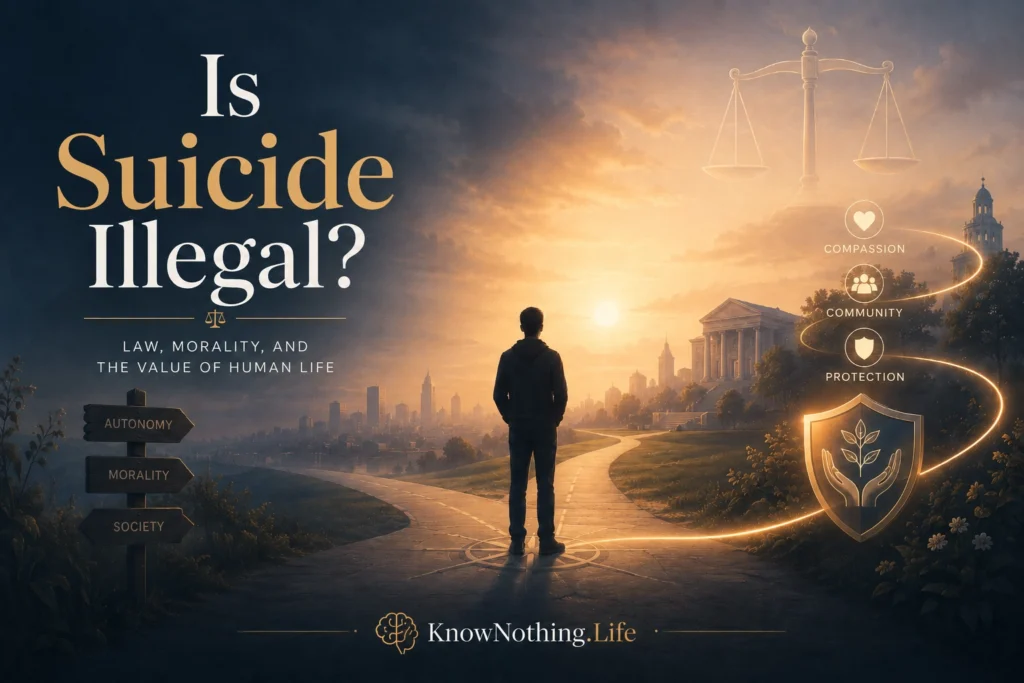
The question “Is suicide illegal?” begins with a complication: in many modern countries, suicide itself is no longer illegal. A person who dies by suicide cannot be punished, and in most contemporary legal systems, a person who survives a suicide attempt is not supposed to be treated as a criminal. The older idea that suicide was a crime came from religious, moral, and legal traditions that viewed self-killing not only as a private tragedy, but as an offense against God, the king, the community, or the social order. Today, however, many legal systems have moved away from criminal punishment and toward medical care, crisis intervention, mental health treatment, and suicide prevention.
Still, the idea that suicide is “illegal” survives in public language for several reasons. First, some countries still criminalize suicide attempts. Second, laws often remain against helping, encouraging, coercing, or assisting another person’s suicide. Third, police and emergency responders may intervene when someone is in immediate danger, not because the person is being treated as a criminal, but because the state claims a duty to preserve life. Finally, the separate debate over physician-assisted dying creates confusion. Suicide, attempted suicide, assisted suicide, and medical aid in dying are related topics, but legally and ethically they are not the same.
The Religious and Historical Roots
For much of Western history, suicide was condemned through religious morality. In Christian thought, life was understood as a gift from God, not a possession that the individual could destroy at will. Augustine argued in The City of God that self-killing violated the commandment against killing. Thomas Aquinas later argued in the Summa Theologica that suicide was wrong for three reasons: it opposed natural self-love, injured the community, and violated God’s authority over life and death. This religious view shaped medieval and early modern law.
Under English common law, suicide was historically treated as felo de se, meaning “felon of himself.” The person who died by suicide could be denied ordinary burial rites, and their property could be forfeited to the Crown. These punishments now seem cruel because they fell mostly on the family, but they reflected an older legal worldview in which crime, sin, property, and public order were deeply connected. Suicide was not viewed simply as the act of a suffering individual. It was treated as a moral and civic violation.
Why Punish a Person Who Is Already Dead?
The old criminalization of suicide may seem illogical because a dead person cannot be imprisoned or rehabilitated. Historically, however, the punishment was symbolic and social. Law was not only trying to punish the deceased; it was trying to condemn the act, deter others, protect religious order, and mark suicide as a violation of communal duty. Property forfeiture, shame, and burial restrictions were meant to send a public message that self-killing stood outside accepted moral life.
The problem was that these punishments harmed survivors. Families who were already grieving could lose inheritance, reputation, and religious consolation. Over time, this became harder to justify. As medicine and psychology developed, suicide was increasingly understood not as rebellion or crime, but as the result of despair, mental illness, unbearable pain, trauma, intoxication, social isolation, or crisis. The legal meaning began to change because the human meaning changed. A person who attempts suicide came to be seen less as an offender and more as someone in need of help.
Decriminalization and Modern Law
In England and Wales, suicide ceased to be a crime under the Suicide Act 1961. That legal shift captured a broader modern movement: suicide prevention should not depend on criminal punishment. Decriminalization did not mean society became indifferent to suicide. It meant that surviving a suicide attempt should lead to care rather than prosecution. Many countries followed similar reasoning, though the pace has varied across legal systems and cultures.
The World Health Organization has argued that criminalizing suicide and suicide attempts worsens stigma and can discourage people from seeking help. If a person fears arrest, shame, legal consequences, or family dishonor, they may be less likely to speak openly about suicidal thoughts. From a public-health perspective, this is dangerous. Prevention depends on disclosure, treatment, crisis support, and reducing isolation. A law that drives suffering underground can make suicide more likely, not less.
Why Assisted Suicide Is Treated Differently
Even where suicide itself is not criminalized, helping someone else die is usually treated very differently. The law has strong reasons to worry about coercion, abuse, pressure, exploitation, and uncertainty. A person may be elderly, disabled, depressed, financially vulnerable, isolated, dependent on caregivers, or afraid of becoming a burden. If assistance in suicide were broadly permitted without safeguards, the law fears that vulnerable people could be pressured, subtly or openly, toward death.
This is why many jurisdictions distinguish between suicide and assisted suicide. The person in crisis may receive emergency help. The person who encourages, manipulates, supplies lethal means, or helps cause another person’s death may face criminal liability. In some places, physician-assisted dying or medical aid in dying is legal under strict conditions, usually for terminally ill adults with decision-making capacity and a limited prognosis. Supporters frame it as autonomy and dignity at the end of life. Critics fear that it can weaken protection for vulnerable people. The debate is not simply about whether death should ever be chosen; it is about who decides, under what conditions, with what safeguards, and what social pressures may be hidden beneath the choice.
The Philosophy of Autonomy and the Value of Life
Philosophically, suicide law sits between two powerful principles: autonomy and protection. Autonomy says that a person has deep authority over their own body and life. From this view, forcing someone to remain alive against their will can look like state control over the most intimate human decision. Thinkers influenced by liberal individualism often argue that adults should be free to make choices about their own lives, even tragic ones, unless they directly harm others.
The opposing principle says that life has value even when a person temporarily cannot feel it. A suicidal crisis may be intense but also changeable. Many people who survive an attempt later report gratitude that they lived. From this view, the state has a duty to intervene because suicidal desire may arise from treatable illness, distorted hopelessness, panic, intoxication, trauma, or temporary collapse. The law therefore often acts paternalistically: it restricts immediate self-destruction in the hope that the person’s future self may recover the will to live.
Suicide, Mental Health, and Public Health
Modern suicide prevention treats suicide less as a legal problem and more as a public-health emergency. Risk can be shaped by depression, bipolar disorder, substance use, psychosis, trauma, chronic pain, grief, social isolation, financial stress, relationship breakdown, humiliation, access to lethal means, and prior attempts. No single factor explains all suicides. Some people plan for a long time; others act during a short crisis. This complexity is one reason criminalization is ineffective. It punishes the surface act without addressing the causes.
Public-health approaches focus on crisis lines, mental health care, substance use treatment, firearm safety, bridge barriers, responsible media reporting, follow-up after attempts, school and workplace support, and reducing stigma. The central idea is that suicidal thoughts should be speakable before they become fatal. A person should be able to say, “I do not feel safe with myself,” without fearing legal punishment. The more a society treats suicidal suffering as shameful or criminal, the harder it becomes to reach people in time.
Why the Law Still Intervenes
Even when suicide is not a crime, the law still allows intervention. Police, paramedics, doctors, therapists, and courts may act if someone appears to be an immediate danger to themselves. This may involve emergency evaluation, temporary hospitalization, welfare checks, or removal of dangerous means. These actions can feel coercive, and sometimes they are experienced as frightening or humiliating. But their legal purpose is usually protective, not punitive.
This distinction is essential. Decriminalizing suicide does not mean society must stand aside when someone is about to die. It means the response should be care rather than punishment. The best modern systems try to combine urgency with dignity: keep the person alive, reduce immediate danger, assess mental state, involve support, and connect them to longer-term care. In practice, systems often fall short. But the principle has changed dramatically from the old criminal model.
Final Thoughts
Suicide was historically illegal because law once treated it as a sin, a crime against the community, and a violation of divine or sovereign authority. Over time, that view became less persuasive as society came to understand suicide through medicine, psychology, trauma, and public health. Today, the better question is not “How should suicide be punished?” but “How can suicide be prevented without increasing shame?”
In many places, suicide itself is no longer illegal, but assisting or encouraging another person’s suicide remains restricted because of concerns about coercion, abuse, and the protection of vulnerable people. Medical aid in dying exists in some jurisdictions under narrow legal safeguards, but it remains ethically contested. The direction of modern law is clear: people in suicidal crisis should not be treated as criminals. They should be treated as human beings in danger, deserving protection, compassion, and help. The law’s task is no longer to condemn the dead. It is to protect the living.