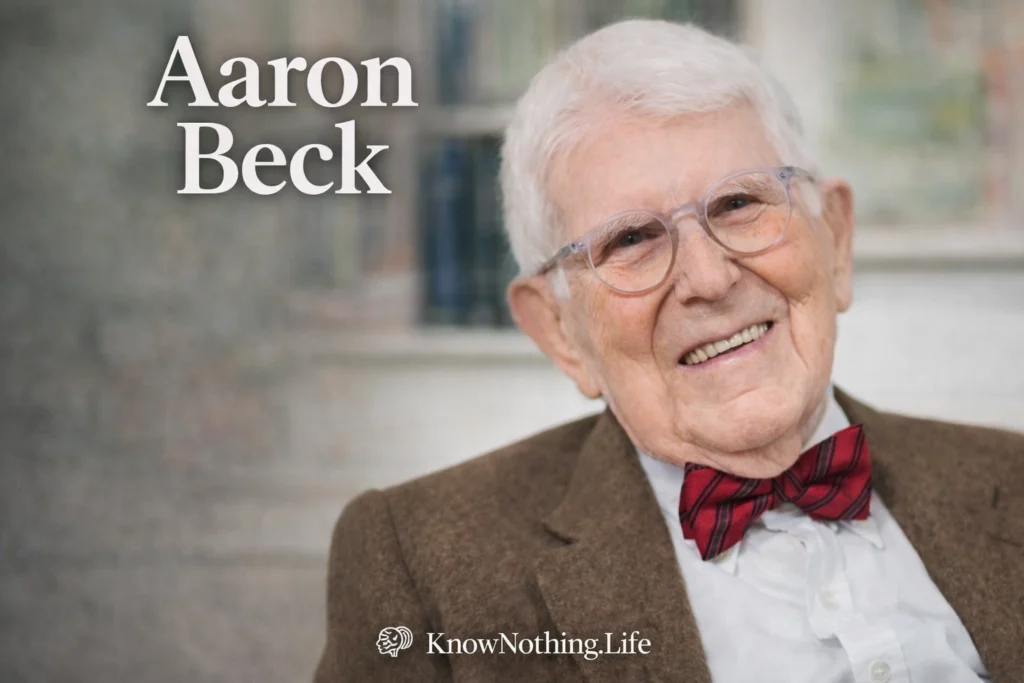
Few figures in modern psychotherapy have had as large and practical an influence as Aaron T. Beck. Best known as the founder of cognitive therapy and one of the central architects of cognitive behavioral therapy, Beck transformed the treatment of depression, anxiety, suicide risk, personality disorders, and many other psychological conditions. His work changed psychotherapy by arguing that emotional suffering is not shaped only by unconscious conflict, childhood experience, or external reinforcement, but also by the way people interpret reality in the present moment.
Beck’s central insight was simple but revolutionary: thoughts matter. The meaning a person gives to an event can shape sadness, fear, anger, hopelessness, and behavior itself. By helping patients identify automatic thoughts, examine distorted beliefs, and test interpretations against evidence, Beck created a form of therapy that was structured, collaborative, practical, and researchable. His ideas helped move psychotherapy into the age of empirical testing and made cognitive behavioral therapy one of the most widely studied and widely used psychological treatments in the world.
Early Life and Intellectual Formation
Aaron Temkin Beck was born on July 18, 1921, in Providence, Rhode Island, to Jewish immigrant parents. His early life was shaped by both intellectual ambition and personal struggle. As a child, he experienced serious illness and anxiety related to medical procedures, experiences that may have contributed to his later interest in fear, vulnerability, and the psychological interpretation of danger. Rather than becoming defined by those early fears, Beck developed a disciplined and scientific temperament that would later shape his therapeutic methods.
Beck studied at Brown University before earning his medical degree from Yale School of Medicine. He trained as a psychiatrist during a period when psychoanalysis dominated American mental health treatment. Like many psychiatrists of his generation, he was initially drawn to Freudian theory, which explained depression through unconscious hostility turned inward and other deep psychodynamic conflicts. Beck began his career working within this intellectual tradition, but he was unusually committed to testing whether its claims could be supported by evidence.
That scientific restlessness became one of the defining traits of his career. Beck did not simply reject psychoanalysis because it was unfashionable or difficult. He tested psychoanalytic assumptions, found that his observations did not support them, and followed the evidence toward a new theory. This willingness to abandon an inherited framework became the beginning of one of the most important revolutions in modern psychotherapy.
From Psychoanalysis to Cognitive Therapy
Beck’s break from psychoanalysis emerged through his research on depression. He initially expected to confirm psychoanalytic ideas, but his clinical observations led him elsewhere. Rather than finding hidden anger as the central feature of depression, he noticed that depressed patients often experienced streams of negative thoughts about themselves, the world, and the future. These thoughts appeared quickly, almost reflexively, and patients often accepted them as reality rather than interpretations.
This observation led Beck to the concept of automatic thoughts. A depressed person might make a small mistake and immediately think, “I am a failure.” A socially anxious person might notice someone looking away and assume, “They dislike me.” A hopeless person might face one setback and conclude, “Nothing will ever improve.” Beck realized that these thoughts were not random. They reflected deeper beliefs and mental habits that shaped emotional experience.
His cognitive model proposed that emotional distress is often maintained by biased interpretations. Beck did not argue that problems are imaginary or that positive thinking alone can cure suffering. Instead, he argued that people often respond not directly to events, but to the meanings they attach to those events. One Beck Institute summary captures the heart of this model: “the meaning they attach to the experience” accounts for emotional reactions. That idea became the foundation of cognitive therapy.
The Cognitive Triad
One of Beck’s most influential concepts was the cognitive triad of depression. He argued that depressed individuals often develop negative views of the self, the world, and the future. The self is seen as defective or inadequate. The world is experienced as rejecting, unfair, or overwhelming. The future appears hopeless, closed, or doomed to repeat suffering. Together, these three patterns reinforce depressive emotion and behavior.
The cognitive triad helped explain why depression can feel so total. A person is not merely sad about one event; the entire structure of meaning becomes darkened. The self feels worthless, the present feels painful, and the future feels impossible. This framework gave therapists a practical way to understand and treat depression by helping patients examine the thoughts and beliefs that maintain despair.
Beck’s approach was powerful because it gave patients tools. Instead of waiting for hidden unconscious material to surface over years, cognitive therapy taught people to observe their thinking, identify distortions, ask questions, gather evidence, and experiment with new behaviors. Therapy became an active collaboration rather than a one-sided interpretation from expert to patient.
Major Works and Psychological Contributions
Beck’s ideas were developed through a series of major works that reshaped clinical psychology and psychiatry. His early article “Thinking and Depression” helped introduce his cognitive model of depression. His book Depression: Causes and Treatment expanded the theory and helped establish depression as a condition that could be understood through patterns of thought, belief, and interpretation.
In Cognitive Therapy and the Emotional Disorders, Beck broadened his theory beyond depression and argued that cognitive patterns play a central role in many forms of psychological distress. His landmark book Cognitive Therapy of Depression, written with A. John Rush, Brian Shaw, and Gary Emery, became one of the foundational treatment manuals for cognitive therapy. It helped standardize therapeutic methods and made the approach easier to test scientifically.
Beck also contributed to the treatment of anxiety through works such as Anxiety Disorders and Phobias: A Cognitive Perspective. He later wrote on personality disorders, relationships, hostility, and suicide. His clinical influence also includes major psychological instruments such as the Beck Depression Inventory and the Beck Hopelessness Scale, tools that became widely used in research and clinical settings.
The Structure of Cognitive Therapy
Cognitive therapy differed from many earlier therapies in both philosophy and method. It was structured, time-sensitive, present-focused, and collaborative. Beck believed therapist and patient should work together like investigators examining the patient’s interpretations of experience. The goal was not to argue a patient out of pain, but to help them test whether their thoughts were accurate, useful, exaggerated, or incomplete.
A central therapeutic method involved identifying automatic thoughts during moments of emotional distress. Once those thoughts were identified, therapist and patient examined evidence for and against them. A thought such as “I always fail” could be explored by asking whether it is literally true, what evidence contradicts it, and whether a more balanced interpretation is possible. Over time, patients could learn to recognize cognitive distortions such as catastrophizing, overgeneralization, mind reading, all-or-nothing thinking, and emotional reasoning.
Beck’s famous clinical spirit was not cold rationalism. It was compassionate empiricism. He believed people suffer deeply when their minds trap them inside distorted meanings. Cognitive therapy offered a disciplined way to loosen those meanings and open emotional possibility. The approach treated patients as active participants in their own recovery.
Suicide, Hopelessness, and Severe Mental Illness
Beck made major contributions to the study of suicide risk. He identified hopelessness as one of the most important psychological predictors of suicidal thinking. This insight changed how clinicians assessed danger, because it showed that suicide risk was not only about sadness or diagnosis but about whether a person believed the future could improve. The Beck Hopelessness Scale became an important tool for evaluating this dimension of risk.
Later in his career, Beck continued extending cognitive therapy into more severe and complex conditions. He explored cognitive approaches to schizophrenia, personality disorders, substance use, and chronic mental health challenges. His later work in recovery-oriented cognitive therapy emphasized strengths, meaning, aspiration, and engagement rather than focusing only on symptom reduction.
This development showed the moral breadth of Beck’s work. He did not see patients as broken collections of symptoms. He saw them as people whose beliefs, expectations, and interpretations could become trapped in painful patterns, but who also retained capacities for learning, hope, connection, and change.
Criticism and Debate
Although Beck’s influence is enormous, cognitive therapy has faced criticism. Some critics argue that CBT can become too technique-focused if practiced mechanically, reducing deep emotional pain to worksheets and thought records. Others argue that cognitive approaches may underemphasize trauma, social inequality, unconscious emotion, or the relational aspects of therapy. Some psychodynamic and humanistic therapists have claimed that changing thoughts is not always enough to address the roots of suffering.
These criticisms are important, but they do not erase Beck’s contribution. In fact, modern CBT has evolved significantly, often integrating mindfulness, acceptance, compassion-focused methods, trauma-informed practice, and interpersonal awareness. Beck’s original model proved powerful partly because it was flexible enough to grow.
The strongest defense of Beck’s legacy is the extraordinary amount of research his work inspired. Cognitive therapy and CBT became testable in ways many earlier therapies were not. Beck helped make psychotherapy more accountable to evidence while still preserving the deeply human goal of reducing suffering.
Legacy and Lasting Influence
Aaron Beck permanently changed modern mental health treatment. His theories helped shift psychotherapy away from long, authority-driven models and toward collaborative, evidence-based care. He gave clinicians a practical language for understanding how thoughts, beliefs, emotions, and behaviors interact. He gave patients tools for examining the meanings that shape their suffering.
His influence extends far beyond therapy offices. Ideas from cognitive therapy now appear in education, coaching, medicine, workplace training, self-help, crisis intervention, and digital mental health programs. Terms such as automatic thoughts, cognitive distortions, core beliefs, and cognitive restructuring have entered mainstream culture because Beck’s framework gave people a clearer way to understand their own minds.
Beck once argued in essence that emotional reactions are shaped by interpretation, not events alone. That idea remains one of the most influential psychological insights of the last century. It does not deny reality. It asks people to examine how reality is being filtered, interpreted, and mentally organized.
Final Thoughts
To study Aaron Beck is to study one of the great practical revolutions in psychotherapy. He showed that the mind is not only a place where symptoms appear, but also a place where healing can begin. By identifying the role of automatic thoughts and distorted beliefs, he gave psychology a powerful method for understanding emotional suffering and helping people change.
Beck’s legacy endures because his work joined compassion with scientific discipline. He believed people could learn to step back from painful thoughts, question them, and build more accurate ways of seeing themselves and their lives. In doing so, he helped millions of people understand a life-changing truth: the way we interpret experience can become a prison, but it can also become a path toward freedom.