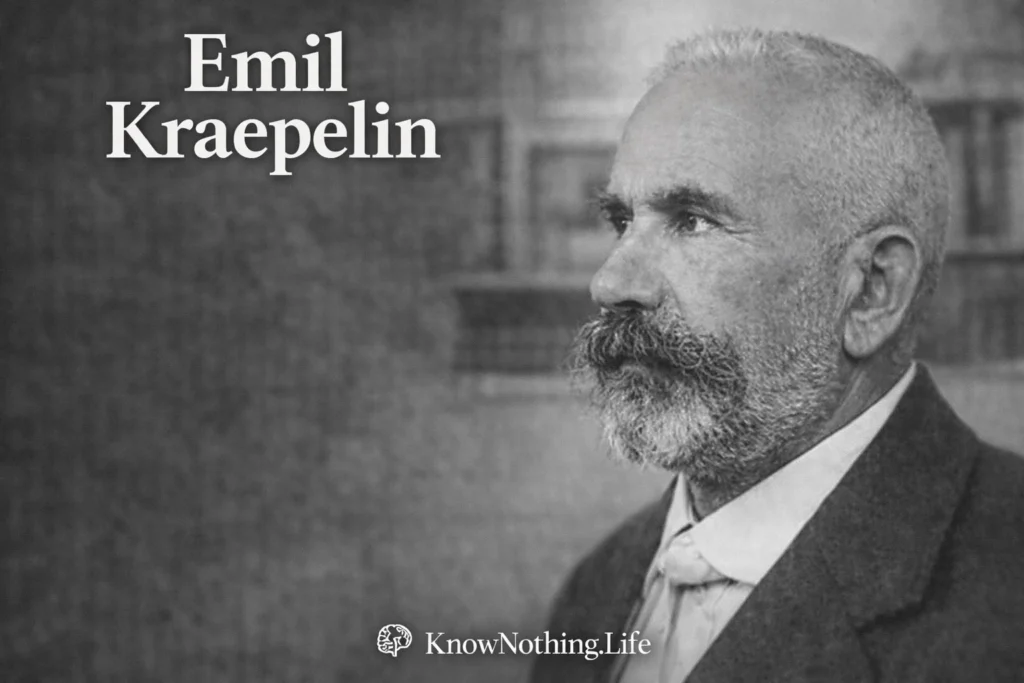
Few figures in the history of psychiatry have shaped modern diagnosis as profoundly as Emil Kraepelin. Often called the father of modern psychiatry, Kraepelin transformed the study of mental illness by insisting that psychiatric disorders should be understood through careful clinical observation, long-term course, outcome, and biological foundation. At a time when psychiatry was still dominated by vague categories, asylum descriptions, and speculative theories, he argued that mental disorders could be classified with the same seriousness used in the rest of medicine.
Kraepelin’s influence remains deeply embedded in modern psychiatry. His distinction between dementia praecox, later renamed schizophrenia, and manic-depressive illness, now associated with bipolar and mood disorders, became one of the central organizing ideas of twentieth-century psychiatric classification. His methods helped move psychiatry away from broad symptom labels and toward diagnostic systems based on patterns over time. Even when modern psychiatry revises, debates, or rejects parts of his system, it still works in the long shadow of what is often called the Kraepelinian tradition.
Early Life and Medical Formation
Emil Wilhelm Georg Magnus Kraepelin was born on February 15, 1856, in Neustrelitz, Germany. He grew up during a period when medicine, biology, and experimental psychology were rapidly changing. German universities were becoming centers of scientific research, and psychiatry was beginning to separate itself from moral philosophy and custodial asylum care. Kraepelin entered medicine at a time when the question of mental illness was still unsettled: were psychiatric disorders diseases of the brain, disturbances of the soul, moral failures, or temporary emotional states?
Kraepelin studied medicine at several universities and received his medical degree from the University of Würzburg in 1878. He was influenced by neurology, neuropathology, and especially experimental psychology. His contact with Wilhelm Wundt, one of the founders of experimental psychology, helped shape his belief that mental processes could be studied systematically rather than merely interpreted. This scientific discipline became one of the defining features of his work. Kraepelin did not want psychiatry to rely on impressions alone. He wanted observation, comparison, record-keeping, and prediction.
Psychiatry as a Medical Science
Kraepelin’s central ambition was to make psychiatry a true branch of medical science. He believed mental disorders should be studied like other illnesses: by observing symptoms, tracing their development, identifying patterns, and eventually discovering biological causes. This medical orientation separated him from approaches that treated madness as a purely moral, spiritual, or philosophical problem.
His major early work, Compendium der Psychiatrie, first published in 1883, introduced the diagnostic thinking that he would continue refining throughout his career. The book later expanded through multiple editions into a vast psychiatry textbook. Kraepelin repeatedly revised his classifications as he gathered new clinical evidence. That willingness to revise was crucial. He did not view diagnosis as a fixed list of names, but as an evolving scientific map that should become more accurate as evidence accumulated.
One statement associated with his mature method described a “decisive step from a symptomatic to a clinical view of insanity.” That phrase captures his importance. Instead of classifying patients only by what symptoms they showed at one moment, Kraepelin emphasized the course of the illness over time. A hallucination, delusion, depression, or excited state mattered, but it mattered most when placed within the larger pattern of onset, progression, remission, relapse, and outcome.
The Clinical Course Method
Kraepelin’s greatest methodological contribution was his insistence that psychiatric diagnosis must consider longitudinal course. Many earlier systems grouped patients according to visible symptoms: mania, melancholia, paranoia, confusion, or insanity. Kraepelin believed these labels were often misleading because different illnesses could produce similar symptoms at a given moment. A patient’s long-term development told a deeper story than a single clinical snapshot.
He kept detailed records of patients and studied how their conditions changed across months and years. This led him to classify disorders not merely by appearance but by prognosis. If two patients both experienced psychosis, but one showed progressive deterioration while the other experienced recurring episodes followed by recovery, Kraepelin considered them likely to suffer from different disease processes. He believed that prediction was the beginning of scientific mastery in psychiatry. As he wrote in substance, the ability to predict the future development of an illness marked the first step toward a practical understanding of the clinical picture.
This approach gave psychiatry a new structure. It encouraged doctors to observe carefully, gather histories, compare outcomes, and distinguish between disorders that looked alike on the surface. Modern diagnosis still reflects this principle. Clinicians do not classify mental disorders only by one symptom, but by duration, pattern, impairment, recurrence, exclusion, and expected course.
Dementia Praecox and Schizophrenia
Kraepelin’s most famous diagnostic category was dementia praecox. The term referred to a severe mental disorder that often appeared relatively early in life and tended, in Kraepelin’s view, toward chronic deterioration. He grouped together conditions such as hebephrenia, catatonia, and paranoid forms under this broader category because he believed they shared a similar course and outcome.
This concept later became central to the development of schizophrenia. Eugen Bleuler, a Swiss psychiatrist, introduced the term schizophrenia in 1911, partly because he believed Kraepelin’s term dementia praecox was too narrow and pessimistic. Not all patients deteriorated in the way Kraepelin expected, and not all cases began early. Still, Kraepelin’s grouping of these psychotic conditions created the foundation upon which Bleuler and later psychiatry built.
Kraepelin’s concept of dementia praecox also reveals both his genius and his limitation. He saw patterns others had missed, but his biological assumptions sometimes exceeded the available evidence. He believed the disorder likely reflected organic changes in the brain, but he did not possess the tools to identify those causes. His classification was powerful, but not final. Modern psychiatry continues to wrestle with the boundaries of schizophrenia, psychosis, and mood disorders in ways that began with Kraepelin’s original problem.
Manic-Depressive Illness
Kraepelin’s second great category was manic-depressive illness. Unlike dementia praecox, which he associated with deterioration, manic-depressive illness involved recurring disturbances of mood that could include mania, depression, mixed states, and periods of recovery. He used the category broadly, incorporating conditions earlier described as mania, melancholia, circular insanity, and periodic insanity.
In Manic-Depressive Insanity and Paranoia, Kraepelin described manic-depressive illness as including “the whole domain of so-called periodic and circular insanity.” This quote shows how broad his concept was. He did not restrict the illness to what modern clinicians would call bipolar disorder alone. Instead, he viewed many recurring mood disturbances as expressions of one large morbid process.
This was one reason his classification became so influential. Kraepelin recognized that mood disorders often unfold cyclically and that mania and depression may belong to a related pattern rather than entirely separate diseases. Modern psychiatry has narrowed and revised his category, but his insight that mood disorders must be understood across time remains foundational.
Major Works and Intellectual Contributions
Kraepelin’s major works shaped psychiatric education for generations. Compendium der Psychiatrie established his early system and began the long series of revisions that made his textbook one of the most influential works in medical psychiatry. Later editions of his psychiatry textbook became increasingly detailed, reflecting decades of clinical observation.
His English-language works, including Dementia Praecox and Paraphrenia and Manic-Depressive Insanity and Paranoia, introduced broader audiences to his mature diagnostic categories. These texts helped spread Kraepelinian psychiatry beyond Germany and made his distinction between chronic psychotic deterioration and episodic mood illness central to international psychiatric thought.
Kraepelin also contributed to psychopharmacology and experimental psychology. He studied the effects of alcohol, fatigue, and drugs on mental performance, showing interest not only in diagnosis but in measurable psychological functioning. His broader scientific vision connected psychiatry with biology, psychology, neurology, and laboratory research.
Criticism and Limitations
Kraepelin’s system has been enormously influential, but it has also faced serious criticism. One major criticism is that his dichotomy between dementia praecox and manic-depressive illness may be too rigid. Many patients show symptoms crossing the boundaries between psychotic and mood disorders. Conditions such as schizoaffective disorder, psychotic depression, bipolar disorder with psychosis, and spectrum models of mental illness all complicate the clean division Kraepelin proposed.
Another criticism concerns his biological certainty. Kraepelin believed mental illnesses were disease entities with underlying biological causes, but the science of his time could not prove those causes. Modern psychiatry still struggles to connect diagnostic categories with precise biological mechanisms. In that sense, Kraepelin’s dream remains unfinished. He gave psychiatry a medical model before psychiatry had the biological evidence needed to fully support it.
Still, his limitations should be understood historically. Kraepelin was not wrong to seek biological explanation. He was working before genetics, neuroimaging, modern pharmacology, and contemporary neuroscience. His classification was not the final truth about mental illness, but it was a major step toward systematic diagnosis.
Legacy and Lasting Influence
Emil Kraepelin died on October 7, 1926, in Munich, but his influence continued to shape psychiatry throughout the twentieth century. The modern diagnostic impulse behind systems such as the DSM and ICD owes much to Kraepelin’s belief that mental disorders should be classified by observable patterns, clinical course, and diagnostic reliability. Even when modern psychiatry criticizes “neo-Kraepelinian” diagnosis, it is still debating the framework he helped create.
His legacy is especially visible in the continued distinction between schizophrenia-spectrum disorders and mood disorders. That distinction has been revised, challenged, and complicated, but it remains central to psychiatric practice. Kraepelin gave psychiatry a language for separating conditions that earlier clinicians often merged together under broad labels of insanity.
Kraepelin’s greatest contribution was not simply inventing names for disorders. It was changing how psychiatrists think. He taught the field to look beyond dramatic symptoms and ask deeper clinical questions: How did the illness begin? How does it progress? Does it remit? Does it recur? What is the outcome? What pattern does the whole life of the illness reveal?
Final Thoughts
To study Emil Kraepelin is to study the beginning of modern psychiatric classification. He brought order to a field that badly needed structure and gave psychiatry a method grounded in observation, course, and outcome. His categories were imperfect, but his scientific ambition transformed mental medicine.
Kraepelin’s work remains important because psychiatry still lives with the questions he raised. Are mental disorders distinct disease entities or overlapping spectra? Should diagnosis be based on symptoms, course, biology, genetics, or lived experience? How can clinicians classify suffering without reducing the person to a label? Kraepelin did not answer all of these questions, but he forced psychiatry to ask them scientifically. His legacy endures because he turned the classification of mental illness into one of medicine’s central intellectual challenges.