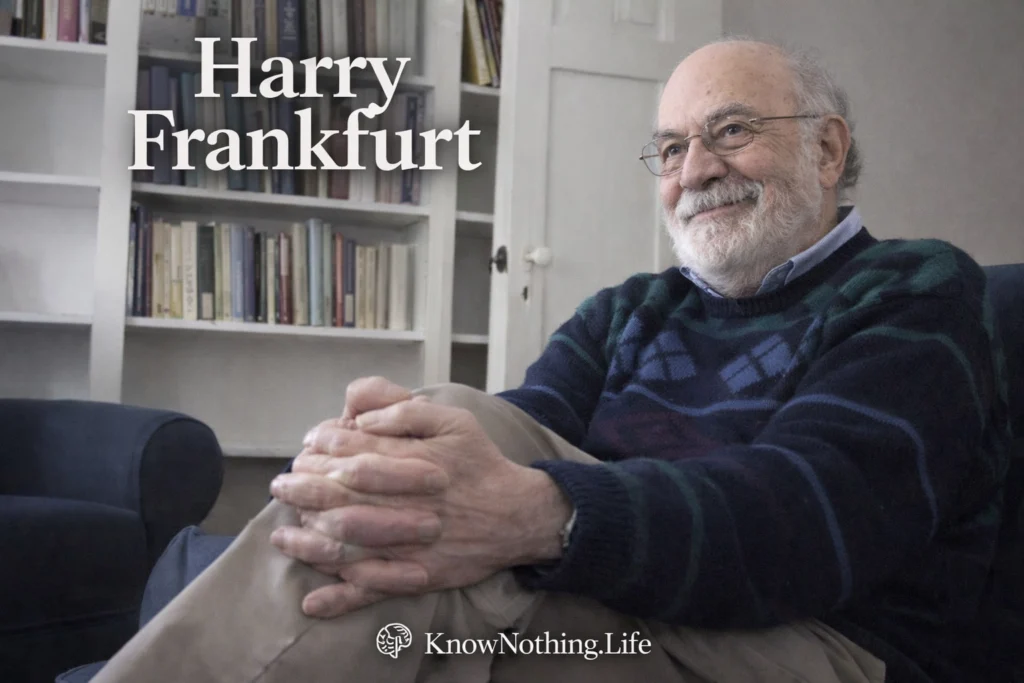
Harry Gordon Frankfurt was born on May 29, 1929, and grew up in Brooklyn and Baltimore. He was raised by his adoptive parents, Bertha and Nathan Frankfurt, in a household far removed from the public fame he would later receive as one of America’s most distinctive moral philosophers. His interest in philosophy began early, reportedly sparked in high school when he encountered the essays of Bertrand Russell. That discovery opened the path toward a lifetime of reflection on freedom, responsibility, truth, love, and the hidden structure of the human will.
Frankfurt earned both his bachelor’s degree and Ph.D. from Johns Hopkins University, completing his doctorate in 1954. After serving in the U.S. Army from 1954 to 1956, he began his academic career at Ohio State University. He later taught at institutions including the State University of New York at Binghamton, Rockefeller University, Yale University, and Princeton University. At Yale, he chaired the philosophy department from 1978 to 1987. In 1990, he joined Princeton’s faculty, where he became professor of philosophy and later professor emeritus.
Descartes, Reason, and Philosophical Style
Before Frankfurt became publicly known for On Bullshit, he was already respected among philosophers for his work on Descartes, moral psychology, and the philosophy of action. His book Demons, Dreamers, and Madmen: The Defense of Reason in Descartes’ Meditations, published in 1970, offered a powerful interpretation of Descartes’ struggle against skepticism. Frankfurt was interested not merely in whether Descartes’ arguments worked, but in what they revealed about the human need for certainty, order, and rational self-possession.
His philosophical style was unusually clean, direct, and psychologically perceptive. Frankfurt did not write like a system builder trying to explain everything from one grand principle. He wrote like someone examining a familiar human experience until it became strange, precise, and newly visible. His essays often begin with ordinary questions: What does it mean to act freely? What is the difference between lying and bullshitting? What do we care about? Why does love matter? From these simple openings, he developed arguments that reshaped major areas of twentieth-century philosophy.
Free Will and the Concept of a Person
Frankfurt’s most influential essay, “Alternate Possibilities and Moral Responsibility,” published in 1969, challenged a long-standing assumption in debates about free will. The assumption, often called the Principle of Alternate Possibilities, says that a person is morally responsible for what he has done only if he could have done otherwise. Frankfurt’s famous counterexamples argued that moral responsibility does not always depend on open alternatives. A person may be responsible for an action even if, unknown to him, circumstances would have prevented any different choice.
These examples became known as “Frankfurt cases,” and they changed the free will debate permanently. Frankfurt’s point was not that freedom is unimportant, but that responsibility depends more deeply on the source of action than on the bare availability of alternatives. In a later autobiographical reflection, he summarized his view by saying that what matters is whether the action was one the agent “really wanted to perform,” not whether the agent could have done something else instead. That shift moved moral philosophy away from a simple question of possible alternatives and toward the inner structure of the will.
First-Order Desires, Second-Order Desires, and the Self
Frankfurt’s 1971 essay “Freedom of the Will and the Concept of a Person” deepened this account. He distinguished between first-order desires and second-order desires. A first-order desire is a desire to do something, such as eating, leaving, speaking, drinking, or resting. A second-order desire is a desire about one’s desires: the desire to want something, or the desire not to be moved by a certain impulse. This distinction gave philosophy a powerful way to describe divided will, addiction, weakness, self-command, and integrity.
For Frankfurt, personhood involves more than having desires. Animals may have immediate desires, but persons can reflect on which desires they want to govern them. A person becomes free in a deeper sense when the desire that moves him is one with which he identifies. This is why Frankfurt’s work became so important in moral psychology. He showed that freedom is not merely doing what one wants. It is having a will that is, in some sense, one’s own. The human self is not just a bundle of impulses; it is a reflective structure of cares, endorsements, conflicts, and commitments.
Caring, Love, and Necessity
Frankfurt’s later work increasingly focused on caring and love. In The Importance of What We Care About, published in 1988, and Necessity, Volition, and Love, published in 1999, he argued that a person’s identity is shaped by what matters to them. We do not become ourselves simply by choosing from neutral options. We become ourselves through commitments that organize our attention, effort, loyalty, and future. What we care about gives our lives structure. It creates reasons for action and gives weight to some possibilities over others.
In The Reasons of Love, Frankfurt argued that love is not merely a feeling or preference. Love is a form of caring that binds the will. To love something is to have one’s life partly organized around its good. This made love central to his moral philosophy. Love provides final ends, not just instrumental goals. It tells us what is worth protecting, pursuing, and remaining faithful to. Frankfurt’s later philosophy therefore moved from free will to a deeper question: not only whether we are free to choose, but what gives our choices importance in the first place.
On Bullshit and the Enemy of Truth
Frankfurt reached a much wider public with On Bullshit, published as a small book in 2005 after earlier appearing as an essay. The book became an unexpected bestseller, partly because of its provocative title, but also because it captured something real about public language. Frankfurt argued that bullshit is not the same as lying. A liar still cares about the truth, if only to conceal it. The bullshitter is more dangerous in a different way because he is indifferent to whether what he says is true or false.
His most famous line from the book is that “bullshit is a greater enemy of the truth than lies are.” The reason is that lying still recognizes truth as important; bullshit erodes concern for truth altogether. This made Frankfurt’s analysis especially relevant to politics, advertising, media, academic language, and everyday self-presentation. He followed the book with On Truth in 2006, insisting that human beings cannot live intelligently without respect for reality. For Frankfurt, truth was not a decorative ideal. It was a condition of responsible thought and meaningful life.
Major Works and Intellectual Range
Frankfurt’s major works include Demons, Dreamers, and Madmen, The Importance of What We Care About, Necessity, Volition, and Love, On Bullshit, On Truth, Taking Ourselves Seriously and Getting It Right, The Reasons of Love, and On Inequality. Across these works, he returned again and again to the same deep concern: what does it mean for a person to be genuinely aligned with himself? His topics ranged from Descartes to moral responsibility, from freedom to love, from truth to economic equality, but the central focus remained the human will.
His later book On Inequality challenged the assumption that economic equality is always the central moral ideal. Frankfurt argued that what matters most is not whether everyone has the same, but whether people have enough. This view, like many of his arguments, was controversial because it refused familiar slogans. Frankfurt was not interested in fashionable agreement. He wanted to clarify what we actually mean when we talk about freedom, truth, love, responsibility, and justice.
Legacy and Lasting Importance
Harry Frankfurt died on July 16, 2023, in Santa Monica, California, at the age of ninety-four. By then, he had become one of the most widely read American philosophers of his generation. Among specialists, he remained influential for Frankfurt cases, second-order desires, and his work on moral responsibility. Among general readers, he became famous for explaining bullshit with analytic seriousness. Both sides of his reputation belong together. He had a rare ability to bring philosophical rigor to ordinary human concerns.
Frankfurt’s lasting importance lies in his insistence that human beings are defined by what they care about. We are not merely creatures with desires; we are creatures who evaluate our desires. We do not merely speak truly or falsely; we reveal whether truth matters to us. We do not merely choose; we identify, commit, love, and take responsibility. Frankfurt’s philosophy asks us to look inward without sentimentality and outward without illusion. It remains powerful because it treats the inner life as something disciplined, morally serious, and worth understanding.