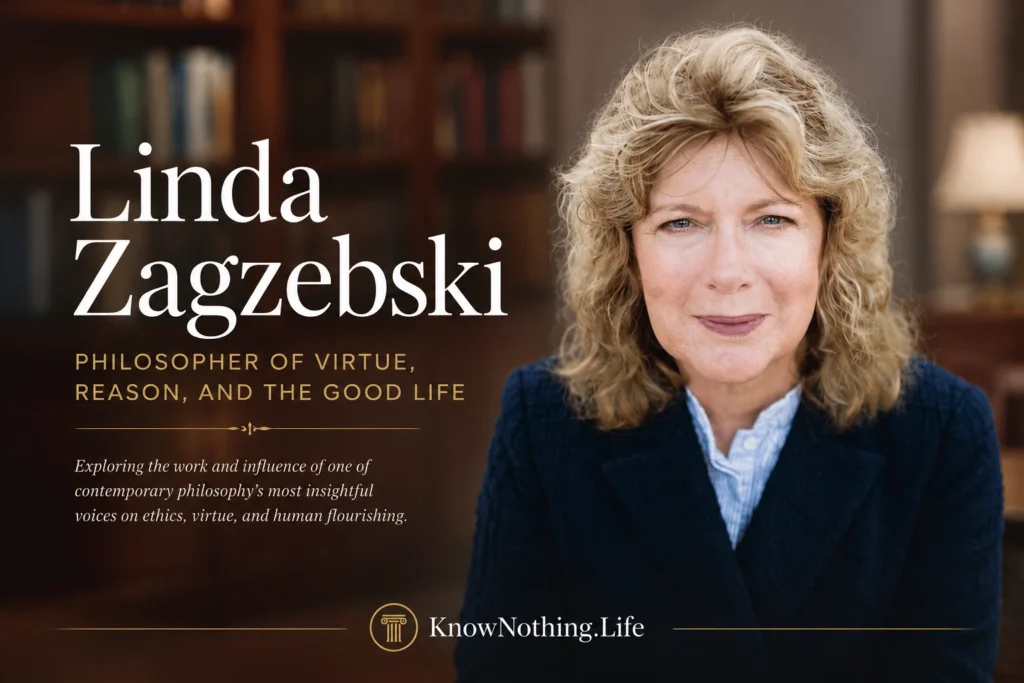
Linda Trinkaus Zagzebski is one of the most influential philosophers of contemporary epistemology, virtue ethics, and philosophy of religion. A native Californian, she entered philosophy through a path that joined technical analytic rigor with older questions about wisdom, faith, moral character, and the shape of a good human life. Her work stands out because she did not treat knowledge as a cold relation between belief and evidence alone. She asked what kind of person a knower must become, what intellectual virtues make truth-seeking admirable, and why trust is not a weakness but an unavoidable part of rational life.
Zagzebski earned her B.A. from Stanford University, her M.A. from the University of California, Berkeley, and her Ph.D. in philosophy from the University of California, Los Angeles. Her dissertation, completed in 1979 under Tyler Burge, was titled Natural Kinds. She taught at Loyola Marymount University for twenty years before moving to the University of Oklahoma, where she became George Lynn Cross Research Professor and Kingfisher College Chair of the Philosophy of Religion and Ethics. Over time, she became known not only as a major philosopher of religion, but as one of the central architects of contemporary virtue epistemology.
Philosophy of Religion, Freedom, and Foreknowledge
Zagzebski’s early work was shaped by philosophy of religion, especially questions about divine knowledge, human freedom, rational faith, and the problem of evil. Her book The Dilemma of Freedom and Foreknowledge, published in 1991, examined one of the oldest puzzles in philosophical theology: if God infallibly knows what a person will do, in what sense is that person free? The problem is not merely religious. It forces philosophers to ask what freedom means, whether the future can be known, and how responsibility can survive in a world where truth about future action may already exist.
This early work showed Zagzebski’s gift for connecting metaphysical puzzles with moral and existential seriousness. She was not interested in abstract paradox for its own sake. Questions about foreknowledge, fatalism, and divine action mattered because they touched the meaning of agency. Later works such as Divine Motivation Theory and Philosophy of Religion: An Historical Introduction continued this pattern. She treated religion as a field where metaphysics, ethics, epistemology, and human longing meet. Her philosophy of religion did not retreat from analytic clarity, but it refused to make religious thought emotionally or morally thin.
Virtues of the Mind
Zagzebski’s most influential book, Virtues of the Mind: An Inquiry into the Nature of Virtue and the Ethical Foundations of Knowledge, was published in 1996. It became a landmark in virtue epistemology, a movement that shifts attention from isolated beliefs to the intellectual character of the believer. Traditional epistemology often asked whether a belief was justified, reliable, properly caused, or immune from skepticism. Zagzebski asked a deeper question: what kind of intellectual person forms good beliefs? Her answer placed virtues such as open-mindedness, intellectual courage, intellectual humility, fairness, perseverance, and love of truth at the center of knowledge.
One of her most quoted definitions is that a virtue is “a deep and enduring acquired excellence of a person.” This definition matters because it makes virtue more than a technique or habit. A virtue is a stable excellence of character, shaped by motivation and success. For Zagzebski, intellectual virtues have both a desire for intellectual goods, such as truth and understanding, and a reliable ability to achieve them. Her theory links epistemology with ethics because knowing well is part of living well. A careless, arrogant, cowardly, or intellectually dishonest person may still stumble into true beliefs, but that is not the model of knowledge at its best.
Knowledge, Gettier Problems, and Intellectual Virtue
Zagzebski also became important for her work on the Gettier problem. Since Edmund Gettier’s 1963 paper, philosophers had struggled with cases in which a person has a justified true belief but still seems not to possess knowledge because the truth is reached by luck. Zagzebski argued that many attempts to fix the traditional justified-true-belief model are vulnerable to the same kind of problem. If justification and truth are only externally attached, lucky success can always return. This pushed her toward a virtue-based account in which knowledge arises from the right kind of intellectual agency.
Her own formulation is often summarized through the idea that knowledge is a true belief arising from acts of intellectual virtue. In other words, knowledge is not merely true belief plus a separate ingredient called justification. It is cognitive success because of intellectual excellence. This makes knowledge similar to other achievements. A good archer does not merely hit the target by accident; the shot succeeds because of skill. Likewise, the knower reaches truth through intellectual character and competence. Zagzebski’s approach helped make virtue epistemology one of the major alternatives to reliabilism, internalism, and traditional foundationalism.
Epistemic Authority and Rational Trust
In Epistemic Authority: A Theory of Trust, Authority, and Autonomy in Belief, published in 2012, Zagzebski turned to the role of trust in knowledge. Modern culture often treats autonomy as thinking entirely for oneself, but Zagzebski challenged that picture. No person can verify everything directly. We depend on teachers, scientists, historians, doctors, witnesses, translators, communities, and traditions. The question is not whether we trust authority, but how we trust it responsibly. Her work argued that trust in others can be part of rational autonomy rather than a surrender of it.
This was especially important in a world of expert disagreement, religious diversity, science communication, and public mistrust. Zagzebski’s theory began from epistemic self-trust: the trust a person has in their own cognitive faculties. But if I trust myself, and I recognize that others often have abilities, evidence, or expertise I lack, then rational consistency may require some trust in others. This does not mean blind obedience. It means that intellectual maturity includes knowing when another person or community has authority. Zagzebski made epistemology more social without making it merely social.
Exemplarist Moral Theory
Zagzebski’s Exemplarist Moral Theory, published in 2017, extended her virtue-centered thought into ethics. Instead of beginning moral theory with abstract rules, consequences, duties, or definitions of the good, she began with admirable persons. We first encounter goodness in examples: heroes, saints, sages, courageous friends, honest teachers, compassionate caregivers, and people whose lives draw our admiration. Her theory uses admiration as a moral starting point, arguing that we identify exemplars through reflective admiration and then understand moral concepts by reference to them.
Her account of admiration is central. She wrote that admiration is an emotion in which the object is “seen as admirable” and which motivates emulation. That idea gives moral theory a practical force. Ethics is not only about deciding what propositions are true; it is about learning whom to imitate and what kind of person to become. In this way, Zagzebski revived an ancient moral insight in a modern analytic form. Human beings learn virtue not only from rules, but from lives. The people we admire help teach us what courage, wisdom, generosity, holiness, and integrity look like in action.
Major Works and Later Thought
Zagzebski’s major works include The Dilemma of Freedom and Foreknowledge, Virtues of the Mind, Divine Motivation Theory, Philosophy of Religion: An Historical Introduction, On Epistemology, Epistemic Authority, Exemplarist Moral Theory, Epistemic Values, God, Knowledge, and the Good, and The Two Greatest Ideas: How Our Grasp of the Universe and Our Minds Changed Everything. Her collected papers and later books show the range of her thought across epistemology, ethics, religious epistemology, theological metaphysics, and the history of ideas.
In The Two Greatest Ideas, published in 2021, Zagzebski turned to a broader civilizational theme: the idea that the human mind can grasp the universe and the idea that the human mind can grasp itself. She suggested that modern culture has been shaped by the tension between these two ideas, and she expressed hope for a third great idea: that the human mind can grasp other minds. This later work fits naturally with her long philosophical career. From virtue epistemology to epistemic authority to exemplarism, she has repeatedly argued that truth is not only a private achievement. It is also interpersonal, moral, and formed through relations of trust, admiration, and shared inquiry.
Legacy and Lasting Importance
Linda Zagzebski’s legacy lies in her ability to reunite areas of philosophy that modern specialization often separates. She connected knowledge with virtue, trust with autonomy, faith with reason, admiration with moral theory, and intellectual character with the pursuit of truth. Her work helped make virtue epistemology one of the most important movements in late twentieth- and early twenty-first-century philosophy. It also gave philosophers of religion a model of how religious questions can be treated with analytic discipline while remaining connected to moral and spiritual life.
Her lasting importance comes from a simple but powerful insight: knowing is something persons do. It is not merely a mechanical relation between evidence and belief. It involves motives, habits, courage, humility, fairness, trust, and the ability to recognize excellence in others. Zagzebski changed epistemology by asking not only what makes a belief justified, but what makes a believer admirable. In doing so, she helped restore wisdom to the center of philosophical inquiry.