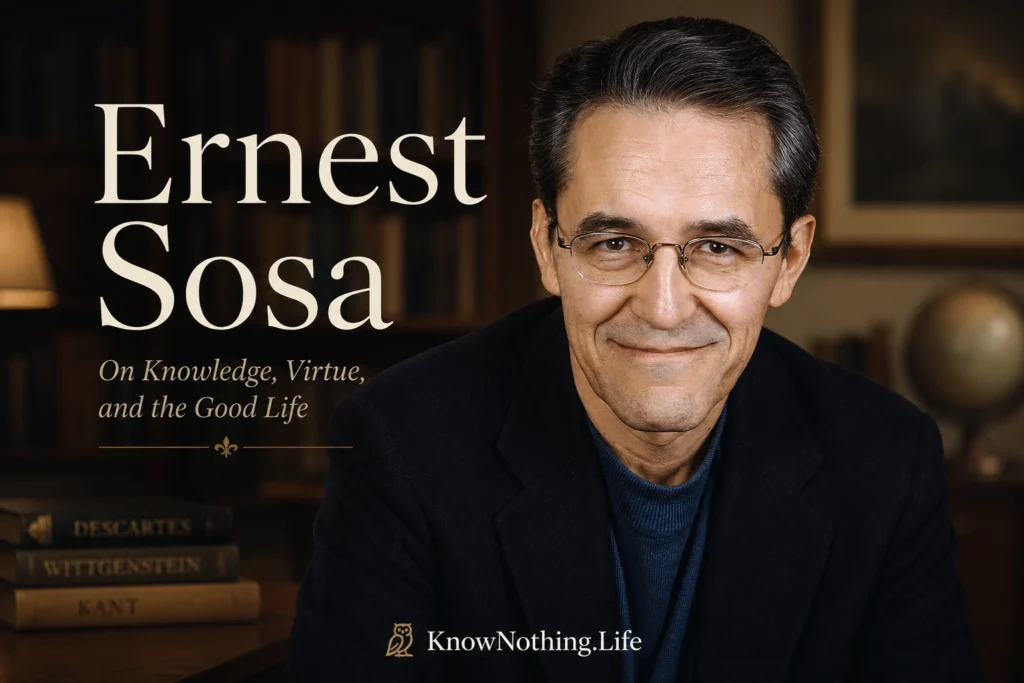
Ernest Sosa was born on June 17, 1940, in Cárdenas, Cuba, and became one of the most important epistemologists of the late twentieth and early twenty-first centuries. His philosophical career has centered on one of the oldest questions in human thought: what does it mean to know something? Sosa’s importance lies in the way he changed that question. Instead of treating knowledge only as a relationship between belief, truth, and justification, he asked what kind of intellectual performance knowledge is. Is knowing more like possessing a static proof, or more like succeeding through skill?
Sosa earned his B.A. from the University of Miami in 1961 and his Ph.D. from the University of Pittsburgh in 1964. At Pittsburgh, he studied in an intellectually rich environment shaped by figures such as Nicholas Rescher and Wilfrid Sellars. That training placed him at the center of analytic philosophy, but Sosa would later develop a style that was distinctively his own: technical, exact, historically informed, and unusually systematic. He joined Brown University in the 1960s and remained there for more than four decades before moving to Rutgers University, where he became Board of Governors Professor of Philosophy.
Brown University, Rutgers, and a Life in Epistemology
At Brown, Sosa became a major figure in American philosophy. He worked in epistemology, metaphysics, philosophy of mind, and moral epistemology, but his deepest influence came through the theory of knowledge. Brown was also the intellectual home of Roderick Chisholm, whose work on epistemic justification, the problem of the criterion, and internalist epistemology shaped many mid-century debates. Sosa inherited those debates but did not simply continue them. He wanted to move beyond the stalemate between rival theories of justification.
Later, at Rutgers, Sosa joined one of the strongest epistemology programs in the world. Rutgers philosophy became associated with major work on knowledge, skepticism, evidence, reliability, disagreement, and the norms of belief. Sosa’s presence helped anchor that reputation. He also played a major editorial role in the profession, serving as editor of Philosophy and Phenomenological Research, Noûs, and Philosophical Issues. His influence therefore came not only from his own books and essays, but from the way he shaped philosophical conversation across generations.
The Raft and the Pyramid
Sosa’s 1980 essay “The Raft and the Pyramid: Coherence versus Foundations in the Theory of Knowledge” is one of the landmarks of contemporary epistemology. Its title captures a dispute that had dominated the field. Foundationalists imagined knowledge as a pyramid resting on secure basic beliefs. Coherentists imagined justification more like a raft, supported by the mutual relations among beliefs rather than by an unquestionable foundation. Sosa saw power and weakness in both images. The pyramid promised security but risked dogmatism. The raft allowed mutual support but risked floating without anchor.
In that essay, Sosa wrote, “There are two key questions of the theory of knowledge: What do we know? How do we know?” The simplicity of those questions concealed the difficulty of the project. Sosa’s solution was to shift attention from the structure of beliefs alone to the virtues or competences of the believer. The knower is not merely a container of justified propositions. The knower is an intellectual agent whose faculties, abilities, and performances can succeed or fail. This move helped launch contemporary virtue epistemology.
Virtue Epistemology
Virtue epistemology is the view that knowledge should be understood through intellectual virtues, competences, or excellences. In Sosa’s version, these virtues are not only moral qualities such as humility or courage, although those may matter. They are also reliable cognitive abilities: perception, memory, inference, introspection, and intellectual judgment when functioning properly in appropriate conditions. A person knows when their true belief is not lucky, but the result of a competence successfully aimed at truth.
This transformed the Gettier problem, one of the central puzzles of modern epistemology. Gettier cases show that justified true belief can still fall short of knowledge when truth is reached by luck. Sosa’s approach explains why: knowledge is not merely a true belief that happens to be justified. It is a true belief because of intellectual competence. A good archer does not merely hit the target by accident; the shot is successful because it manifests skill. Likewise, the knower reaches truth through a reliable intellectual ability. Sosa made knowledge look less like possession and more like achievement.
Accuracy, Adroitness, and Aptness
One of Sosa’s most famous contributions is the AAA structure: accuracy, adroitness, and aptness. A performance is accurate when it achieves its aim. It is adroit when it manifests competence. It is apt when it succeeds because of that competence. A shot can be accurate if it hits the target, adroit if it is skillfully made, and apt if it hits the target because it was skillfully made. Sosa applied this structure to belief. A belief is accurate if it is true, adroit if it manifests intellectual competence, and apt if it is true because competent.
This model gave epistemology a clear way to explain why luck undermines knowledge. If a person believes the truth by accident, the belief may be accurate but not apt. If a person reasons skillfully but happens to be misled by abnormal conditions, the belief may be adroit but not accurate. Knowledge requires the right connection between success and ability. This is why Sosa’s work became so influential. It gave philosophers a vocabulary for evaluating belief as a performance, while preserving the traditional idea that knowledge is deeply connected to truth.
Animal Knowledge and Reflective Knowledge
In A Virtue Epistemology: Apt Belief and Reflective Knowledge, published in 2007, Sosa developed a distinction between animal knowledge and reflective knowledge. Animal knowledge is basic apt belief: a belief that is true because it arises from a reliable competence. A person may know that there is a tree ahead because vision is functioning well in normal conditions. The person does not need to run through a philosophical proof of perception. The belief succeeds through competence.
Reflective knowledge adds another level. It involves not only having an apt belief, but having an appropriate perspective on one’s own reliability, situation, and method. Reflective knowledge is knowledge with epistemic self-awareness. This distinction allowed Sosa to respond to skepticism without demanding impossible certainty. Ordinary creatures can know the world through competent faculties, while reflective thinkers can assess whether those faculties are trustworthy in context. Sosa’s theory therefore preserves ordinary knowledge while respecting philosophy’s demand for reflection.
Skepticism, Safety, and Intellectual Perspective
Sosa’s work on skepticism is central to his importance. Skeptics ask whether we can know anything about the external world, other minds, the past, or even our own reasoning. Sosa did not dismiss skepticism as foolish. He treated it as a serious pressure test for theories of knowledge. His virtue epistemology responds by asking whether belief is formed through competences operating in suitable environments. The skeptic imagines conditions in which our faculties would fail, but the mere possibility of error does not show that ordinary knowledge disappears.
Sosa also contributed to debates about safety, sensitivity, contextualism, disagreement, intuition, and philosophical methodology. His later work defended the role of intuitions in philosophy while trying to understand them through epistemic competence. Philosophers, on this view, are not simply reporting private feelings. At their best, they exercise trained judgment about cases, concepts, and implications. Whether one accepts this defense or not, Sosa’s approach made philosophical method itself part of epistemology. He asked not only how ordinary people know, but how philosophers know when they philosophize.
Major Works and Lasting Legacy
Sosa’s major works include Knowledge in Perspective: Selected Essays in Epistemology, A Virtue Epistemology: Apt Belief and Reflective Knowledge, Reflective Knowledge: Apt Belief and Reflective Knowledge, Volume II, Knowing Full Well, Judgment and Agency, and Epistemology. His essays, including “The Raft and the Pyramid,” “How to Defeat Opposition to Moore,” and later writings on intuitions, disagreement, and reflective knowledge, helped define the agenda of contemporary epistemology. He also received major recognition for his contributions, including the Rolf Schock Prize in Logic and Philosophy.
Ernest Sosa’s lasting importance lies in his ability to make knowledge active. He showed that knowing is not merely having a belief that fits the world. It is a kind of success through intellectual competence. This achievement-based view brought together questions about truth, ability, luck, agency, and reflection. It gave epistemology a way to move beyond older battles between foundationalism and coherentism, internalism and externalism, skepticism and common sense. Sosa remains essential because he helped philosophy see the knower not as a passive spectator, but as a skilled intellectual performer aiming at truth.