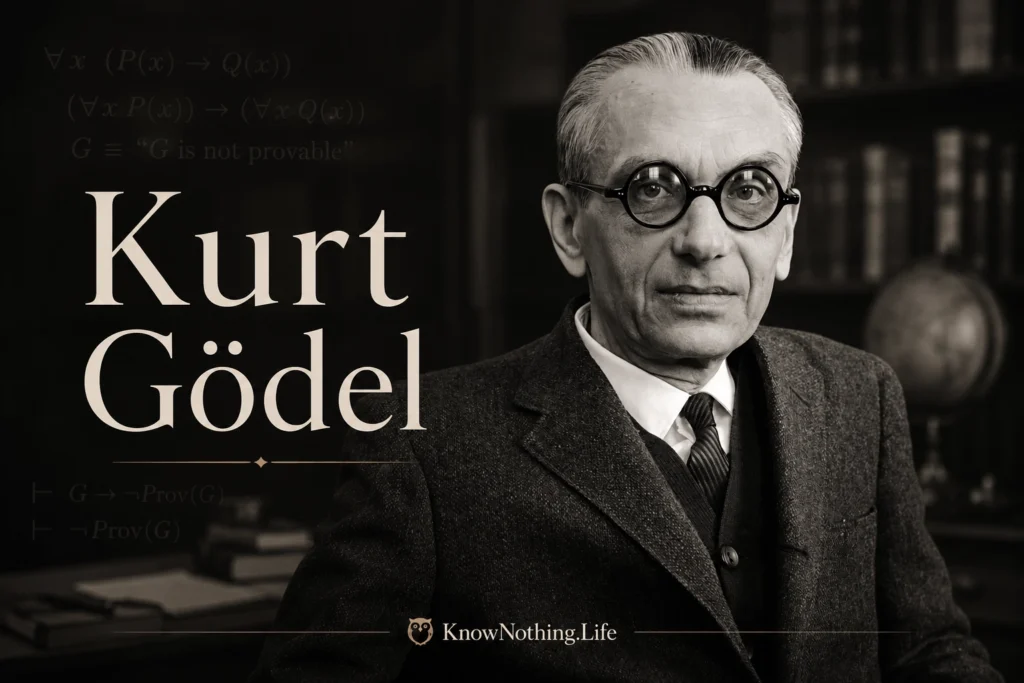
Kurt Friedrich Gödel was born on April 28, 1906, in Brünn, Austria-Hungary, now Brno in the Czech Republic. He grew up in a prosperous German-speaking family, the son of Rudolf Gödel, a textile manager, and Marianne Handschuh Gödel. As a child, he was known in the family as “Mr. Why” because of his constant questioning. That nickname fits the adult Gödel perfectly. His life’s work was driven by a relentless demand to know what can be proved, what can be known, and whether truth is larger than any system designed to capture it.
Gödel entered the University of Vienna in 1924, originally intending to study physics, but he soon moved toward mathematics and logic. Vienna in the 1920s was one of the world’s great intellectual centers, home to the Vienna Circle, logical positivism, mathematical formalism, and fierce debates about the foundations of knowledge. Gödel attended meetings of the Vienna Circle, but he never fully shared its empiricist suspicion of metaphysics. Even as a young man, he leaned toward realism and Platonism: the belief that mathematical truth is not invented by the human mind, but discovered.
The Completeness Theorem
Gödel’s doctoral dissertation, completed at the University of Vienna in 1929 and published in 1930, proved the completeness theorem for first-order logic. This result should not be confused with his later incompleteness theorems. The completeness theorem showed that first-order logic is complete in a specific technical sense: every logically valid formula can be proved from the formal rules of the system. It was a major achievement for a young scholar and helped establish Gödel as one of the most brilliant logicians of his generation.
The theorem mattered because it connected semantic truth with formal proof. If a statement is valid in every model of first-order logic, then there is a proof of it. This gave first-order logic a kind of harmony between truth and derivation. Yet almost immediately afterward, Gödel would prove that arithmetic and stronger mathematical systems do not enjoy such perfect harmony. His career therefore contains one of the great ironies of intellectual history: he first proved a powerful kind of completeness, then proved a deeper and more devastating incompleteness.
Hilbert’s Program and the Dream of Certainty
To understand Gödel’s revolution, one must understand the dream he interrupted. In the early twentieth century, the mathematician David Hilbert hoped to place all of mathematics on secure formal foundations. The goal was to show that mathematics could be formalized in axiomatic systems that were complete, consistent, and mechanically checkable. Every true mathematical statement would be provable, and the consistency of the system could be demonstrated by safe, finite methods. Hilbert’s famous confidence was often summarized by the phrase that in mathematics there is no “ignorabimus”—no final “we shall not know.”
Gödel did not attack mathematics from outside. He worked from within formal logic itself. His method was not rhetorical skepticism, but mathematical construction. By coding statements, proofs, and formulas as numbers, he allowed arithmetic to speak about its own provability. This technique, now called Gödel numbering, turned logic back upon itself. It made self-reference exact rather than merely paradoxical. The result was one of the most important discoveries in the history of thought.
The Incompleteness Theorems
In 1931, Gödel published “On Formally Undecidable Propositions of Principia Mathematica and Related Systems I.” The paper proved that any sufficiently strong, consistent, effectively axiomatized formal system capable of expressing arithmetic contains statements that cannot be proved or disproved within that system. In the language commonly used to summarize the result, there are propositions “neither provable nor refutable” inside the system. This was the first incompleteness theorem.
The second incompleteness theorem went even further. It showed that such a system cannot prove its own consistency from within itself, assuming it is in fact consistent. Together, the theorems shattered the strongest version of Hilbert’s program. Gödel did not prove that mathematics is meaningless, irrational, or unreliable. He proved something subtler and more profound: formal proof is not the same as mathematical truth. Any system strong enough to contain arithmetic has limits that cannot be overcome simply by making the system more careful.
Truth, Proof, and Mathematical Platonism
Gödel’s theorems changed philosophy because they separated truth from formal derivability. A statement may be true even if it cannot be proved within a given system. For Gödel, this supported a Platonist view of mathematics. Mathematical objects and truths were not merely human conventions or marks on paper. They had an objective reality that the mind could apprehend, even if no formal system could exhaust them. His famous line, “Either mathematics is too big for the human mind, or the human mind is more than a machine,” captures the philosophical force of his position.
This made Gödel a difficult figure for both formalists and positivists. He was a master of formal logic, yet he did not believe formal logic was the whole of reason. He admired rigorous proof, yet believed truth outruns proof. He lived among some of the most scientifically minded thinkers of the twentieth century, yet he remained open to metaphysics, rational intuition, and even theological arguments. Gödel’s mind was mathematical in method but philosophical in scope.
The Institute for Advanced Study and Einstein
Gödel first visited the Institute for Advanced Study in Princeton during the 1933–1934 academic year. Political turmoil in Europe increasingly disrupted his life, and in 1940 he and his wife Adele left Europe permanently, traveling through the Soviet Union and Japan before reaching the United States. He became associated with the Institute for Advanced Study for the rest of his career, eventually becoming Professor in the School of Mathematics and later Professor Emeritus.
At Princeton, Gödel developed a close friendship with Albert Einstein. The two men were very different in temperament, but they shared a belief in a rationally ordered reality and a dissatisfaction with purely conventional views of science. Einstein reportedly said that he came to the Institute mainly for the privilege of walking home with Gödel. Their friendship became one of the great symbolic pairings of modern intellect: Einstein had transformed space and time; Gödel had transformed truth and proof.
Set Theory, Time, and Later Work
Gödel’s later work extended far beyond incompleteness. In 1938 and 1940, he proved the relative consistency of the axiom of choice and the generalized continuum hypothesis with the standard axioms of set theory, assuming those axioms are consistent. This work introduced the constructible universe, often denoted L, and became foundational in modern set theory. Although Paul Cohen later proved the independence of the continuum hypothesis from standard set theory, Gödel’s contribution was essential to that larger story.
Gödel also made a surprising contribution to general relativity. In 1949, he found solutions to Einstein’s field equations describing rotating universes in which closed timelike curves are possible. In plain language, his models suggested that certain mathematically possible universes would allow paths through time that loop back on themselves. Gödel was fascinated by the philosophical implications of time, and his work challenged the idea that time is an absolute flow built into reality. Once again, he used mathematics to unsettle common assumptions.
Works, Personality, and Final Years
Gödel’s major works include his doctoral dissertation on completeness, the 1931 incompleteness paper, the set-theoretic papers on the axiom of choice and generalized continuum hypothesis, his essay “Russell’s Mathematical Logic,” his work on rotating universes, and writings later collected in volumes such as Collected Works. He published relatively little compared with some major mathematicians, but almost everything he did publish was deep. His work has influenced logic, mathematics, computer science, philosophy of mind, metaphysics, artificial intelligence, and the philosophy of mathematics.
Gödel’s private life was marked by anxiety, fragile health, and increasing paranoia. His wife Adele was a stabilizing presence, and when she became ill late in his life, his own condition worsened. He died in Princeton on January 14, 1978. The circumstances of his death were tragic, but they should not reduce him to eccentricity. Gödel was not important because he was strange. He was important because he saw, with unmatched clarity, that formal systems have boundaries.
Legacy and Lasting Importance
Kurt Gödel’s legacy is immense because his theorems changed the meaning of mathematical certainty. Before him, many thinkers hoped that mathematics could be captured by a complete formal system. After him, that hope had to be abandoned or radically revised. He showed that arithmetic contains depths no single mechanical procedure can exhaust. In doing so, he reshaped debates about computation, truth, mind, logic, and the foundations of science.
Gödel’s lasting importance lies in the distinction he forced the modern world to face: proof is powerful, but it is not identical with truth. Systems are necessary, but they are not final. Rules can generate knowledge, but they cannot contain all knowledge. His work remains one of the greatest achievements of human reason because it revealed reason’s own limits without destroying its dignity. Kurt Gödel did not make mathematics smaller. He made it more mysterious, more inexhaustible, and more profound.