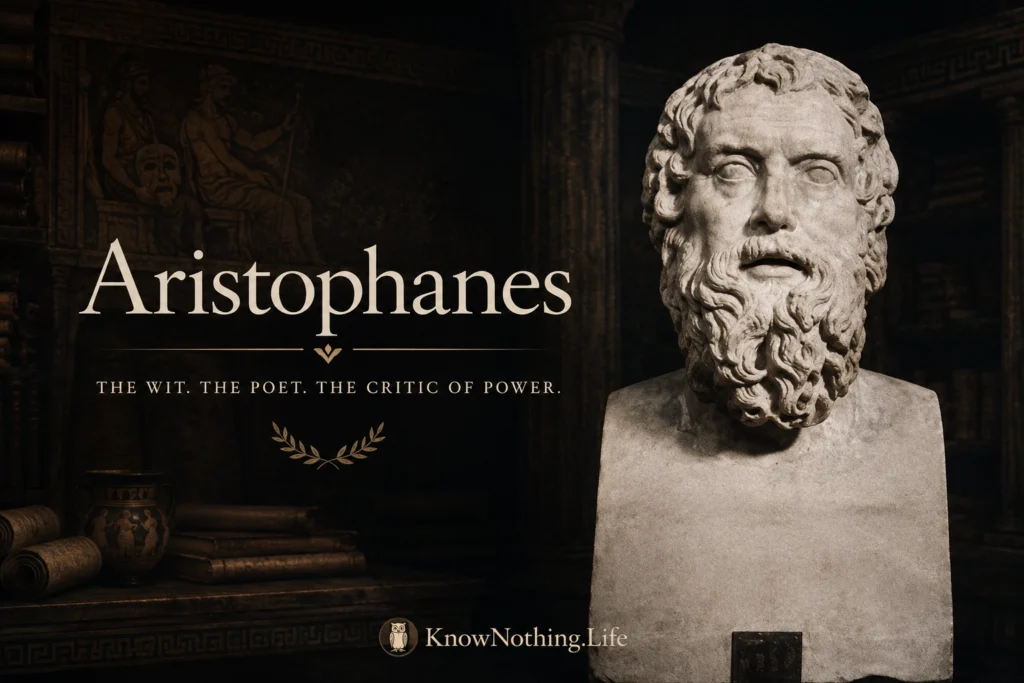
Aristophanes was born in Athens sometime between about 460 and 450 BCE, during the height of the city’s cultural and political power. Little is known with certainty about his family or private life, though ancient evidence identifies his father as Philippus and connects him with the deme of Cydathenaeum. What is clear is that Aristophanes belonged to a generation that inherited the glory of Periclean Athens but lived through the long catastrophe of the Peloponnesian War. His imagination was formed by a city of festivals, assemblies, lawsuits, military anxiety, intellectual experiment, and public speech.
Athens was the perfect home for his kind of comedy because it was a city that argued with itself in public. Politicians, generals, poets, philosophers, jurors, farmers, demagogues, and ordinary citizens all became material for the comic stage. Aristophanes did not write polite entertainment. He wrote for civic festivals where comedy could be obscene, musical, fantastical, political, and personally insulting. His plays suggest a man educated in poetry, rhetoric, myth, tragic drama, and the new intellectual movements of his age. He knew Homer, Euripides, Aeschylus, Sophocles, Socrates, and the language of democratic politics well enough to parody them all.
Old Comedy and the Freedom of Ridicule
Aristophanes is the greatest surviving poet of Old Comedy, the wild dramatic form that flourished in fifth-century Athens. Old Comedy had few modern equivalents. It mixed political satire, slapstick, fantasy, lyrical choruses, sexual jokes, direct address to the audience, masks, songs, insults, and impossible plots that somehow revealed real civic tensions. A private citizen might make a personal peace treaty with Sparta; birds might found a city in the sky; women might seize control of the Acropolis; Dionysus might travel to the underworld to retrieve a dead tragedian. The absurdity was not a distraction from seriousness. It was the method by which seriousness became visible.
Unlike later comedy of manners, Aristophanic comedy names names. Cleon, Euripides, Socrates, Lamachus, and other public figures are mocked openly. This makes Aristophanes invaluable as a witness to Athenian democracy, but also dangerous as a source. He was a comic poet, not a neutral reporter. His distortions were deliberate. Yet those distortions reveal what mattered enough to laugh at: war, empire, rhetoric, education, masculinity, religion, money, juries, class resentment, intellectual fashion, and the fragility of civic judgment. His comedy is Athens arguing with itself in costume.
The Early Plays and the War
Aristophanes’ dramatic career began with lost plays such as The Banqueters and The Babylonians. The latter reportedly angered Cleon, the powerful Athenian politician, because of its criticism of Athens and its allies. The first complete surviving play, The Acharnians, was produced in 425 BCE. Its hero, Dicaeopolis, is tired of war and makes a private peace for himself. The premise is ridiculous, but the longing beneath it is real. In one of the play’s most famous lines, Dicaeopolis declares that “Comedy too can sometimes discern what is right” and that he will say what is true even if he does not please.
That line captures Aristophanes’ self-image as more than a joke-maker. He saw comedy as a civic instrument, a form that could expose folly where solemn speech failed. The Knights, produced in 424 BCE, attacked Cleon with ferocious energy, representing Athenian politics as a grotesque contest of flattery, appetite, and manipulation. The Wasps, produced in 422 BCE, turned the Athenian obsession with jury service into a domestic farce. In these early works, Aristophanes appears as a comic defender of ordinary judgment against demagoguery, litigation, and war fever.
Socrates, Euripides, and Intellectual Satire
The Clouds, first produced in 423 BCE and later revised, is one of Aristophanes’ most famous and controversial plays because of its caricature of Socrates. In the play, Socrates runs a “Thinkery,” where students learn clever arguments, naturalistic explanations, and verbal tricks that can help them escape debts and overturn traditional morality. This is not the Socrates of Plato’s mature dialogues. It is a comic fusion of philosopher, sophist, scientist, and intellectual fraud. Yet it mattered historically because Plato’s Apology later suggests that comic slanders helped shape public suspicion of Socrates.
Aristophanes also mocked Euripides repeatedly, especially in Thesmophoriazusae and The Frogs. Euripides represented for him a modernizing, argumentative, psychologically clever kind of tragedy that could be both brilliant and corrupting. In The Frogs, produced in 405 BCE after the deaths of Euripides and Sophocles, Dionysus travels to Hades to bring back a great tragic poet. The debate between Aeschylus and Euripides becomes a comic trial of literature itself. Aristophanes asks what poetry is for: entertainment, verbal cleverness, moral education, civic strength, or all of these at once.
Peace, Birds, and Comic Fantasy
Peace, produced in 421 BCE shortly before the Peace of Nicias, shows a farmer named Trygaeus flying to heaven on a giant dung beetle to rescue the goddess Peace. The image is hilariously undignified, but the emotional core is sincere. Aristophanes longed for rural life, festivals, vineyards, feasting, and freedom from military ruin. In the play, the comic poet boasts that he has “pained folk but little and caused them much amusement,” a self-defense that presents comedy as a public service rather than mere insult.
The Birds, produced in 414 BCE, may be Aristophanes’ most dazzling fantasy. Two Athenians persuade the birds to build a city in the sky, Cloudcuckooland, and block communication between gods and humans. The play is airy, strange, musical, and politically suggestive without reducing itself to one simple allegory. Written during the period of Athens’ disastrous Sicilian ambitions, it turns imperial imagination into winged absurdity. Aristophanes understood that political dreams often begin as fantasies of escape and end as projects of domination.
Lysistrata and the Power of Reversal
Lysistrata, produced in 411 BCE, remains Aristophanes’ best-known play for modern audiences. Its plot is famous: the women of Greece, led by Lysistrata, refuse sex with their husbands until the men agree to end the war. At the same time, the women seize the Acropolis and control the treasury, recognizing that war depends not only on male honor but on money. The play is comic, bawdy, and impossible, but its impossible reversal exposes a political truth: those excluded from public power still bear the costs of public decisions.
Aristophanes was not a modern feminist, and the play should not be simplified into a contemporary manifesto. Yet Lysistrata gives women extraordinary comic intelligence, discipline, and strategic power. It imagines peace coming not through generals or assemblies, but through those whose bodies and households absorb the suffering of war. The comedy works because Athens is turned upside down. Men become ridiculous; women become organizers; sex becomes politics; the home becomes a battlefield; and laughter becomes a way of imagining a different civic order.
Later Works and Changing Comedy
After the Peloponnesian War, Aristophanes continued to write, but comedy itself was changing. The old freedom of direct political attack began to soften into forms closer to Middle and New Comedy. Ecclesiazusae, also called Assemblywomen, imagines women taking over the Athenian assembly and introducing communal property and social reorganization. Plutus, or Wealth, produced in its surviving version in 388 BCE, personifies wealth as a blind god whose restored sight would allow riches to go to the just.
These later plays are often judged less explosive than Acharnians, Birds, or Frogs, but they remain important. They show Aristophanes adapting to a changed Athens after defeat, oligarchic terror, democratic restoration, and economic strain. The comic energy is more restrained, the chorus less central, and the satire less tied to immediate political personalities. Yet the old questions remain: who deserves wealth, who governs the city, what happens when ideals become systems, and how easily reform can become absurd.
Legacy and Lasting Importance
Aristophanes probably died in or shortly after 386 BCE. Ancient tradition credits him with at least forty plays, though only eleven survive complete: Acharnians, Knights, Clouds, Wasps, Peace, Birds, Lysistrata, Thesmophoriazusae, Frogs, Ecclesiazusae, and Plutus. That survival is extraordinary. He is the only playwright of Old Comedy whose complete plays have come down to us, which means that much of what modern readers know about that form comes through him.
Aristophanes’ lasting importance lies in his fusion of laughter and intelligence. He proved that comedy can be vulgar and profound, topical and timeless, irresponsible and morally sharp. He mocked democracy while depending on its freedoms. He attacked war while delighting in comic violence. He ridiculed intellectuals while displaying immense intellectual sophistication. He remains essential because he shows what comedy can do at its highest level: make a city see itself, not through solemn instruction, but through the shock of laughter.