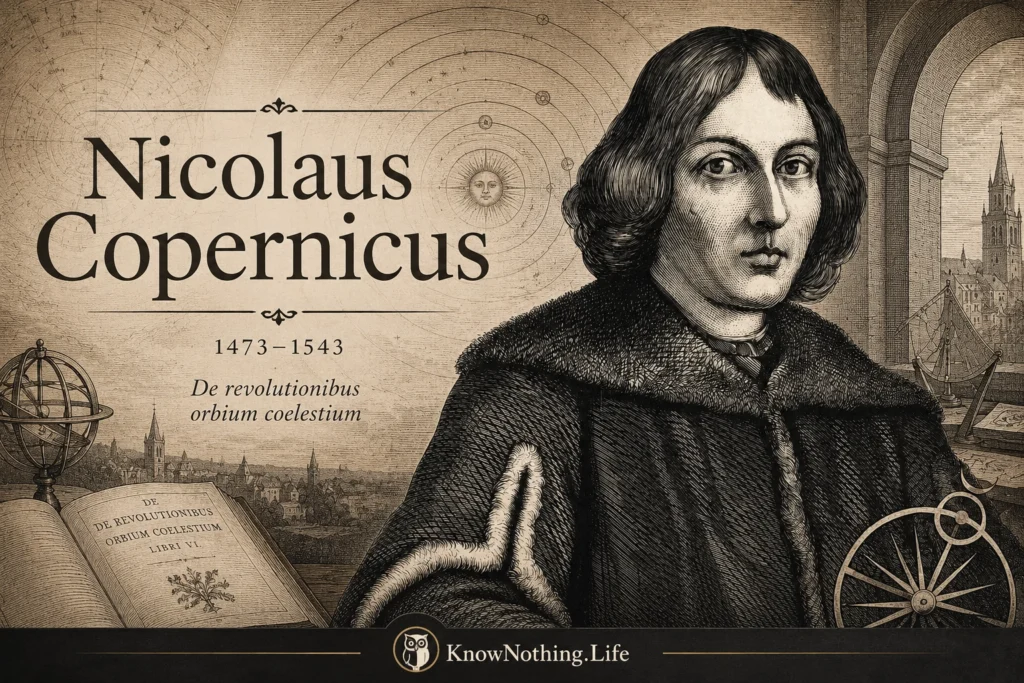
Nicolaus Copernicus was born on February 19, 1473, in Toruń, a prosperous city on the Vistula River in Royal Prussia, then under the Polish crown. He was the youngest child of Nicolaus Copernicus Sr., a merchant, and Barbara Watzenrode, whose family belonged to the urban elite. His father died when Copernicus was still a boy, and his maternal uncle, Lucas Watzenrode, took responsibility for his education and career. Watzenrode later became bishop of Warmia, and his influence gave Copernicus the security, patronage, and ecclesiastical position that made his long intellectual life possible.
Copernicus did not begin as a revolutionary outsider shouting against tradition. He was trained inside the learned world of late medieval and Renaissance Europe: Latin scholarship, church administration, mathematics, medicine, law, astronomy, and classical texts. This matters because his achievement was not a rejection of learning but a reordering of it. He inherited the astronomy of Ptolemy, the physics of Aristotle, the mathematical techniques of earlier astronomers, and the humanist recovery of Greek learning. His revolution came from mastering the old system deeply enough to see where it failed.
Education in Kraków and Italy
In 1491, Copernicus entered the University of Kraków, one of the important centers for mathematical and astronomical study in central Europe. There he encountered arithmetic, geometry, astronomy, and astrology as they were then understood. Astrology was not yet sharply separated from astronomy in medical and university settings, and the study of heavenly motions served calendars, medicine, navigation, liturgy, and philosophical cosmology. Kraków awakened Copernicus’s astronomical interests, even though he did not take a degree there.
He later studied in Italy, first at Bologna, where he pursued canon law and lived with the astronomer Domenico Maria Novara. This connection gave Copernicus direct experience with observation and with criticism of inherited Ptolemaic astronomy. He also studied medicine at Padua and received a doctorate in canon law from Ferrara. Italy exposed him to Renaissance humanism, Greek texts, mathematical astronomy, and the intellectual confidence to revisit ancient authorities. By the time he returned north, Copernicus was not only a church administrator. He was a mathematically trained scholar with a growing suspicion that the standard picture of the cosmos was needlessly complicated and physically unsatisfying.
Canon, Physician, Administrator, Astronomer
Copernicus spent much of his adult life as a canon of the cathedral chapter of Warmia, especially at Frombork. His position was ecclesiastical, but not priestly in the ordinary pastoral sense. He administered property, helped manage chapter affairs, practiced medicine, advised on finances, and served during periods of political conflict. He was a practical man as well as a theoretical thinker. His life was not spent in a modern observatory, and he did not have a telescope, which would not appear until long after his death.
His administrative duties slowed his astronomical work, but they did not extinguish it. Copernicus observed the heavens when conditions allowed, collected data, worked through inherited tables, and gradually shaped a new planetary arrangement. He also wrote on monetary reform in Monetae cudendae ratio, showing his interest in economics and public order. This broader range is often forgotten. Copernicus was not simply “the man who said Earth moves.” He was a Renaissance intellectual whose astronomy belonged to a wider life of law, medicine, mathematics, governance, and reform.
The Problem With the Old Cosmos
The dominant astronomical model of Copernicus’s world came from Ptolemy’s Almagest, which placed Earth at the center and explained planetary motions through combinations of circles, epicycles, eccentrics, and equants. The system could predict planetary positions, but it did so at the cost of increasing complexity. It also conflicted with the ideal of uniform circular motion, an ancient principle that many astronomers still found philosophically important. Copernicus was deeply troubled by this tension. He wanted a system that preserved mathematical order while explaining apparent irregularities more coherently.
His great insight was to treat Earth not as the fixed center of all things but as one planet among others. If Earth rotated daily and revolved annually around the sun, then many apparent motions in the sky could be reinterpreted. The daily turning of the heavens became the rotation of Earth. The yearly path of the sun became the motion of Earth around the sun. The puzzling retrograde motions of planets became appearances caused by observing them from a moving Earth. The universe did not become simpler in every technical detail, because Copernicus still used circles and epicycles, but its structure became more unified.
Commentariolus and the First Outline
Before publishing his major book, Copernicus privately circulated a short manuscript now known as the Commentariolus, or “Little Commentary,” probably around 1514. In it, he sketched the main principles of his heliocentric arrangement without the full mathematical demonstrations he planned for a larger work. The Commentariolus stated that there is no single center of all celestial spheres, that Earth is not the center of the universe, that the sun is near the center, and that Earth has motions of rotation and revolution.
This private circulation reveals both confidence and caution. Copernicus wanted serious astronomers to know his ideas, but he delayed full publication for decades. The delay has often been explained as fear of religious persecution, but the situation was more complex. He knew the mathematics required long refinement, and he lived far from major academic centers. He was also aware that moving Earth would disturb philosophy, theology, and common sense. His own phrase, “Astronomy is written for astronomers,” shows both his confidence and his boundary-setting. He wanted technical critics, not careless condemnation.
De Revolutionibus and the Heliocentric System
Copernicus’s masterpiece, De revolutionibus orbium coelestium, or On the Revolutions of the Heavenly Spheres, was published in Nuremberg in 1543, the year of his death. The book was organized in six parts, beginning with the general structure of the cosmos and moving into increasingly technical treatments of spherical astronomy, solar motion, lunar motion, planetary longitude, and latitude. It was not a popular manifesto. It was a demanding mathematical work addressed to readers capable of following astronomical models and geometrical reasoning.
One of the most famous lines from the work declares, “Finally we shall place the Sun himself at the center of the Universe.” Copernicus did not mean the sun was exactly the modern gravitational center of the solar system in a Newtonian sense. He still worked within a cosmos of spheres, circular motions, and ancient assumptions. Yet the conceptual shift was immense. Earth was no longer the cosmic anchor. Humanity’s home became a moving body, and the heavens became intelligible through the relocation of the observer.
Rheticus, Osiander, and Publication
The young mathematician Georg Joachim Rheticus played a crucial role in bringing Copernicus’s work to print. Rheticus visited Copernicus in 1539, studied his theory, and published the Narratio prima in 1540, the first printed account of the Copernican system. Its favorable reception helped persuade Copernicus to release the larger work. Rheticus carried the manuscript to Nuremberg, but he eventually had to leave the printing process, and supervision passed to Andreas Osiander.
Osiander added an anonymous preface suggesting that the heliocentric model need not be true or even probable, so long as it allowed accurate calculation. This preface did not represent Copernicus’s own position and later caused confusion. Copernicus had dedicated the book to Pope Paul III and clearly presented his system as more than a convenient fiction. He believed the order of the planets, their periods, and their apparent motions made better sense when Earth moved. The book’s full force lay in its claim that mathematical harmony could reveal the real structure of the heavens.
Reception and Scientific Legacy
Copernicus did not instantly overthrow the old universe. Many sixteenth-century astronomers admired parts of his mathematics while rejecting Earth’s motion. Some valued his elimination of the equant more than his heliocentrism. Others used Copernican tables without accepting the Copernican cosmos. The full transformation required later figures: Tycho Brahe’s observations, Johannes Kepler’s elliptical orbits, Galileo’s telescopic evidence and defense of Earth’s motion, and Isaac Newton’s theory of gravitation. Copernicus began a revolution that others completed.
His legacy lies not only in placing the sun near the center, but in changing the intellectual direction of astronomy. He made it possible to ask whether appearances should be explained by the motion of the observer, not only by the motion of observed bodies. He also showed that mathematical order could challenge inherited common sense. The “Copernican revolution” became a metaphor for any intellectual transformation that displaces humanity from a privileged center. After Copernicus, the universe was no longer arranged around human perception.
Death and Lasting Importance
Copernicus died on May 24, 1543, in Frombork. Tradition holds that he saw a printed copy of De revolutionibus near the end of his life, though the details are uncertain. What is certain is that he left behind one of the most consequential books in the history of science. He had not solved every astronomical problem. His system retained circular orbits, epicycles, and several older assumptions. Yet by moving Earth, he changed the problem itself.
Nicolaus Copernicus remains essential because he represents the disciplined courage of a thinker who revised the world without abandoning rigor. He did not merely speculate that things might be different. He labored for decades to make a different cosmos mathematically plausible. His work joined observation, calculation, classical learning, and intellectual independence. In doing so, he gave modern science one of its defining acts: the willingness to let reason move the ground beneath our feet.