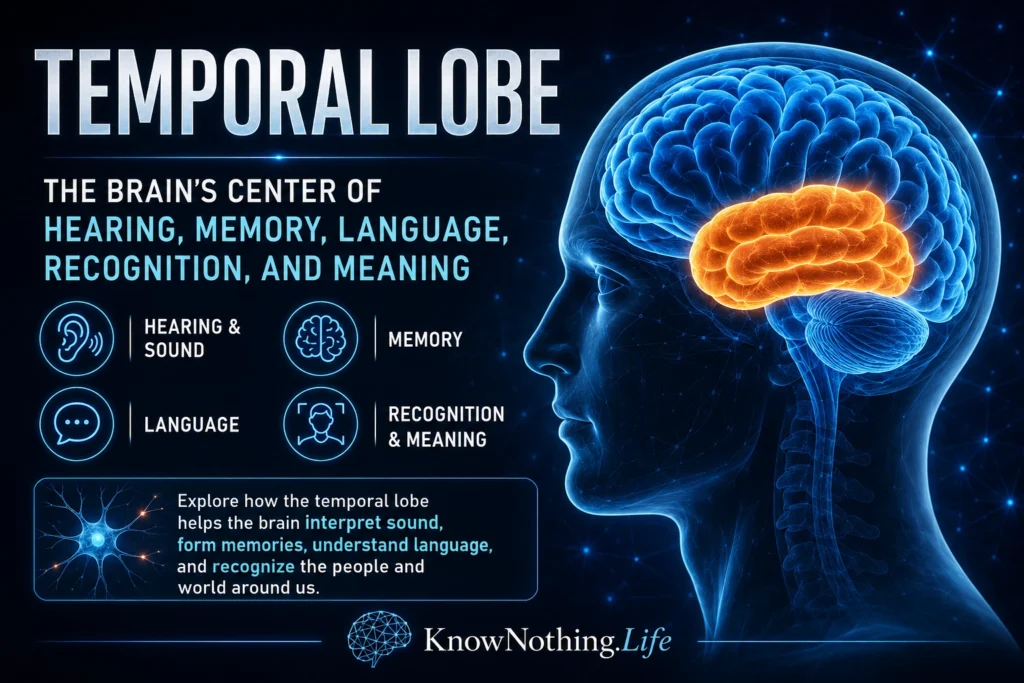
The temporal lobe is one of the four major lobes of the cerebral cortex, located on the side of the brain beneath the lateral fissure and roughly behind the temples. It is strongly involved in hearing, language comprehension, memory formation, object recognition, face perception, emotion, and the interpretation of meaning. The temporal lobe helps the brain answer questions that are essential to human life: What am I hearing? Whose face is this? What does this word mean? Have I experienced this before? Why does this sound, smell, scene, or voice feel familiar? A medical overview of temporal-lobe neuroanatomy describes this region as important for language processing, social cues, emotion, facial recognition, auditory processing, and episodic memory.
The temporal lobe is sometimes described as the brain’s “meaning” region because it links sensory experience with memory and recognition. Vision may begin in the occipital lobe, and sound may enter the brain through auditory pathways, but the temporal lobe helps identify what those signals mean. It allows a voice to become a familiar person, a melody to become a remembered song, and a word to become an idea. Like every major brain region, it does not act alone. It works with the frontal lobe, parietal lobe, occipital lobe, limbic system, thalamus, basal ganglia, and brainstem. Its special importance lies in connecting perception with memory, emotion, and understanding.
Anatomy and Major Regions
The temporal lobe contains several important cortical and medial structures, including the superior temporal gyrus, middle temporal gyrus, inferior temporal gyrus, fusiform gyrus, parahippocampal gyrus, hippocampus, and amygdala-related networks. The superior temporal gyrus includes regions important for hearing and speech perception. The fusiform gyrus contributes to high-level visual recognition, especially face recognition. The medial temporal lobe contains the hippocampal formation and related structures that are crucial for forming new declarative memories. These structures make the temporal lobe one of the brain’s central meeting places for sound, vision, memory, emotion, and identity.
The temporal lobe is also organized differently across the two hemispheres. In most people, the left temporal lobe is more involved in language comprehension, word meaning, and verbal memory, while the right temporal lobe often contributes more strongly to music, tone of voice, face recognition, social perception, and nonverbal memory. This division is not absolute. Both temporal lobes participate in many functions, and complex abilities depend on networks that cross hemispheres. Still, hemispheric specialization helps explain why injury to different sides of the temporal lobe can produce different symptoms, such as language problems after dominant temporal damage or difficulty recognizing faces and emotional tone after right temporal damage.
Hearing and Auditory Processing
The temporal lobe is the primary cortical destination for auditory information. Sound waves are converted into neural signals in the inner ear, relayed through the brainstem and thalamus, and then processed in the auditory cortex of the superior temporal region. This allows the brain to interpret pitch, rhythm, volume, tone, location, and pattern. Hearing is not merely the passive registration of sound. The temporal lobe helps sort sound into meaningful categories: speech, music, warning signals, environmental noises, emotional tone, and familiar voices. This is why the same vibration in the air can become a word, a siren, a laugh, or a song.
Auditory processing is especially important for speech. Human language depends on the ability to rapidly distinguish subtle sound differences and connect them to words and meaning. Research on the functional neuroanatomy of language has emphasized that auditory-related areas in the temporal lobe are critical for speech recognition, even though speech comprehension also depends on broader frontal, parietal, and temporal networks. When a person understands a sentence, the brain must decode sound, identify words, interpret grammar, connect meaning to context, and update understanding moment by moment. The temporal lobe is central to this transformation of sound into language.
Language Comprehension and Wernicke’s Area
One of the most historically important temporal-lobe functions is language comprehension. In the nineteenth century, German neurologist Carl Wernicke described patients who could speak fluently but produced language that lacked clear meaning and had severe difficulty understanding speech. This condition became known as Wernicke’s aphasia, traditionally associated with damage near the posterior superior temporal region of the dominant hemisphere. Modern descriptions still identify Wernicke’s aphasia with impaired comprehension, fluent but often nonsensical speech, naming problems, repetition difficulty, and poor awareness of speech errors.
Modern neuroscience has refined the older idea of a single “Wernicke’s area.” Jeffrey Binder’s review argues that the term has often been used too loosely and that posterior language processing is better understood through distributed networks rather than one isolated comprehension center. This does not make Wernicke’s discovery unimportant. Instead, it shows how neuroscience progresses: early lesion studies revealed that language has biological organization, while modern imaging and neuropsychology show that comprehension involves multiple interacting regions. The temporal lobe remains essential, but language is not locked inside one cortical spot. It is a living network of sound, meaning, memory, and expression.
Memory and the Medial Temporal Lobe
The temporal lobe is one of the most important brain regions for memory, especially because of the hippocampus and surrounding medial temporal-lobe structures. The hippocampus is embedded deep within the temporal lobe and plays a major role in learning and memory. Reviews of hippocampal function describe it as vital for learning, memory, and vulnerability to many neurological and psychiatric conditions. It helps form new declarative memories, including memories of facts, events, places, and personal experiences. Without healthy medial temporal-lobe function, a person may remain awake, intelligent, and conversational, yet struggle to form new lasting memories.
The most famous case in memory neuroscience is patient H.M., studied by William Scoville and Brenda Milner after surgery that removed parts of his medial temporal lobes, including hippocampal regions. H.M. developed profound anterograde amnesia, meaning he could not form many new long-term memories, while other abilities remained partly intact. Neuroscientist Larry Squire later described H.M.’s case as foundational because it established that memory is a distinct cerebral function and identified the medial temporal lobe as essential for memory formation. This case changed neuroscience by showing that memory is not one simple faculty. It has different systems, and the temporal lobe is crucial for some of the most personal forms of remembering.
Recognition, Faces, and Meaning
The temporal lobe is also central to visual recognition. Although the occipital lobe processes early visual information, the temporal lobe helps identify what is being seen. This function is often associated with the ventral visual stream, sometimes called the “what” pathway, which supports object recognition, face perception, and the interpretation of visual meaning. Damage to temporal visual areas can cause agnosia, a condition in which a person may see objects but struggle to recognize what they are. This shows that seeing and recognizing are not the same process. The eyes and early visual cortex may deliver visual information, but temporal regions help make that information meaningful.
Face recognition is one of the best-known examples. Nancy Kanwisher and colleagues used functional MRI to identify a region in the fusiform gyrus that was more active when participants viewed faces than when they viewed common objects, helping establish the fusiform face area as a major concept in cognitive neuroscience. Face perception is not merely about identifying shapes. It is tied to memory, emotion, trust, familiarity, and social life. The temporal lobe helps turn a visual pattern into a person: someone known, unknown, safe, threatening, loved, or remembered.
Emotion, Social Perception, and the Amygdala
The temporal lobe is closely connected to emotion, partly through medial temporal structures such as the amygdala. The amygdala helps evaluate emotional significance, especially in relation to threat, fear, salience, and social meaning. It does not act as a simple “fear center,” but it plays an important role in helping the brain decide what matters emotionally. Because the temporal lobe links perception with memory and emotion, it helps explain why a voice, smell, song, or face can instantly trigger a powerful feeling. Emotional memory is not separate from perception; the brain often interprets the world through the history of what similar experiences have meant before.
Social perception also depends heavily on temporal-lobe networks. The brain must interpret faces, voices, gaze direction, tone, gestures, emotional expressions, and narrative context. Temporal regions help integrate these signals into judgments about other people’s intentions and identities. This is why temporal-lobe dysfunction can affect more than hearing or memory. It may alter recognition, emotional interpretation, social understanding, and the sense of familiarity. The temporal lobe helps make the world personally meaningful rather than merely perceptually available.
Why the Temporal Lobe Matters
The temporal lobe matters because it helps transform sensation into understanding. It allows sound to become speech, faces to become identities, events to become memories, and experiences to become meaningful parts of a life story. Without the temporal lobe, the world might still contain sights and sounds, but it would be harder to recognize them, remember them, interpret them, or connect them to emotion. It is one of the brain’s great meaning-making systems.
The temporal lobe also shows that memory, language, perception, and emotion cannot be cleanly separated. A word is not just a sound; it carries memory and meaning. A face is not just a pattern; it carries identity and feeling. A song is not just vibration; it may carry a whole period of life. The temporal lobe helps bind these dimensions together. To understand it is to understand one of the brain’s most important bridges between the world outside and the remembered, emotional, meaningful world within.