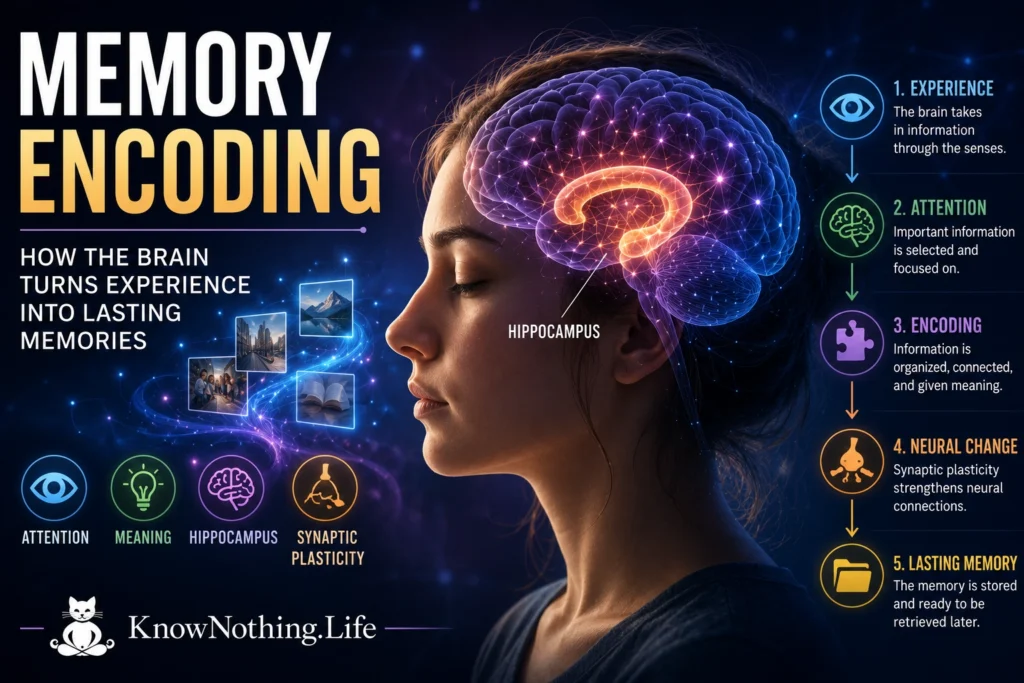
Memory encoding is the set of processes through which perception, thought, and action are transformed into neural representations that can influence the future. The brain encounters far more information than it could permanently preserve, so encoding is selective rather than automatic. Sensory systems first analyze color, sound, movement, language, touch, and other features. Attention then prioritizes some of this activity, while working-memory systems briefly maintain and organize what appears relevant. Successful encoding occurs when the brain establishes a representation capable of surviving beyond the immediate moment and later being reconstructed through retrieval.
Encoding should not be confused with permanent storage. A newly encoded experience remains vulnerable to distraction, interference, injury, and the passage of time. Consolidation processes must stabilize and reorganize it, while later retrieval depends on the availability of suitable cues. The importance of the medial temporal lobe became clear through William Scoville and Brenda Milner’s 1957 study, “Loss of Recent Memory After Bilateral Hippocampal Lesions.” Their patient H.M., later identified as Henry Molaison, retained language, perception, and short-term mental activity but could no longer form many lasting memories of new events after extensive medial temporal surgery. The case demonstrated that experiencing information and encoding it into durable declarative memory are separable brain functions.
Attention, Meaning, and Depth of Processing
Attention determines which parts of experience receive sufficient processing to become memorable. A person may look directly at a page while failing to encode its meaning because attention is directed toward another thought. Divided attention is particularly disruptive during initial learning. Fergus Craik, Richard Govoni, Moshe Naveh-Benjamin, and Nicole Anderson found that performing a second task during encoding caused substantial reductions in later recall and recognition. Dividing attention during retrieval had much smaller effects on memory accuracy, indicating that building a memory generally requires more controlled processing than accessing an already established representation.
The kind of processing applied to information also matters. In their influential 1975 paper, “Depth of Processing and the Retention of Words in Episodic Memory,” Craik and Endel Tulving asked participants to make judgments about words. Some questions concerned visual appearance or sound, while others required consideration of meaning. Words processed semantically were remembered far better than words examined only for capitalization or rhyme. The experiments showed that memory is strengthened not merely by spending more time with information, but by interpreting, elaborating, and connecting it to existing knowledge. A concept explained in one’s own words is usually encoded more richly than the same concept copied repeatedly without understanding.
The Hippocampus and the Binding of Experience
An episodic memory contains more than an isolated object or fact. It may include where an event occurred, who was present, what happened first, how the person felt, and which details belonged together. The hippocampus and surrounding medial temporal structures help bind these elements into relational representations. This binding allows a sight, smell, word, or location to later reactivate a larger event. The hippocampus does not store every sensory detail by itself; it interacts with distributed cortical regions that process visual, auditory, spatial, semantic, and emotional information.
Functional-imaging studies provided a way to observe this process while memories were being formed. In 1998, John Brewer and colleagues measured brain activity while participants viewed scenes and later tested their memory. Activity in medial temporal and prefrontal regions was greater for scenes that were subsequently remembered than for those that were forgotten. Anthony Wagner and colleagues reported a similar “subsequent-memory effect” for words: patterns of activity during learning predicted whether individual verbal experiences would later be remembered. These experiments demonstrated that later memory success can be traced to measurable differences present during the original encoding event.
The hippocampus also helps prevent similar experiences from blending together. This process is commonly called pattern separation. For example, remembering where a car was parked today requires distinguishing the current location from many similar parking experiences. Using high-resolution functional MRI, Craig Stark, Leila Kirwan, and colleagues found activity consistent with pattern separation in the dentate gyrus and CA3 regions of the human hippocampus during memory encoding. Later work showed that greater distinctiveness among hippocampal activity patterns predicted better subsequent memory, supporting the idea that durable encoding requires both connecting related information and separating competing events.
Synaptic Plasticity and the Formation of Memory Traces
At the cellular level, memory encoding depends on neural plasticity: the ability of synapses and circuits to change in response to activity. In 1973, Tim Bliss and Terje Lømo reported long-lasting potentiation of synaptic transmission in the rabbit hippocampus. After particular patterns of electrical stimulation, later signals passing through the same pathway produced stronger responses. This phenomenon, known as long-term potentiation, offered a biological mechanism through which coordinated neural activity could strengthen connections and preserve aspects of experience.
Long-term potentiation is not a complete explanation of memory, but it captures an important principle: the effect of one neuron on another can be modified by experience. Plasticity may involve changes in neurotransmitter release, receptor number and sensitivity, intracellular signaling, gene expression, protein synthesis, dendritic spines, and the formation or removal of synapses. The hippocampus rapidly encodes relationships among elements of an event, while gradual changes across cortical networks contribute to longer-term representation. Memory traces are therefore distributed patterns of altered connectivity, not miniature pictures or recordings stored in a single cell.
Emotion, Novelty, and Stress
Emotion can strongly influence what is encoded. Events associated with danger, reward, surprise, or personal importance recruit the amygdala and stress-related chemical systems that modulate memory formation elsewhere in the brain. Larry Cahill and James McGaugh found that participants remembered an emotionally arousing story better than a closely matched neutral version after a two-week delay. Cahill and colleagues later showed that amygdala activity during the encoding of emotional material was correlated with long-term recall. The amygdala appears to influence the strength assigned to significant experiences rather than serving as the sole storage location for emotional memories.
Novelty can similarly signal that information deserves additional processing. Human recordings have identified novelty-sensitive dopamine neurons in the substantia nigra whose activity predicts successful declarative-memory formation. Interactions among the hippocampus, dopaminergic midbrain, and prefrontal cortex may help strengthen memories for unexpected or motivationally important events. Familiar material is not necessarily encoded poorly, especially when it fits established knowledge, but novelty can increase attention and promote the persistence of selected memories.
Stress has more complicated effects. Moderate arousal may strengthen memory for central emotional information, while intense or prolonged stress can interfere with attention, hippocampal function, and memory for neutral details. Studies of stress-induced cortisol increases have found reduced delayed recall for some material encoded after a stressful event, even when immediate recall was unaffected. Other experiments have reported enhanced emotional memory under elevated cortisol. The outcome depends on timing, intensity, emotional arousal, individual differences, and whether researchers measure items, contextual details, consolidation, or retrieval. Stress does not universally improve or impair encoding; it redistributes memory toward information the brain treats as biologically significant.
Encoding for Future Retrieval
A memory can be encoded successfully yet remain difficult to retrieve if the available cues do not match the way the event was originally processed. Endel Tulving and Donald Thomson developed this idea in their 1973 paper, “Encoding Specificity and Retrieval Processes in Episodic Memory.” According to the encoding-specificity principle, a retrieval cue is effective when it reinstates information incorporated into the memory trace during learning. This explains why returning to a location, hearing a particular song, or encountering a distinctive smell can suddenly restore an experience that had seemed forgotten.
Effective encoding therefore involves preparing useful routes back to the information. Elaborating on meaning, connecting ideas to prior knowledge, generating examples, organizing material, and testing oneself can create distinctive associations that later serve as retrieval cues. Simply rereading may produce a temporary sense of familiarity without building the relational structure needed for recall. The best encoding strategy also depends on the future task: concentrating on meaning benefits conceptual tests, while attention to sound or visual form may be useful when those features will later serve as cues.
Encoding is also influenced by the brain’s current biological condition. Sleep deprivation before learning can reduce hippocampal activity and impair the formation of new episodic memories. Matthew Walker and colleagues found that one night without sleep produced a significant deficit in hippocampal encoding and poorer subsequent retention. Sleep after learning supports consolidation, but adequate sleep before learning is equally important because it prepares the hippocampal and attentional systems to receive new information.
Memory encoding is not the passive transfer of experience into storage. It is an active process of selection, interpretation, association, and neural change. Attention determines what enters processing, meaning and prior knowledge shape how it is represented, the hippocampus binds and separates events, synaptic plasticity alters neural connections, and emotion or novelty influences which experiences receive priority. Every lasting memory begins as a particular way of processing an event—and what the brain does during that moment helps determine what can later be remembered.