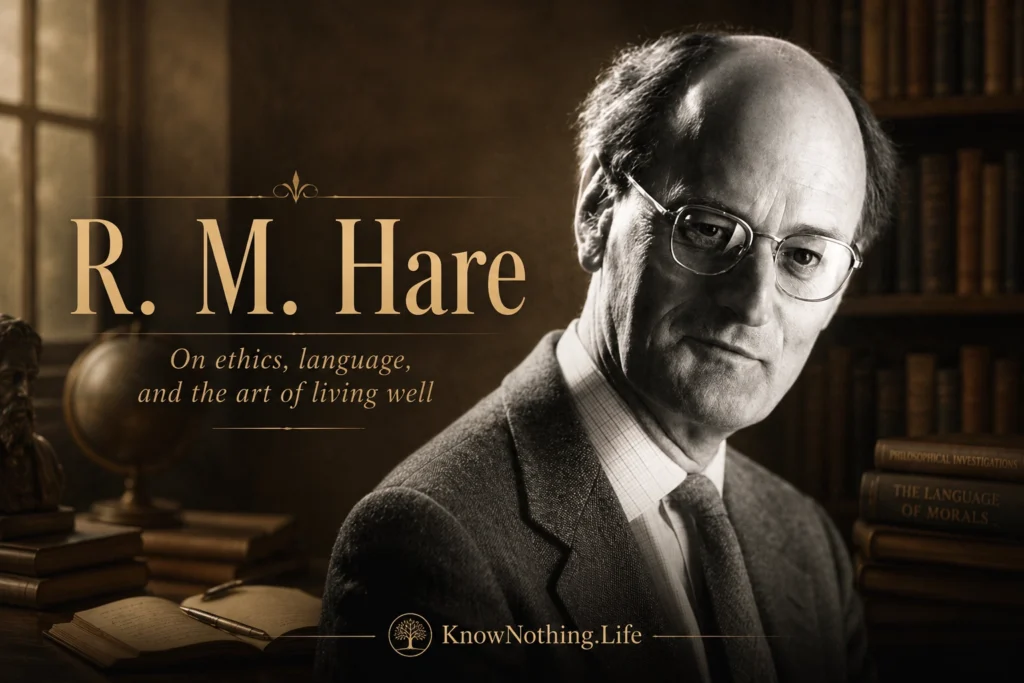
Richard Mervyn Hare, known professionally as R. M. Hare and personally as Dick Hare, was born on March 21, 1919, at Backwell Down, near Bristol, England. He came from a comfortable English family, but his childhood was marked by loss. His father died when Hare was young, and his mother died several years later. Those early losses, combined with the social inequalities he saw during the economic hardship of the 1930s, helped turn him toward moral philosophy. For Hare, ethics was never merely an academic puzzle. It was a way of asking how human beings ought to live when comfort, suffering, freedom, obedience, and responsibility collide.
Hare studied at Rugby School and then won a scholarship to Balliol College, Oxford, in 1937, where he began reading Greats, the traditional Oxford course in classics, philosophy, and ancient history. His classical education gave him a deep connection to Plato and Aristotle, but the crisis of his generation was not ancient. Europe was moving toward war, and Hare had to decide whether pacifism or military service was the morally responsible course. That decision became one of the formative questions of his life: can moral disagreement be argued about rationally, or must it collapse into personal preference?
War, Captivity, and Moral Seriousness
When the Second World War began, Hare volunteered for the Royal Artillery. He was sent to India and later served in Southeast Asia. In February 1942, after the fall of Singapore, he was captured by Japanese forces and spent three and a half years as a prisoner of war. He endured forced labor connected with the Burma railway and later imprisonment in Singapore. Hare rarely spoke in detail about the worst of this experience. In his autobiography he wrote, “I prefer to pass over our sufferings,” a restraint that says much about both his character and the severity of what he had endured.
The war mattered philosophically. Hare had not learned ethics from comfortable seminar-room examples alone. He had seen obedience, cruelty, fear, discipline, suffering, and survival under extreme conditions. Later, when critics treated his moral theory as too abstract, they sometimes forgot that it was formed by someone who had faced moral pressure in life-or-death circumstances. Hare wanted ethics to be rational because irrationality in morals was not harmless. If people cannot reason about what they ought to do, power, conformity, prejudice, and violence easily take over.
Oxford and The Language of Morals
After the war, Hare returned to Balliol and completed his studies. He was soon elected to a fellowship there and became one of the most influential Oxford moral philosophers of the postwar period. His first major book, The Language of Morals, published in 1952, established his reputation. At the time, British moral philosophy was shaped by debates over emotivism, especially the view that moral judgments mainly express feelings, attitudes, or approvals. Hare accepted that moral language was not simply descriptive, but he rejected the idea that it was therefore irrational.
His central claim was that moral judgments are prescriptive. To say that someone ought to do something is not merely to report a fact; it is to guide conduct. Moral language has a practical force. At the same time, Hare argued that moral judgments are not arbitrary commands. They also have a logical structure. If a person sincerely says that one action is wrong, that person must be prepared to apply the same judgment to relevantly similar cases. This combination of prescriptivity and universalizability became the core of Hare’s moral philosophy.
Universal Prescriptivism
Hare’s theory came to be called universal prescriptivism. It tried to preserve two things that were often pulled apart: freedom and rationality. On one side, moral judgments involve choice and commitment. They are not forced on us by facts in the same way that ordinary empirical conclusions may be. On the other side, once we make moral judgments, we are bound by consistency. We cannot rationally prescribe one rule for ourselves and a contradictory rule for others in the same relevant circumstances.
This gave Hare’s theory a partly Kantian shape, though he was not simply a Kantian. Like Kant, he thought universalizability was central to morality. Like utilitarians, he believed we must take other people’s interests seriously. Unlike moral realists, he did not think moral facts exist as independent properties waiting to be observed. Moral reasoning, for Hare, begins from the logic of moral words themselves. As he later wrote in Moral Thinking, “If we were to alter the meaning of our words, we should be altering the questions we were asking.”
Freedom and Reason
Hare’s second major book, Freedom and Reason, appeared in 1963. The title announced the problem he wanted to solve. Many philosophers had treated freedom and reason as enemies: if morality is rational, perhaps it constrains freedom; if morality is free, perhaps it is subjective and irrational. Hare argued that this opposition was false. Moral language gives us freedom because we must prescribe; it gives us reason because our prescriptions must be universalizable and consistent.
In Freedom and Reason, Hare also developed his view that moral arguments can occur even between people who do not already share the same moral assumptions. This was a crucial ambition. He wanted to avoid the idea that moral debate is possible only among those who already agree. If moral words carry logical commitments, then moral disagreement can be clarified and tested. People may still refuse consistency, sympathy, or imagination, but then the failure is visible. Hare’s ethics aimed to show how moral reasoning could be more than rhetoric.
Moral Thinking and Preference Utilitarianism
In 1981, Hare published Moral Thinking: Its Levels, Method, and Point, the mature statement of his theory. In this book, he distinguished between two levels of moral thinking: the intuitive level and the critical level. At the intuitive level, ordinary people rely on general principles, habits, and moral rules that guide action in daily life. At the critical level, one examines those rules more deeply, considering the preferences and interests of everyone affected. Hare famously described these two roles through the images of “proles” and “archangels,” not as social classes but as modes of moral thought.
This led Hare toward preference utilitarianism. If one universalizes one’s prescriptions while fully considering the standpoints of all affected persons, then one must give weight to their preferences. Hare did not present this as a simple emotional sympathy. It was a logical requirement of universal moral thinking. His view remained controversial, especially because critics doubted whether universal prescriptivism really leads to utilitarian conclusions. Yet Moral Thinking showed the full ambition of his system: to combine Kantian consistency, utilitarian concern for others, and ordinary moral practice into one rational structure.
Applied Ethics and Later Career
Hare’s work was not confined to metaethics. He wrote on political responsibility, war, apartheid, abortion, population ethics, education, medical ethics, urban planning, and practical decision-making. He became White’s Professor of Moral Philosophy at Oxford in 1966, after many years at Balliol, and was elected a Fellow of the British Academy. In 1983, he retired early from Oxford and became Graduate Research Professor of Philosophy at the University of Florida, where he hoped to help develop applied philosophy.
His later works included Applications of Moral Philosophy, Essays on the Moral Concepts, Essays in Ethical Theory, Essays on Political Morality, Essays on Bioethics, Sorting Out Ethics, and Objective Prescriptions. Even when the fashion of moral philosophy moved away from prescriptivism, Hare continued to defend the possibility of rational moral argument. He knew his system had critics, but he never gave up the ambition he once described as finding “a way of answering moral questions rationally.”
Death and Lasting Legacy
R. M. Hare died on January 29, 2002. By then, his influence had already passed through several phases. In the 1950s and 1960s, prescriptivism stood near the center of British moral philosophy. Later, virtue ethics, moral realism, contractualism, expressivism, and other approaches challenged its dominance. Yet Hare’s work did not disappear. His analysis of moral language, his insistence on universalizability, and his effort to connect metaethics with practical ethics remain central to understanding twentieth-century moral philosophy.
Hare’s lasting importance lies in his refusal to choose between moral seriousness and rational analysis. He knew that moral judgments guide action, express commitment, and cannot simply be read off from facts. But he also believed that morality need not collapse into feeling, tribal loyalty, or personal taste. His philosophy asks each person to face a demanding question: can I prescribe this not only for myself, but for anyone in the same relevant situation? That question remains one of the clearest tests of moral consistency, and it is why Hare’s work still matters.