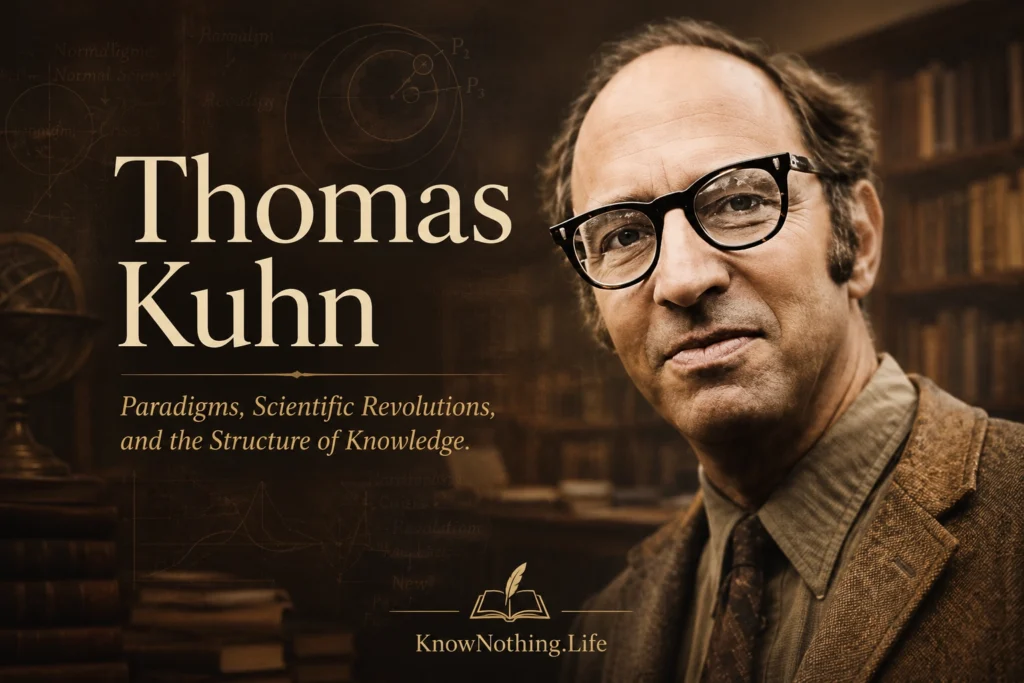
Thomas Samuel Kuhn was born on July 18, 1922, in Cincinnati, Ohio, and became one of the most influential philosophers of science of the twentieth century. Unlike many philosophers who began from logic, metaphysics, or moral theory, Kuhn began from physics. He studied at Harvard University, earning degrees in physics before turning toward the history and philosophy of science. That scientific formation mattered deeply. Kuhn did not approach science as an outsider hostile to its authority. He approached it as someone trained inside scientific practice who later became unsettled by the difference between how science was taught and how it actually developed.
During graduate study, Kuhn was asked to help teach a course on science for nonscientists. That assignment changed his life. Reading older scientific texts, especially Aristotle’s physics, he discovered that past science could not be understood simply as bad modern science. Aristotle was not stupid because he lacked Newton’s categories; he was working within a different conceptual world. Kuhn later recalled that exposure to older theory “radically undermined” some of his assumptions about science. From that experience grew his central insight: scientific change is not always a smooth accumulation of facts, but sometimes a transformation in the very framework through which facts are seen.
Harvard, History of Science, and The Copernican Revolution
Kuhn taught at Harvard in the years after the Second World War and became increasingly involved in the history of science. His first major book, The Copernican Revolution, published in 1957, examined the transition from the Earth-centered astronomy of Ptolemy to the Sun-centered system associated with Copernicus, Kepler, Galileo, and Newton. The book was more than a historical account of astronomy. It was an early study of how scientific world pictures change, how old systems can remain rational for long periods, and how new systems become convincing before they are complete.
The Copernican case showed Kuhn that scientific revolutions are not simple moments when facts defeat error. The older system often solves real problems; the new system often begins with its own difficulties. What changes is not merely one proposition but a network of methods, standards, examples, instruments, expectations, and accepted problems. Kuhn was learning to see science as a human practice carried by communities, not as a purely mechanical method that automatically turns observation into truth.
The Structure of Scientific Revolutions
Kuhn’s most famous book, The Structure of Scientific Revolutions, was published in 1962 and quickly became one of the most important works in modern intellectual history. Its influence spread far beyond philosophy of science into sociology, history, anthropology, political theory, literary studies, business, and ordinary public language. The phrase “paradigm shift” became so common that it often lost the technical meaning Kuhn gave it, but the reason it spread is clear: Kuhn offered a powerful vocabulary for describing deep changes in thought.
The book challenged the older view that science advances mainly by accumulating verified facts. Kuhn argued that mature sciences usually operate within a paradigm: a shared framework of theories, methods, standards, instruments, and exemplary achievements. Within a paradigm, scientists conduct what he called normal science, solving puzzles that the paradigm makes visible. He described normal science as research “firmly based” on recognized scientific achievements. The point was not that normal science is dull or uncreative. It is productive precisely because a scientific community shares enough assumptions to focus its work.
Normal Science and Puzzle-Solving
Kuhn’s idea of normal science was one of his most misunderstood contributions. He did not use “normal” as an insult. Normal science is the disciplined work scientists do when they accept a framework and extend it. They measure constants, refine theories, solve technical problems, apply methods, and bring stubborn details into alignment. Most science, most of the time, is normal science. It is not revolutionary, but it is essential.
For Kuhn, puzzle-solving explains both the strength and the limitation of scientific communities. A paradigm tells scientists what counts as a legitimate problem and what counts as an acceptable solution. It gives research direction. But this also means that scientists do not approach the world with neutral eyes. They see through learned categories. An anomaly is not simply any surprising fact. It is a result that resists explanation within a reigning paradigm. At first, anomalies are usually handled as puzzles to be solved, not as reasons to abandon the whole framework.
Crisis, Revolution, and Paradigm Change
Scientific revolutions begin when anomalies accumulate or become especially troubling, producing a crisis in which confidence in the existing paradigm weakens. During crisis, alternative frameworks may appear. These alternatives do not simply add new facts; they reorganize the field. A revolution occurs when a scientific community shifts allegiance from one paradigm to another. Kuhn famously described revolutions as “non-cumulative developmental episodes,” meaning that they are not just additions to what came before. They change the rules of the game.
Examples such as the Copernican revolution, Lavoisier’s chemical revolution, Einstein’s relativity, and quantum theory helped Kuhn show that scientific change can transform basic concepts. After a revolution, scientists may use familiar words differently, ask different questions, value different explanations, and see old data in new ways. Kuhn’s strongest claim was not that evidence is irrelevant. It was that evidence is interpreted within frameworks, and those frameworks themselves can change.
Incommensurability and Seeing Differently
Kuhn’s most controversial idea was incommensurability. He argued that competing paradigms may be difficult to compare by a neutral standard because they organize problems, methods, and meanings differently. This did not mean, as some critics charged, that scientific choice is irrational or that all theories are equally good. Kuhn did not deny evidence, argument, accuracy, or progress. He argued that theory choice involves judgment, not an algorithm.
In a scientific revolution, the world of the scientist can appear to change because the conceptual order through which the world is investigated has changed. Kuhn wrote that after a revolution, scientists respond to a different world. The phrase sounds extreme, but his point was philosophical, not magical. The physical world does not vanish and reappear. What changes is the learned structure of attention, classification, measurement, and explanation. Scientists literally notice different things because their training and expectations have changed.
Later Clarifications and Misunderstandings
Kuhn spent much of his later career clarifying what he did and did not mean. He rejected the idea that his work made science irrational. He also resisted the loose popular use of “paradigm” to mean any idea, trend, or business slogan. For Kuhn, a paradigm was rooted in scientific practice, community training, shared examples, and puzzle-solving competence. It was not merely a worldview floating above evidence.
In the postscript to later editions of The Structure of Scientific Revolutions, Kuhn tried to refine his terminology, emphasizing disciplinary matrices, exemplars, values, and scientific communities. He also insisted that he was not denying progress. In one memorable formulation, he called himself “a convinced believer in scientific progress.” His point was that progress does not always look like a straight road. It can involve loss as well as gain, discontinuity as well as accumulation, and transformation as well as extension.
Major Works and Academic Career
Kuhn held positions at Harvard, the University of California, Berkeley, Princeton University, and the Massachusetts Institute of Technology. At Berkeley, he worked in both history and philosophy and helped direct the Sources for the History of Quantum Physics project. At Princeton, he held the M. Taylor Pyne Professorship of Philosophy and History of Science. Later, at MIT, he became Laurence S. Rockefeller Professor of Philosophy. His career reflected the hybrid nature of his thought: he belonged to physics, history, philosophy, and the sociology of scientific knowledge, without fitting neatly into any one field.
His major works include The Copernican Revolution, The Structure of Scientific Revolutions, The Essential Tension, Black-Body Theory and the Quantum Discontinuity, and the posthumously published The Road Since Structure. The Essential Tension collected essays on tradition and innovation in science, while Black-Body Theory showed Kuhn applying his historical method in detail to the emergence of quantum theory. These works reveal that Kuhn was not merely a theorist of one catchy phrase. He was a historian who believed that philosophy of science must answer to actual scientific development.
Criticism and Influence
Kuhn’s work provoked intense criticism. Some philosophers argued that he exaggerated discontinuity and made science seem too dependent on social agreement. Karl Popper’s defenders preferred a model of bold conjectures and severe attempts at falsification. Logical empiricists worried that Kuhn had weakened the rational structure of scientific justification. Later sociologists and postmodern readers sometimes pushed Kuhn’s ideas toward relativism in ways he did not endorse. The controversies were not accidents; they were signs that Kuhn had struck the center of a major intellectual problem.
His influence remains enormous because he changed the questions people ask about science. After Kuhn, it became harder to describe science as a simple march from ignorance to truth. Historians and philosophers had to examine training, instruments, communities, exemplars, anomalies, values, and the historical life of concepts. Kuhn did not make science weaker. He made it more human, more historical, and in some ways more impressive, because scientific reason survives not by being detached from history, but by working through it.
Death and Lasting Legacy
Thomas Kuhn died on June 17, 1996, in Cambridge, Massachusetts, after suffering from cancer. By then, The Structure of Scientific Revolutions had become one of the most cited academic books of the twentieth century and one of the rare works of philosophy to reshape everyday language. The term “paradigm shift” is now often overused, but its popularity shows how deeply Kuhn changed modern thought about change itself.
Kuhn’s lasting importance lies in his account of science as a structured, communal, historical practice. He showed that scientific knowledge grows through discipline and disruption, tradition and crisis, puzzle-solving and revolution. He did not reduce science to politics or opinion. He showed that even the most rational human practices develop through inherited frameworks that can be transformed. Thomas Kuhn remains essential because he taught the modern world that seeing scientifically is itself something learned, and that the greatest revolutions change not only what we know, but what we are able to see.