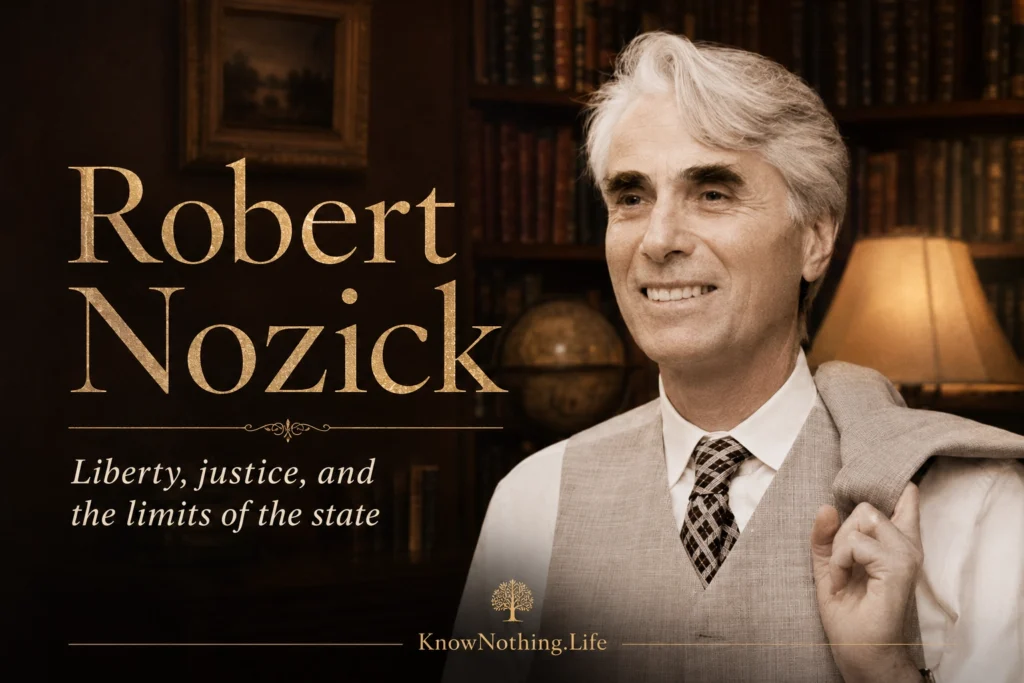
Robert Nozick was born on November 16, 1938, in Brooklyn, New York, into a Jewish family whose background connected him to the immigrant experience and the intense intellectual life of mid-century New York. As a teenager, he discovered philosophy through Plato’s Republic, later remembering the excitement of carrying the book around the streets of Brooklyn even before he fully understood it. That early image is revealing: Nozick was drawn to philosophy not as a school subject, but as an adventure in thinking.
He studied at Columbia College, earning his A.B. in 1959, then went to Princeton University, where he completed his M.A. in 1961 and his Ph.D. in 1963. His dissertation was supervised by Carl Hempel and focused on decision theory, showing an early interest in rational choice, explanation, and the structure of reasoning. During these years, Nozick was known as a brilliant young philosopher, fast, original, and intellectually restless. He would later become famous for refusing to remain inside one narrow field, moving from political philosophy to epistemology, metaphysics, rationality, value, and the meaning of life.
From the New Left to Libertarianism
Nozick’s political development was not predictable. Like many young intellectuals of his generation, he was initially attracted to the New Left and to socialist ideas. Over time, however, his reading of thinkers such as F. A. Hayek, Ludwig von Mises, Murray Rothbard, Milton Friedman, and others moved him toward libertarianism. This shift did not make him a simple political partisan. He was often uncomfortable with being treated as an official philosopher of the right, because he saw individual liberty as applying across the board, including to personal freedoms that some conservatives opposed.
This intellectual movement mattered because it gave Nozick’s political philosophy its unusual force. He did not defend free markets merely as efficient economic arrangements. He defended them as part of a broader theory of persons as separate beings with rights. His political thought begins from the conviction that individuals are not instruments of collective goals. They have their own lives, projects, bodies, talents, and moral boundaries. Political institutions must respect those boundaries, even when violating them might appear to produce attractive social outcomes.
Harvard and the Life of a Philosopher
After early appointments at Princeton and Rockefeller University, Nozick joined Harvard in 1969 as a full professor at only thirty years old. He spent the rest of his career there, eventually becoming Arthur Kingsley Porter Professor of Philosophy and later Joseph Pellegrino University Professor. At Harvard, he was known for intellectual range, unusual teaching, and a style of philosophizing that preferred exploration to finality. He rarely taught the same course twice, and he treated the classroom as a place to think in public rather than merely deliver finished doctrine.
Nozick’s philosophical temperament was striking. He disliked the idea that philosophy should trap opponents in arguments from which there is “no escape,” asking why philosophers should “be bludgeoning people like that.” This remark captures his later method. Even when he defended strong conclusions, he preferred explanation, possibility, and illuminating alternatives over rigid systems. He once said he did not want to spend his life writing “The Son of Anarchy, State, and Utopia.” That refusal to repeat himself became both a strength and a source of frustration for readers who wanted him to defend his most famous book in detail.
Anarchy, State, and Utopia
Nozick became world-famous with Anarchy, State, and Utopia, published in 1974. The book appeared only a few years after John Rawls’s A Theory of Justice, and together the two works revived analytic political philosophy. Rawls offered a powerful defense of justice as fairness and the redistributive liberal state. Nozick answered with a rights-based defense of the minimal state. His opening sentence became one of the most famous in modern political philosophy: “Individuals have rights, and there are things no person or group may do to them.”
The book argues that no state more extensive than a minimal state can be justified. A legitimate state may protect people against force, theft, fraud, and contract violation, but it may not coercively redistribute resources simply to produce a preferred social pattern. Nozick’s argument is deontological rather than merely economic. Rights operate as side constraints on what others, including governments, may do. Persons are not raw material for maximizing welfare, equality, virtue, or national greatness. A state that uses some people for the benefit of others fails to treat them as separate moral agents.
Entitlement Theory and the Wilt Chamberlain Argument
Nozick’s theory of distributive justice is called the entitlement theory. It asks not whether a distribution fits an ideal pattern, but whether people are entitled to what they hold. A holding is just if it arose through just acquisition, just transfer, or proper rectification of past injustice. This makes Nozick’s theory historical rather than end-state-based. To know whether a distribution is just, we must know how it came about.
His famous Wilt Chamberlain argument illustrates the point. Imagine a society with a distribution everyone agrees is just. Now imagine many people freely choose to pay a small amount to watch Chamberlain play basketball, making him far wealthier than others. The new distribution breaks the original pattern, but it arose through voluntary exchanges. Nozick’s conclusion is that “liberty upsets patterns.” Any state committed to maintaining a fixed distribution must continually interfere with voluntary choices. The argument became one of the most influential challenges to egalitarian theories of justice.
Utopia and the Framework for Experiment
The final part of Anarchy, State, and Utopia is sometimes overshadowed by the libertarian argument, but it is essential to the book’s ambition. Nozick does not present one perfect community for everyone. Instead, he imagines a “framework for utopia,” a minimal state within which many different communities can form, dissolve, compete, and coexist. People differ too deeply in temperament, values, religion, ambition, tastes, and visions of the good life for one imposed social ideal to suit them all.
This utopian argument gives Nozick’s libertarianism a pluralist dimension. The minimal state is not supposed to be a thin, lonely world of isolated market actors. It is supposed to create space for many forms of association: religious communities, artistic communities, socialist communes, capitalist enterprises, experimental schools, ascetic groups, and luxurious enclaves, so long as people enter and leave without coercion. Nozick’s political imagination was not merely anti-state. It was anti-monopoly over the human good.
The Experience Machine and the Value of Reality
One of Nozick’s most famous thought experiments appears in Anarchy, State, and Utopia, but its importance reaches far beyond political theory. The experience machine asks whether we would plug into a machine that could give us any pleasurable or meaningful-seeming experiences we wanted, while our real bodies floated in a tank. If pleasure were the only thing that mattered, plugging in would seem rational. Nozick thought most people would refuse, and that refusal reveals something deep about human value.
The experience machine challenges simple hedonism. We do not want merely to feel as if we write a great novel, love someone, raise children, climb a mountain, or help a friend. We want actually to do those things, to be certain kinds of people, and to live in contact with reality. This thought experiment has become central in debates about well-being, authenticity, virtual reality, simulation, and artificial experience. Nozick’s point was not that pleasure is worthless. It was that human beings care about more than experience from the inside. They care about truth, agency, and real connection.
Beyond Political Philosophy
After Anarchy, State, and Utopia, Nozick deliberately moved into other philosophical territories. Philosophical Explanations, published in 1981, addressed free will, personal identity, why there is something rather than nothing, knowledge, value, and the nature of philosophical method. In that book, he rejected the idea that philosophy must always produce coercive proof. He wrote that “there are various philosophical views, mutually incompatible, which cannot be dismissed or simply rejected,” and described philosophy’s output as a “basketful” of admissible views.
His later books continued this exploratory spirit. The Examined Life reflected on love, death, sexuality, happiness, the Holocaust, parents, children, and meaning. The Nature of Rationality examined principles, decision, and symbolic utility. Socratic Puzzles collected essays, reviews, and philosophical fiction. Invariances, published shortly before his death, developed a theory of objectivity based on invariance under transformations. Nozick’s later work did not receive the same public attention as his political philosophy, but it showed a thinker still trying to widen the range of analytic philosophy.
Criticism and Controversy
Nozick’s work provoked intense criticism. Egalitarian liberals argued that his libertarianism neglected the moral significance of social background, inherited disadvantage, disability, public goods, and structural injustice. Others challenged his account of acquisition, asking how original property rights can be justified in a world already marked by conquest, exclusion, and historical violence. Critics also argued that voluntary exchange is not always morally pure when bargaining power is deeply unequal.
Nozick himself did not spend the rest of his life defending the book against critics, and this became part of his reputation. Some readers admired his independence; others saw it as evasion. Later, in The Examined Life and The Nature of Rationality, he appeared to soften aspects of his earlier libertarianism, though he later said rumors of his “apostasy” were exaggerated. This ambiguity is part of Nozick’s legacy. He was not a party philosopher. He was a restless thinker who preferred opening questions to guarding a doctrine.
Death and Lasting Legacy
Robert Nozick died on January 23, 2002, after years of illness from stomach cancer. He was sixty-three. At Harvard, colleagues remembered him as a wide-ranging, fearless, and unusually lively mind. His major works include Anarchy, State, and Utopia, Philosophical Explanations, The Examined Life, The Nature of Rationality, Socratic Puzzles, and Invariances. Across them, he moved through political philosophy, epistemology, metaphysics, rational choice, ethics, and philosophical reflection on life itself.
Nozick’s lasting importance lies in the force of his questions. He made libertarian political philosophy intellectually unavoidable, gave modern political theory one of its strongest critiques of redistribution, and forced defenders of equality to clarify their principles. But he also gave philosophy the experience machine, a pluralist model of explanation, and a style of inquiry that valued possibility over closure. Robert Nozick remains essential because he refused to treat persons, ideas, or lives as things to be arranged from above. His philosophy begins with rights, but it ends with wonder: the sense that human beings are separate, searching, and never fully captured by any system.