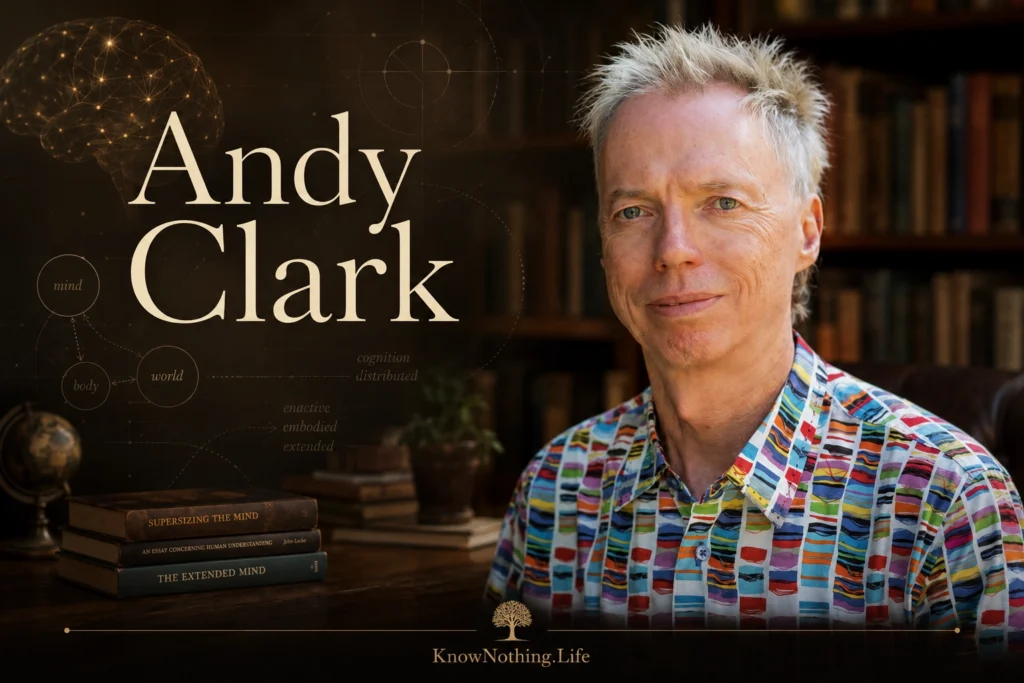
Andy Clark was born in 1957 and became one of the most influential philosophers of mind and cognitive science of his generation. Trained at the University of Stirling, where he earned both a B.A. and a doctorate, Clark entered philosophy at a moment when cognitive science was changing how scholars thought about mind, intelligence, perception, language, and computation. The old picture of the mind as a private inner theater was being challenged by artificial intelligence, neuroscience, robotics, psychology, and theories of embodied action. Clark would become one of the philosophers most responsible for turning those challenges into a new vision of human thought.
From early in his career, Clark resisted the idea that intelligence could be understood by looking only inside the skull. Human beings, he argued, think with bodies, tools, words, gestures, notebooks, computers, institutions, and social environments. This did not mean that the brain was unimportant. On the contrary, Clark’s work treats the brain as wonderfully adaptive. But the brain is adaptive partly because it is so good at using what lies beyond itself. For Clark, the mind is not a sealed container. It is an active system in constant exchange with the world.
Connectionism, Cognitive Science, and Early Work
Clark’s early books, including Microcognition: Philosophy, Cognitive Science and Parallel Distributed Processing and Associative Engines: Connectionism, Concepts, and Representational Change, placed him in the debates surrounding connectionism and artificial neural networks. In the 1980s and early 1990s, philosophers and cognitive scientists were arguing over whether the mind should be understood mainly as a rule-governed symbol-manipulating machine or as a more distributed, pattern-sensitive, adaptive system. Clark helped explain why connectionist models mattered philosophically: they suggested that thought might be less centralized, less language-like, and more context-sensitive than traditional theories assumed.
Yet Clark did not become a simple anti-computational romantic. His originality lay in refusing narrow choices. He was interested in symbols, neural networks, bodies, robots, language, and external tools, because each revealed part of the larger machinery of intelligence. His 1997 book Being There: Putting Brain, Body, and World Together Again announced the direction of his mature thought. Cognition, he argued, is often not something the brain performs alone and then sends outward into action. It is something that unfolds through loops connecting brain, body, and environment.
Being There and Embodied Cognition
Being There became a key text in embodied and situated cognition. The book challenged the traditional image of the mind as a detached problem-solver that first builds an internal model of the world and then acts on it. Clark emphasized instead that intelligent agents often reduce cognitive burden by structuring their surroundings. We arrange desks, mark calendars, use maps, place reminders, write lists, rotate objects, and rely on visible cues so that the world helps us think. The environment is not merely a stage on which cognition performs. It is part of the performance.
This idea also connected Clark with work in robotics and artificial life. Rather than building machines that carry a complete internal representation of the world, researchers could design agents that exploit bodily movement and environmental feedback. Intelligence becomes less like a commander issuing orders from a central headquarters and more like a dance between organism and world. Clark’s philosophy helped make this shift intelligible. He showed that practical intelligence is often opportunistic, improvised, and distributed across whatever resources a creature can recruit.
The Extended Mind
Clark’s most famous contribution came in the 1998 article “The Extended Mind,” written with David Chalmers. The paper begins with the question, “Where does the mind stop and the rest of the world begin?” Clark and Chalmers argued for “active externalism,” the view that parts of the environment can become genuine components of cognitive processes when they play the right role. Their best-known example is Otto, a man with memory impairment who relies on a notebook in the way another person might rely on biological memory. If the notebook is constantly available and guides action in the same functional way, why deny that it is part of Otto’s cognitive system?
The argument became one of the most discussed ideas in contemporary philosophy of mind. It did not merely say that tools help thought; everyone already knew that. It proposed that, in some cases, tools partly constitute thought. Clark and Chalmers wrote that when it comes to belief, there is “nothing sacred about skull and skin.” The line captures the radical force of the thesis. If a notebook, phone, sketchpad, or computer functions as an integrated part of memory, reasoning, or planning, then the boundaries of mind may be wider than biology alone.
Natural-Born Cyborgs
Clark developed this idea for a broader audience in Natural-Born Cyborgs: Minds, Technologies, and the Future of Human Intelligence. The book argued that human beings are not suddenly becoming cyborgs because of smartphones, implants, or artificial intelligence. We have always been cyborg-like creatures because we naturally incorporate tools into our thinking. Language, writing, clocks, maps, libraries, calculators, and digital devices are not alien intrusions into human nature. They express human nature as Clark understands it: a tendency to extend, scaffold, and transform cognition through technology.
One of Clark’s most striking formulations is that “it becomes harder and harder to say where the world stops and the person begins.” This does not mean that every tool is part of the self or that technology is always liberating. Clark’s position is more subtle. Technologies can expand human possibility, but they can also reshape attention, dependence, identity, and vulnerability. If our minds are partly built through our tools, then changing our tools changes us. The future of technology is therefore not merely a matter of convenience. It is a matter of cognitive and personal transformation.
Supersizing the Mind
In Supersizing the Mind: Embodiment, Action, and Cognitive Extension, Clark gave his extended-mind theory its most sustained defense. The book responded to critics who argued that external tools are merely causes or aids of cognition, not parts of cognition itself. Clark answered by emphasizing functional integration. If an external resource is reliably available, automatically trusted, and deeply woven into problem-solving, then excluding it simply because it lies outside the skin may be an arbitrary prejudice.
A central insight of this work is that environmental engineering is also self-engineering. Humans build worlds that build minds. Schools, cities, notebooks, interfaces, rituals, diagrams, labels, and digital networks reshape what people can notice, remember, imagine, and decide. This is why Clark’s philosophy matters beyond academic debates. It gives a framework for thinking about education, design, disability, technology, artificial intelligence, and ethics. A society that changes the cognitive environment is also changing the people who inhabit it.
Predictive Processing and Surfing Uncertainty
In later work, Clark became one of the most important philosophical interpreters of predictive processing. His book Surfing Uncertainty: Prediction, Action, and the Embodied Mind presents the brain as a prediction engine that constantly anticipates sensory input and updates its models when errors arise. Perception, on this view, is not passive reception. The brain actively predicts the causes of sensory signals, while the world corrects or confirms those predictions. We do not simply receive reality from the outside in; we meet it through controlled, revisable expectation.
Clark’s phrase “perception itself is a kind of controlled hallucination” became a memorable way to summarize this view. The point is not that reality is imaginary. It is that experience depends on the brain’s best guess about what is happening, constrained by sensory feedback. This helps explain illusions, expectation effects, bodily self-awareness, pain, mood, and action. The predictive mind is always surfing uncertainty, staying balanced between what it expects and what the world reveals.
The Experience Machine and Later Thought
Clark brought these ideas to a wider readership in The Experience Machine: How Our Minds Predict and Shape Reality. The book explains how predictive processing affects perception, emotion, chronic pain, mental health, attention, and the sense of self. In one concise formulation, Clark writes, “To perceive is to find the predictions” that fit the evidence. This vision makes the mind active all the way down. Experience is not a mirror held up to the world. It is a negotiated achievement between brain, body, and environment.
This later work also shows the continuity of Clark’s career. The extended mind and the predictive mind are not separate projects. Both reject the idea of an isolated inner spectator. In the extended-mind thesis, thought spreads outward into tools and environments. In predictive processing, perception and action form a loop in which the organism constantly tests and adjusts its grip on the world. In both cases, intelligence is relational, embodied, adaptive, and dynamic.
Legacy and Lasting Importance
Andy Clark has held major academic posts at institutions including the University of Sussex, Washington University in St. Louis, Indiana University Bloomington, and the University of Edinburgh, and he is Professor of Cognitive Philosophy at the University of Sussex. His major works include Microcognition, Associative Engines, Being There, Mindware, Natural-Born Cyborgs, Supersizing the Mind, Surfing Uncertainty, and The Experience Machine. He was elected a Fellow of the British Academy and the Royal Society of Edinburgh, reflecting his influence across philosophy, cognitive science, neuroscience, robotics, and artificial intelligence.
Clark’s importance lies in his ability to make philosophy answerable to science without reducing it to science. He has offered new ways to think about minds that are embodied, technologically extended, and predictively engaged with the world. Whether one agrees with every claim or not, his work has changed the basic question. The mind is no longer simply something hidden inside the head. It is something enacted through brains, bodies, tools, practices, and worlds. Andy Clark remains essential because he shows that to understand human intelligence, we must look not only inward, but outward.