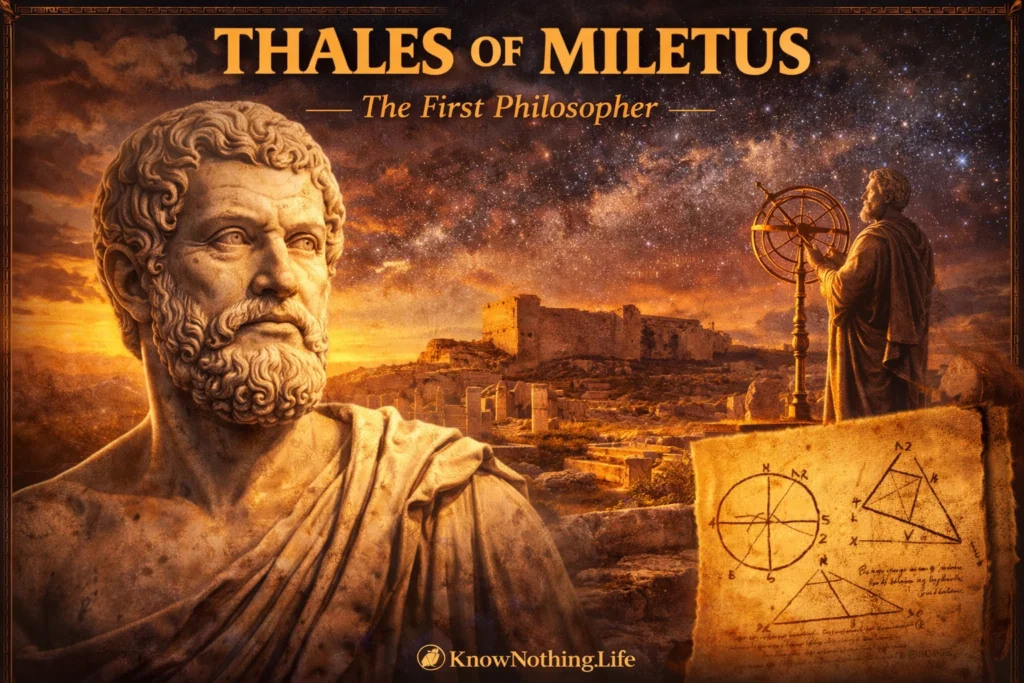
The origins of Western philosophy are often traced to Thales of Miletus, a figure whose ideas marked a decisive shift from mythological explanations of the world to rational inquiry. Rather than attributing natural phenomena to the actions of gods, Thales sought to understand the universe through observation, reasoning, and the search for underlying principles. In doing so, he established a new way of thinking that would shape intellectual history for centuries.
Born in the ancient city of Miletus around the early 6th century BCE, Thales lived during a time of cultural exchange and economic growth. Miletus was a hub of trade and ideas, connecting the Greek world with Egypt and the Near East. This environment provided fertile ground for intellectual development, allowing Thales to draw on diverse influences while forging his own path. His work represents the beginning of philosophy as a distinct discipline, grounded in reason rather than tradition.
Life and Historical Context
Although little is known about Thales’ life with certainty, historical accounts portray him as both a thinker and a practical figure. He is often described as a mathematician, astronomer, and engineer, reflecting the breadth of his interests. Unlike later philosophers who focused primarily on abstract questions, Thales engaged directly with the natural world, seeking explanations that could be tested and observed.
Thales is said to have traveled to Egypt, where he studied geometry and astronomy. These experiences likely influenced his approach to knowledge, emphasizing measurement and calculation. His ability to apply theoretical insights to practical problems earned him a reputation as one of the “Seven Sages of Greece,” a group of early thinkers known for their wisdom and contributions to society.
The historical context in which Thales lived was characterized by a transition from mythos to logos—from storytelling to rational explanation. This shift was not immediate or complete, but Thales played a crucial role in initiating it. By proposing natural causes for natural phenomena, he challenged traditional beliefs and opened the door to scientific inquiry.
The First Principle: Water as Arche
At the core of Thales’ philosophy is his claim that water is the fundamental principle, or arche, of all things. According to this view, everything in the universe originates from and is sustained by water. While this idea may seem simplistic by modern standards, it represents a significant departure from mythological explanations.
Thales’ reasoning was based on observation. He noted the importance of moisture for life, the presence of water in various forms, and its role in sustaining the environment. From these observations, he concluded that water must be the underlying substance of reality. This approach reflects an early attempt to identify a unifying principle that explains the diversity of the world.
The concept of an arche introduced by Thales became a central concern for later philosophers. Thinkers such as Anaximander and Anaximenes proposed alternative principles, but the idea of a fundamental substance remained a key focus. Thales’ contribution lies not in the specific choice of water, but in the method of seeking a rational explanation.
Mathematics and Geometry
Thales is also credited with important contributions to mathematics, particularly in geometry. Although many of these attributions come from later sources, they reflect his reputation as a pioneer in applying mathematical reasoning to the natural world. He is said to have used geometric principles to measure the height of pyramids and the distance of ships at sea.
One of the most notable achievements attributed to Thales is his use of similar triangles to determine heights and distances. This method demonstrates an understanding of proportional relationships and the ability to apply abstract concepts to practical problems. Such innovations laid the groundwork for the development of geometry as a formal discipline.
His mathematical work reflects a broader commitment to rational inquiry. By using measurement and calculation, Thales showed that knowledge could be obtained through systematic methods rather than speculation. This approach would become a defining feature of scientific thought.
Astronomy and Natural Phenomena
Thales’ interest in astronomy further illustrates his commitment to understanding the natural world. He is famously credited with predicting a solar eclipse, an achievement that, whether fully accurate or not, highlights his reputation as an observer of celestial phenomena. His work in this area reflects an early attempt to identify patterns and regularities in the movements of the heavens.
In addition to astronomy, Thales explored other natural phenomena, including earthquakes and magnetism. He is said to have proposed that earthquakes are caused by movements of water beneath the Earth, an explanation that, while incorrect, represents a shift toward natural causation. Similarly, his observations of magnetism and static electricity suggest an interest in forces that were not yet understood.
These investigations demonstrate Thales’ willingness to question assumptions and seek explanations grounded in observation. His work marks the beginning of a scientific approach to understanding the world, emphasizing inquiry and evidence over tradition.
Quotes and Attributed Sayings
Since Thales left no written works, his ideas are preserved through later accounts, particularly those of Aristotle and other historians. Several sayings are attributed to him, reflecting both his philosophical insights and his practical wisdom:
- “Water is the principle of all things.”
- “All things are full of gods.”
- “The most difficult thing in life is to know yourself.”
- “Time is the wisest of all things, for it brings everything to light.”
These statements capture the essence of Thales’ thought, combining natural explanation with broader reflections on life and knowledge. They illustrate a thinker who sought to understand both the physical world and the human condition.
Influence on Philosophy and Science
Thales’ influence on subsequent philosophy is profound. As the first thinker to propose a natural explanation for the origin of the world, he established a framework for inquiry that would be developed by later philosophers. His emphasis on rational explanation and observation became foundational principles of Western thought.
The Milesian school, which includes figures such as Anaximander and Anaximenes, built upon Thales’ ideas, exploring alternative explanations for the nature of reality. These thinkers continued the search for an arche, refining and expanding the methods introduced by Thales.
Beyond philosophy, Thales’ work influenced the development of science and mathematics. His approach to understanding the world through observation and reasoning laid the groundwork for disciplines that would emerge centuries later. He represents the beginning of a tradition that values inquiry, evidence, and the pursuit of knowledge.
Legacy and Historical Significance
Thales’ legacy extends far beyond his specific ideas. He is often regarded as the first philosopher because he introduced a new way of thinking—one that seeks explanations based on reason rather than myth. This shift marks the beginning of philosophy as a systematic discipline.
His contributions to mathematics, astronomy, and natural philosophy reflect a holistic approach to knowledge. Thales did not separate disciplines as they are today; instead, he viewed them as interconnected aspects of understanding the world. This perspective underscores the unity of knowledge and the importance of interdisciplinary inquiry.
Despite the limited historical record, Thales remains a central figure in the history of ideas. His work continues to be studied and interpreted, offering insights into the origins of philosophy and science.
Conclusion
Thales of Miletus stands at the beginning of a tradition that continues to shape human understanding. By seeking natural explanations for natural phenomena, he transformed the way people think about the world, laying the foundation for philosophy and science.
His identification of water as the fundamental principle may no longer be accepted, but the method behind it—the search for underlying causes through observation and reason—remains central to intellectual inquiry. Thales’ legacy lies in this approach, which continues to guide the pursuit of knowledge.
In the transition from myth to reason, Thales represents a decisive moment in human history. His work reminds us that understanding begins with questioning, and that even the simplest ideas can lead to profound discoveries.