Circadian rhythms are internally generated biological cycles that repeat approximately every twenty-four hours. The word circadian comes from Latin roots meaning “about a day,” reflecting the fact that the body’s natural timing system does not necessarily run at exactly twenty-four hours without environmental guidance. These rhythms organize sleep and wakefulness, body temperature, hormone secretion, digestion, metabolism, attention, immune activity, and many other physiological processes. A true circadian rhythm continues under constant conditions, distinguishing it from a behavior that occurs only because the environment changes between day and night.
Human experiments conducted under controlled lighting and scheduling conditions have shown that the intrinsic period of the circadian pacemaker averages slightly longer than twenty-four hours. In a landmark 1999 study, Charles Czeisler and colleagues estimated an average intrinsic period of approximately 24.18 hours in healthy younger and older adults. The difference may seem small, but it means that the human clock must be adjusted each day to remain synchronized with the twenty-four-hour environment. Light is the most important signal performing this adjustment, although food timing, physical activity, temperature, and social schedules can also influence specific rhythms.
The Suprachiasmatic Nucleus
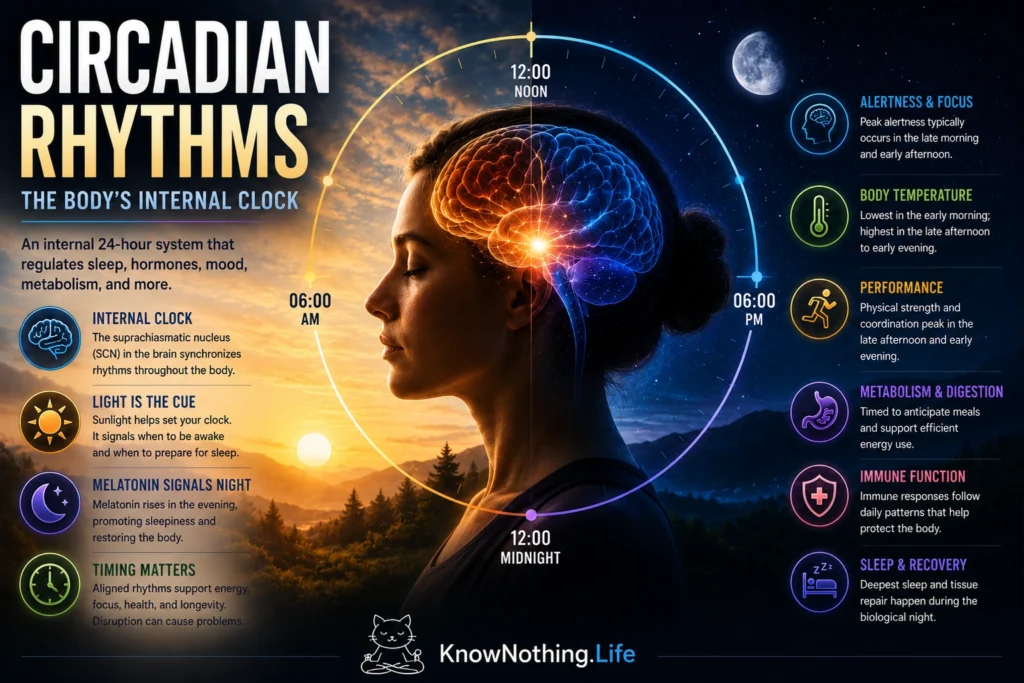
The principal circadian pacemaker in mammals is located in the suprachiasmatic nucleus, or SCN, a small region of the hypothalamus positioned above the optic chiasm. The SCN receives information about environmental light from the eyes and uses that information to coordinate rhythms throughout the brain and body. It does not directly perform every circadian function. Instead, it acts more like a conductor, synchronizing neural activity, hormone secretion, body temperature, behavior, and subsidiary clocks located in peripheral organs.
The central role of the SCN became clear through two influential experiments published in 1972. Robert Moore and Victor Eichler found that damage to the SCN eliminated the normal daily rhythm of adrenal corticosterone secretion in rats. In a separate study, Friedrich Stephan and Irving Zucker showed that bilateral SCN lesions abolished circadian rhythms in drinking and locomotor activity. These findings demonstrated that the SCN was not merely responding to rhythmic behavior generated elsewhere. Its activity was necessary for coordinating both endocrine and behavioral cycles.
The Molecular Clock Inside Cells
Circadian timing also exists at the cellular level. Within many cells, groups of clock genes and proteins interact through delayed feedback loops. Certain proteins promote the expression of other clock genes, whose protein products later return to inhibit the activity that produced them. The proteins are gradually modified and degraded, allowing the cycle to begin again. Because gene expression, protein accumulation, inhibition, and breakdown require time, the feedback loop produces an oscillation lasting approximately one day.
Ronald Konopka and Seymour Benzer provided early evidence that circadian behavior has a genetic basis in their 1971 paper Clock Mutants of Drosophila melanogaster. They identified fruit-fly mutations that produced an abnormally short rhythm, an abnormally long rhythm, or a complete loss of ordinary circadian rhythmicity. More than two decades later, Joseph Takahashi and colleagues identified the mouse Clock gene through positional cloning. Mutations in this gene lengthened the animals’ free-running period and could eventually cause behavioral rhythms to disappear under constant conditions. These studies helped establish that biological time is generated by identifiable molecular machinery rather than by a vague response to daily routine.
Light and Circadian Entrainment
The internal clock must be synchronized, or entrained, to the external world. Light reaching the retina activates pathways that communicate with the SCN, allowing the pacemaker to compare internal time with the environmental light-dark cycle. The effect of light depends strongly on when exposure occurs. Light encountered during the biological evening or early night generally shifts the clock later, while light during the late night or early biological morning tends to shift it earlier. Light during other phases may produce relatively little change.
Charles Czeisler and colleagues demonstrated in 1986 that appropriately timed bright light could reset the human circadian pacemaker. Their work challenged earlier suggestions that human rhythms were synchronized mainly by social routines rather than by light. The findings explain why timed light exposure can help shift sleep schedules, while poorly timed nighttime light can delay biological night. The relevant variable is not simply whether a room appears bright enough for vision; intensity, timing, duration, wavelength, and previous light exposure all influence the circadian response.
Melatonin and Biological Night
Melatonin is a hormone produced mainly by the pineal gland under the control of the circadian system. Its concentration usually rises in the evening, remains elevated during biological night, and declines toward morning. Melatonin does not create the circadian clock, and it is not merely a chemical switch that causes unconsciousness. It functions primarily as a signal of internal night, communicating circadian timing to the brain and other tissues. Sleep may become easier when melatonin rises because the signal occurs alongside changes in temperature, alertness, and sleep propensity.
Alfred Lewy and colleagues demonstrated in 1980 that bright artificial light could suppress nocturnal melatonin secretion in humans. This discovery provided direct evidence that environmental light can produce an endocrine response associated with circadian timing. Evening light may suppress or delay melatonin, especially when it is sufficiently intense or enriched in wavelengths to which the circadian system is sensitive. The behavioral consequences depend on timing: light can be useful when deliberately applied to shift the clock, yet disruptive when it repeatedly extends the biological day into the night.
Circadian Rhythms and Sleep
The circadian system is closely connected to sleep, but the two are not identical. Sleep is regulated partly by a homeostatic process in which pressure to sleep accumulates during wakefulness and declines during sleep. At the same time, the circadian pacemaker produces a changing signal that promotes wakefulness or sleep at different biological times. These processes interact. A person may remain awake for many hours and accumulate substantial sleep pressure, yet still experience a temporary evening increase in alertness because the circadian system is promoting wakefulness.
Dererk-Jan Dijk and Charles Czeisler separated these influences using forced-desynchrony experiments in which participants lived on schedules outside the normal range of entrainment. Their findings showed that sleep structure and sleep tendency were shaped independently by time awake and circadian phase. Sleep is usually most consolidated when the scheduled sleep period aligns with the biological night. When people attempt to sleep during a circadian phase that promotes alertness, sleep may become shorter or more fragmented even when they are tired. Conversely, wakefulness during the biological night is often accompanied by reduced alertness and impaired performance.
Clocks Throughout the Body
The SCN is the central coordinator, but it is not the body’s only clock. Rhythmic gene activity has been observed in the liver, pancreas, muscles, adipose tissue, heart, and other organs. These peripheral clocks help tissues prepare for predictable daily demands. The liver can anticipate periods of feeding and fasting, while metabolic tissues can alter enzyme activity, nutrient handling, and hormone sensitivity according to biological time. Coordination among these clocks allows the body to perform related functions in an organized sequence.
Food timing can shift peripheral clocks even when the central pacemaker remains aligned with the light-dark cycle. In 2000, Frédéric Damiola and colleagues restricted food availability in rodents to unusual times and found that circadian gene expression shifted in peripheral tissues while the SCN remained comparatively resistant to the feeding schedule. The experiment showed that different environmental cues can affect different parts of the circadian system. Light remains the dominant synchronizer of the SCN, while meal timing can strongly influence metabolic clocks. Misalignment can therefore occur within the body when sleep, light exposure, and eating schedules send conflicting temporal information.
Circadian Misalignment
Circadian misalignment occurs when behavior and environmental demands conflict with internal biological time. Jet lag is a temporary example: the traveler’s clock remains synchronized to the departure location while the new environment follows another schedule. Shift work can produce a more persistent conflict because workers may be expected to remain alert at night, sleep during the day, and return to daytime activity on days off. Complete adaptation is difficult when light exposure, meals, work demands, and family routines repeatedly pull the system in different directions.
Frank Scheer and colleagues examined circadian misalignment under controlled laboratory conditions in a 2009 study. Participants living on a schedule that placed behavioral cycles out of alignment with their internal clocks developed changes in glucose regulation, blood pressure, and hormonal patterns. The experiment did not show that every night worker will develop the same health problems, but it demonstrated that misalignment itself can produce adverse metabolic and cardiovascular effects independently of ordinary lifestyle explanations. Circadian disruption therefore involves more than feeling sleepy at an inconvenient time; it can change how the body processes food and regulates essential physiological functions.
Why Circadian Rhythms Matter
Circadian rhythms allow the body to anticipate recurring demands rather than merely react after they appear. Cortisol can rise before ordinary waking, body temperature can change before sleep, and metabolic tissues can prepare for expected periods of food intake. This predictive organization improves efficiency by placing physiological processes at times when they are most useful. The circadian system also prevents incompatible activities from occurring at maximum intensity simultaneously, helping coordinate repair, digestion, movement, attention, and sleep across the day.
The evidence shows that the body does not contain one simple clock that merely announces bedtime. It contains a network of molecular and neural clocks coordinated by the SCN and adjusted through light, behavior, and food timing. These systems influence when people feel alert, when hormones are released, and how organs respond to the same event at different times. Circadian health therefore depends on alignment: internal clocks, environmental light, sleep, meals, and daily activity function best when they provide a reasonably consistent account of what time it is.