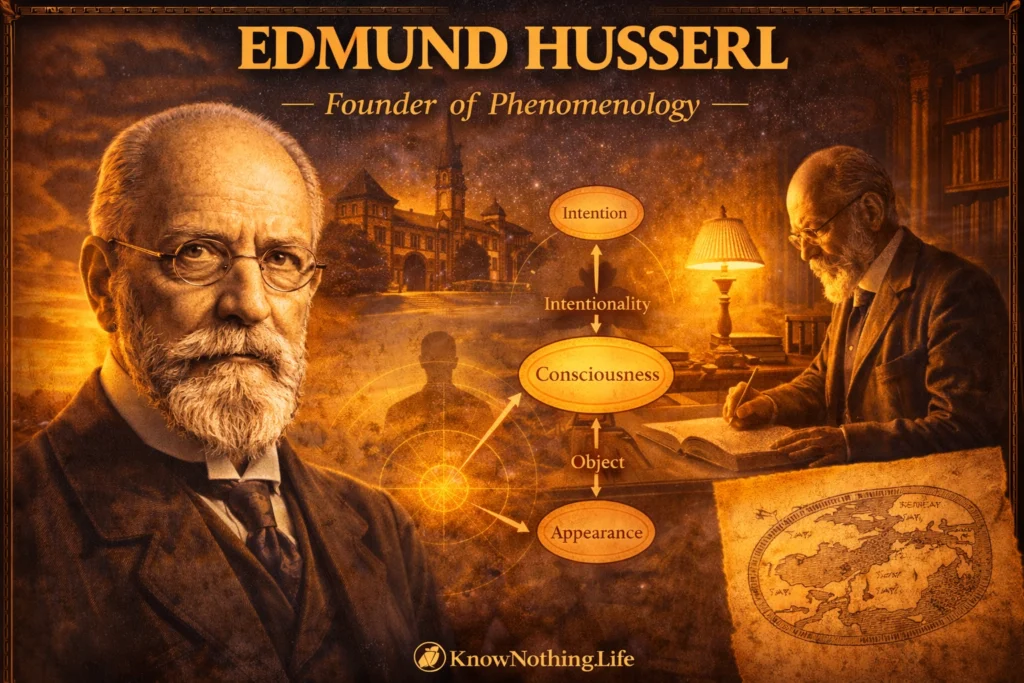
The philosophy of Edmund Husserl marks one of the most important turning points in modern thought, redefining how philosophy approaches consciousness, knowledge, and experience. As the founder of phenomenology, Husserl sought to establish philosophy as a rigorous science grounded not in speculation, but in the careful examination of lived experience. His work represents a response to both the rise of scientific naturalism and the limitations of traditional metaphysics.
Born in 1859 in Prostějov (then part of the Austrian Empire), Husserl lived during a period of intellectual transformation. The rapid development of science and mathematics had reshaped the understanding of reality, yet questions about consciousness and meaning remained unresolved. Husserl’s project aimed to address these gaps by focusing on the structures of experience itself, offering a new foundation for philosophy.
Early Life and Intellectual Formation
Husserl’s early education was rooted in mathematics, a discipline that would profoundly influence his philosophical approach. He studied under prominent mathematicians, including Karl Weierstrass, and developed a deep appreciation for precision and logical rigor. This background shaped his later efforts to make philosophy as exact as mathematics.
His transition from mathematics to philosophy was influenced by his engagement with Franz Brentano, whose concept of intentionality—the idea that consciousness is always directed toward something—became central to Husserl’s thought. Brentano’s emphasis on the study of mental phenomena provided a starting point, but Husserl sought to develop these ideas into a comprehensive philosophical system.
Husserl’s early work, particularly Philosophy of Arithmetic, reflects his attempt to bridge mathematics and philosophy. However, he soon recognized the limitations of purely logical approaches, leading him to develop a new method that would focus directly on experience.
Logical Investigations and the Birth of Phenomenology
Husserl’s breakthrough came with the publication of Logical Investigations, a work that laid the foundation for phenomenology. In this text, he critiques psychologism—the idea that logical laws are based on psychological processes—and argues instead for the objectivity of logic.
This work introduces key concepts that define phenomenology, including the analysis of intentionality and the distinction between the act of consciousness and its object. Husserl emphasizes that meaning is not derived from external reality alone, but from the way objects are experienced by consciousness.
The Logical Investigations represent a shift toward a new method of philosophical inquiry, one that seeks to describe experience as it is given. This descriptive approach avoids assumptions about the external world, focusing instead on the structures that make experience possible.
Phenomenological Reduction and Epoché
One of Husserl’s most significant contributions is the development of the phenomenological method, particularly the concepts of epoché and reduction. The epoché involves suspending judgment about the existence of the external world, allowing the philosopher to focus purely on experience.
Through this process, Husserl aims to uncover the essential structures of consciousness. By setting aside assumptions and beliefs, the philosopher can examine how objects appear to the mind, revealing the underlying patterns of perception and meaning.
The phenomenological reduction takes this process further, directing attention to the relationship between consciousness and its objects. This method allows Husserl to explore the foundations of knowledge, seeking to establish a secure basis for philosophy.
Time, Consciousness, and Intentionality
Husserl’s analysis of time-consciousness represents one of his most profound contributions. He examines how the experience of time is structured, distinguishing between retention (the immediate past), the present moment, and protention (the anticipation of the future). This framework reveals that consciousness is not static, but dynamic and continuous.
Intentionality remains central to this analysis. Every act of consciousness is directed toward an object, whether real or imagined. This relationship defines the structure of experience, linking the subject and the world in a fundamental way.
Husserl’s exploration of these concepts highlights the complexity of consciousness. By examining how experiences are structured, he provides insights into perception, memory, and imagination, contributing to a deeper understanding of the mind.
Later Works and the Crisis of European Sciences
In his later work, particularly The Crisis of European Sciences, Husserl addresses the broader implications of his philosophy. He argues that modern science, while successful in explaining the physical world, has lost sight of its connection to human experience.
Husserl identifies a “crisis” in which scientific knowledge becomes detached from meaning, reducing the world to a set of abstract measurements. He calls for a return to the “lifeworld,” the everyday world of experience that forms the basis of all knowledge.
This critique reflects Husserl’s broader concern with the foundations of knowledge. By reconnecting science with experience, he seeks to restore its relevance and significance, emphasizing the importance of human perspective.
Quotes and Key Ideas
Husserl’s writings contain statements that capture the essence of his philosophical project. Among his most notable quotes:
- “Back to the things themselves!”
- “Every consciousness is consciousness of something.”
- “Experience by itself is not science.”
- “The world is always already there before reflection begins.”
These statements reflect his emphasis on experience, intentionality, and the need for rigorous analysis. They highlight a philosophy that seeks to uncover the structures underlying human understanding. Husserl’s key ideas—phenomenology, intentionality, epoché, and the lifeworld—have become foundational concepts in modern philosophy. They continue to influence a wide range of disciplines.
Influence and Legacy
Husserl’s influence extends far beyond his own work, shaping the development of 20th-century philosophy. His ideas inspired thinkers such as Martin Heidegger, who expanded phenomenology into existential analysis, and Maurice Merleau-Ponty, who explored perception and embodiment.
Phenomenology also influenced fields such as psychology, sociology, and cognitive science. Its emphasis on experience and meaning has provided a framework for understanding human behavior and perception in new ways. Husserl’s legacy lies in his attempt to establish philosophy as a rigorous discipline grounded in experience. His work continues to be studied and developed, reflecting its enduring relevance.
Conclusion
Edmund Husserl stands as one of the most important philosophers of the modern era, redefining the study of consciousness and the foundations of knowledge. Through phenomenology, he introduced a method that emphasizes the careful examination of experience, offering a new approach to philosophical inquiry.
His work challenges us to reconsider the relationship between the mind and the world, highlighting the importance of perception and meaning. By focusing on the structures of consciousness, Husserl provides a framework for understanding how we experience reality. In a world shaped by scientific and technological advancements, Husserl’s philosophy remains a vital reminder of the importance of human experience. His insights continue to guide the exploration of consciousness, knowledge, and the nature of reality.