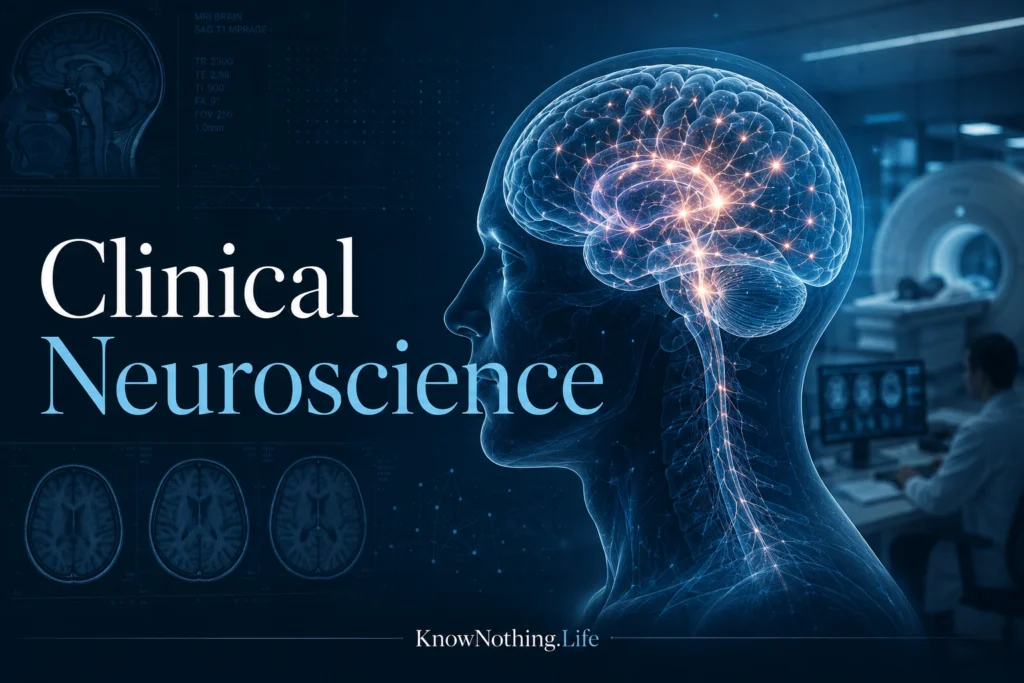
Clinical neuroscience examines how changes in the brain, spinal cord, peripheral nerves, and related biological systems produce disorders of thought, emotion, sensation, movement, and behavior. It sits at the intersection of neurology, psychiatry, neurosurgery, neuropsychology, neuroradiology, genetics, pharmacology, and rehabilitation medicine. Rather than treating the nervous system as an abstract collection of cells and circuits, the field asks how those systems function in living people, how they become impaired, and how scientific knowledge can be converted into diagnosis, prevention, treatment, and recovery.
A clinical neuroscientist may study ion channels that cause epilepsy, networks associated with depression, immune responses that damage myelin, vascular events that interrupt cerebral blood flow, or genetic mutations that lead to degeneration. Yet the ultimate reference point remains the patient. Symptoms must be connected to mechanisms, and mechanisms must be tested against meaningful outcomes. This movement from bedside observation to laboratory investigation and back again distinguishes clinical neuroscience from basic research conducted without an immediate clinical question.
From Brain Lesions to Neural Systems
Modern clinical neuroscience grew from the recognition that injuries and diseases could reveal the organization of the healthy brain. Nineteenth-century observations associated language loss with damage to particular cortical regions, but later research showed that many complex abilities depend on distributed systems. One of the most influential cases was patient H.M., whose inability to form new declarative memories followed bilateral medial temporal surgery for epilepsy. William Scoville and Brenda Milner’s 1957 report, “Loss of Recent Memory After Bilateral Hippocampal Lesions,” demonstrated that hippocampal and neighboring medial temporal structures are essential for forming lasting memories, while other kinds of learning may remain relatively preserved.
Cases such as H.M. established a durable principle: neurological symptoms can act as natural experiments, but interpretation requires precision. A lesion may damage several structures, disconnect distant regions, alter compensatory activity, or produce effects that change over time. Clinical neuroscience therefore moved from simple localization toward network models. Marcus Raichle and colleagues’ 2001 study, “A Default Mode of Brain Function,” showed that organized neural activity persists during quiet rest, helping establish the modern investigation of intrinsic functional networks. Clinicians increasingly ask not only where damage occurs, but how disease disrupts communication across the brain.
Diagnosing Disease Through Multiple Levels of Evidence
Clinical diagnosis still begins with history and examination. Patterns of weakness, sensory loss, language difficulty, memory change, involuntary movement, or altered consciousness can suggest which systems are affected and how quickly a disorder is developing. Technology then extends the examination. Structural magnetic resonance imaging reveals anatomy, diffusion imaging evaluates white-matter pathways, electroencephalography records electrical rhythms, and cerebrospinal fluid, blood, imaging, and genetic tests provide molecular or physiological evidence. Because no single measurement fully explains a patient, strong diagnoses usually depend on converging information.
Alzheimer’s disease illustrates this approach. In a landmark study of families with dominantly inherited disease, Randall Bateman and colleagues found that biochemical, imaging, metabolic, and cognitive changes appeared in an ordered sequence beginning years before expected symptom onset. The findings strengthened the view that neurodegenerative disease can develop long before dementia becomes obvious. Genetics has also reorganized diagnostic categories. Independent studies published in 2011 identified expanded repeats in C9ORF72 as a major genetic cause linking amyotrophic lateral sclerosis and frontotemporal dementia, helping explain why movement, language, personality, and executive symptoms may appear within the same biological spectrum.
Turning Mechanisms Into Treatment
The most visible achievement of clinical neuroscience is its ability to convert mechanistic knowledge into therapies. Deep-brain stimulation demonstrates this translation. Electrodes implanted in carefully selected targets can modify abnormal circuit activity in movement disorders. In a randomized trial led by Günther Deuschl, patients with advanced Parkinson’s disease who received subthalamic stimulation plus medication showed greater improvements in motor function and quality of life than patients receiving medication alone. The procedure does not cure Parkinson’s disease and can produce surgical, cognitive, or psychiatric complications, but it shows that altering network dynamics can relieve disabling symptoms.
Closed-loop systems take this idea further by recording neural activity and delivering stimulation when pathological patterns are detected. The pivotal responsive neurostimulation trial for drug-resistant focal epilepsy found that stimulation directed at seizure-generating regions reduced seizure frequency and that benefits improved over time. Clinical neuroscience has also transformed emergency treatment. The MR CLEAN trial showed that intraarterial treatment improved outcomes for selected patients with acute ischemic stroke caused by large-vessel occlusion. These advances share the same logic: identify the mechanism, select patients using biological evidence, intervene within the correct circuit or time window, and measure functional improvement.
Psychiatry as Clinical Neuroscience
Psychiatric disorders have historically been classified through reported experience and observable behavior, partly because their biology is distributed, variable, and difficult to measure. Clinical neuroscience does not make subjective experience less important; it attempts to connect that experience with changes in synapses, stress systems, development, immune signaling, and large-scale networks. Depression, schizophrenia, addiction, and anxiety are not reducible to a single neurotransmitter or region. Their symptoms emerge through interactions among biological vulnerability, learning, environment, relationships, and culture.
Research on ketamine illustrates how clinical observation can challenge an established model. In a randomized crossover trial, Carlos Zarate and colleagues found that a single intravenous dose of the NMDA-receptor antagonist produced rapid antidepressant effects in some patients with treatment-resistant major depression. The result shifted attention toward glutamatergic signaling, synaptic plasticity, and rapid changes in neural function. It also demonstrated a central lesson of the field: a treatment can reveal mechanisms even when those mechanisms remain incompletely understood. Response variability and safety concerns still require replication, longer follow-up, and careful patient selection.
Precision, Ethics, and the Future
The future of clinical neuroscience is likely to be increasingly individualized. Two patients with the same diagnosis may have different genetic risks, circuit abnormalities, rates of progression, and responses to treatment. Precision approaches seek biomarkers that can divide broad syndromes into biologically meaningful subgroups, predict outcomes, and guide therapy. Brain-responsive devices, advanced imaging, digital behavioral measurements, and molecular profiling may allow clinicians to adapt treatment as a condition changes. These tools should strengthen rather than replace clinical judgment.
Greater power also creates ethical obligations. Brain data can reveal sensitive information about cognition, emotion, risk, and identity. Implantable devices raise questions about agency, consent, long-term maintenance, and responsibility for changes in mood or behavior. Predictive biomarkers may identify disease risk before effective prevention exists, while expensive therapies can deepen inequalities in access. Clinical neuroscience must therefore be evaluated not only by whether it can alter the nervous system, but by whether it improves the life of the person receiving care.
Conclusion
Clinical neuroscience has changed medicine by linking symptoms to cells, circuits, networks, genes, and environments. Landmark work on memory, intrinsic brain activity, inherited neurodegeneration, neurostimulation, stroke intervention, and rapid antidepressant treatment shows how observations can move between laboratory and clinic. The field’s greatest strength is integration: a disorder may be molecular in origin, network-based in expression, psychological in experience, and social in consequence.
As its methods become more precise, progress will require reproducible evidence, realistic interpretations of biomarkers, meaningful clinical outcomes, and respect for individual values. The brain is the organ through which people remember, decide, communicate, and understand themselves. Treating its disorders therefore demands both biological rigor and a careful appreciation of personhood.