The philosophy of Hans-Georg Gadamer represents one of the most influential developments in 20th-century continental thought, particularly in the field of hermeneutics—the theory of interpretation. Gadamer’s work challenges the assumption that understanding is a purely objective process, arguing instead that it is shaped by history, language, and tradition. His philosophy invites us to reconsider how we interpret texts, ideas, and even the world itself.
Born in 1900 in Marburg, Gadamer lived through a period of profound intellectual and political change. His work emerges in dialogue with earlier thinkers, particularly Martin Heidegger, whose influence is evident in Gadamer’s emphasis on being, language, and the situated nature of understanding. However, Gadamer develops these ideas in a distinct direction, focusing on the role of tradition and dialogue in shaping meaning.
Early Life and Intellectual Formation
Gadamer’s early education was shaped by a strong humanistic background, with an emphasis on classical languages and literature. His father, a chemist, encouraged a scientific approach to knowledge, but Gadamer was drawn to the humanities, particularly philosophy and philology. This tension between scientific objectivity and humanistic inquiry would later become a central theme in his work.
He studied at the University of Marburg, where he was influenced by neo-Kantian philosophy. However, his intellectual trajectory changed significantly when he encountered Heidegger, whose lectures introduced a new way of thinking about existence and understanding. Heidegger’s emphasis on the historical and interpretive nature of human experience had a lasting impact on Gadamer.
Despite this influence, Gadamer did not simply adopt Heidegger’s ideas. Instead, he sought to develop a philosophy that emphasized dialogue, tradition, and the continuity of understanding. His work reflects a commitment to exploring how meaning emerges through interaction and interpretation.
Truth and Method
Gadamer’s most significant work, Truth and Method, represents a comprehensive exploration of hermeneutics and the nature of understanding. In this text, he challenges the idea that truth can be achieved through method alone, particularly in the human sciences.
He argues that understanding is not a mechanical process that can be reduced to a set of rules. Instead, it involves a dynamic interaction between the interpreter and the object of interpretation. This process is shaped by historical context, language, and the interpreter’s own perspective.
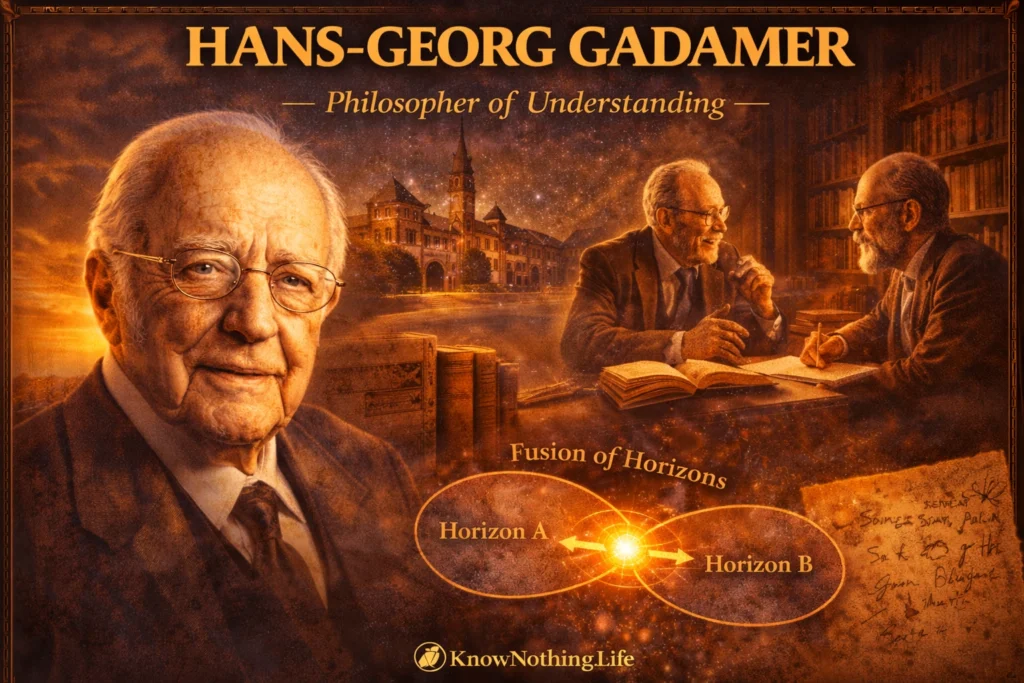
Gadamer introduces the concept of the “fusion of horizons,” which describes how understanding occurs when different perspectives come together. Rather than eliminating bias, this process acknowledges that interpretation is always influenced by prior assumptions. By engaging with these assumptions, we can achieve a deeper and more meaningful understanding.
Tradition and Historical Consciousness
A central theme in Gadamer’s philosophy is the role of tradition in shaping understanding. He rejects the Enlightenment ideal of complete objectivity, arguing that we are always situated within a historical context that influences our perspective. Tradition is not something to be overcome, but something that enables understanding.
Gadamer emphasizes the importance of historical consciousness—the awareness that our interpretations are shaped by the past. This awareness allows us to engage more critically with our assumptions, recognizing that they are part of a larger historical process.
Rather than viewing tradition as a limitation, Gadamer sees it as a source of insight. By engaging with the past, we can enrich our understanding of the present. This perspective highlights the continuity of human experience and the importance of dialogue across time.
Language and the Nature of Understanding
For Gadamer, language plays a central role in the process of understanding. He argues that language is not merely a tool for communication, but the medium through which reality is revealed. This idea echoes Heidegger’s claim that language is the “house of Being,” but Gadamer develops it in a more dialogical direction.
Understanding, in Gadamer’s view, is fundamentally linguistic. It occurs through conversation, interpretation, and the exchange of ideas. This process is not limited to spoken language, but includes all forms of symbolic expression, including art and literature.
Gadamer’s emphasis on language highlights the communal nature of understanding. Meaning is not created in isolation, but emerges through interaction with others. This perspective underscores the importance of dialogue in the pursuit of knowledge.
Dialogue and the Hermeneutic Experience
Dialogue is at the heart of Gadamer’s philosophy. He argues that genuine understanding arises through conversation, where participants are open to the perspectives of others. This process involves a willingness to question one’s own assumptions and engage with alternative viewpoints. The hermeneutic experience, as described by Gadamer, is not about achieving certainty, but about deepening understanding.
It is a process of continual refinement, where meaning evolves through interaction and reflection. This approach contrasts with models of knowledge that emphasize fixed truths and definitive answers. Gadamer’s focus on dialogue reflects a broader commitment to openness and humility. By recognizing the limits of our understanding, we can engage more meaningfully with others and the world around us.
Quotes and Key Ideas
Gadamer’s writings include statements that capture the essence of his philosophical approach. Among his most notable quotes:
- “Being that can be understood is language.”
- “The fusion of horizons is the achievement of understanding.”
- “We understand in a different way, if we understand at all.”
- “Prejudices are not necessarily unjustified and erroneous.”
These statements reflect his emphasis on language, interpretation, and the role of tradition in shaping understanding. They highlight a philosophy that values dialogue and openness.
Gadamer’s key ideas—hermeneutics, the fusion of horizons, historical consciousness, and the centrality of language—have had a lasting impact on philosophy and the humanities. They continue to influence fields such as literary theory, theology, and social science.
Influence and Legacy
Gadamer’s influence extends across multiple disciplines, shaping contemporary discussions of interpretation and understanding. His work has been particularly important in the development of philosophical hermeneutics, providing a framework for analyzing texts, art, and cultural practices.
His ideas have also influenced thinkers such as Paul Ricoeur, who expanded hermeneutics into new areas, including narrative and identity. In addition, Gadamer’s emphasis on dialogue has had implications for political theory and ethics, highlighting the importance of communication and mutual understanding.
Gadamer’s legacy lies in his ability to bridge tradition and innovation. By engaging with the past while addressing contemporary issues, he created a philosophy that remains relevant and dynamic.
Conclusion
Hans-Georg Gadamer stands as one of the most important philosophers of the 20th century, offering a profound rethinking of understanding, interpretation, and the role of tradition. His work challenges the idea of objective knowledge, emphasizing instead the importance of dialogue, language, and historical context.
Through concepts such as the fusion of horizons and the hermeneutic experience, Gadamer provides a framework for engaging with the world in a thoughtful and reflective way. His philosophy encourages openness, humility, and a willingness to learn from others. In a world characterized by complexity and diversity, Gadamer’s insights remain deeply relevant. They remind us that understanding is not a fixed achievement, but an ongoing process shaped by interaction and reflection.