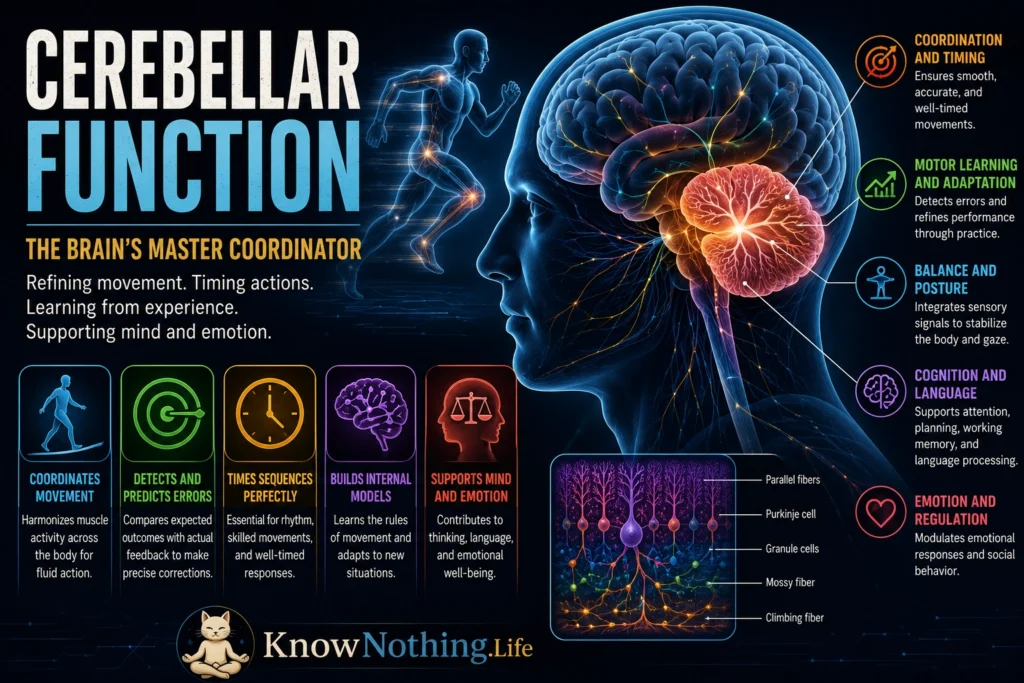
The cerebellum is a densely organized brain structure positioned behind the brainstem and beneath the rear portions of the cerebral hemispheres. Its name means “little brain,” but its influence extends throughout the nervous system. It receives information about intended actions, ongoing movement, sensory feedback, balance, and the state of the body. Rather than directly initiating most voluntary movements, the cerebellum helps ensure that actions are accurately timed, properly scaled, and adjusted when circumstances change. Cerebellar disorders commonly produce ataxia, including irregular gait, inaccurate limb movements, unstable posture, abnormal eye movements, and impaired speech coordination.
The cerebellum also participates in learning, prediction, cognition, language, and emotional regulation. Its contributions are often described as modulatory: it compares patterns, detects deviations, and improves the efficiency or consistency of activity occurring elsewhere. This helps explain why cerebellar injury rarely eliminates a complex ability entirely. Instead, behavior may become disorganized, poorly timed, unusually variable, or difficult to adapt. Research on cerebellar functional topography indicates that motor, cognitive, and affective processes engage different but partly overlapping cerebellar territories connected with corresponding cerebral and brainstem networks.
Cerebellar Circuits and Purkinje Cells
The cerebellar cortex contains a highly regular neural architecture repeated across its folded surface. Information arrives through mossy fibers and climbing fibers, which influence granule cells, interneurons, and Purkinje cells. Purkinje cells form the sole output of the cerebellar cortex and inhibit neurons in the deep cerebellar nuclei and vestibular nuclei. These deeper structures provide much of the cerebellum’s output to motor, thalamic, and brainstem systems. The repeated organization of this circuit has encouraged the idea that different cerebellar regions may perform related computations on different kinds of information.
Purkinje cells produce two distinctive forms of electrical activity. Simple spikes occur frequently and reflect the combined influence of many inputs, while complex spikes are triggered by powerful climbing-fiber signals originating in the inferior olive. In a study of eye movements, Reza Shadmehr and colleagues found that Purkinje-cell complex spikes encoded movement errors and were followed by changes in simple-spike activity that helped reduce similar errors on later trials. The results support a model in which cerebellar cells compare predictions with outcomes and alter future commands through experience-dependent plasticity.
Coordination and Error Correction
Coordinated movement requires the nervous system to control many muscles and joints while dealing with delays, changing loads, and unpredictable environments. The cerebellum helps regulate the relationships among these elements. When a person reaches for an object, cerebellar circuits contribute to the timing and scaling of muscular forces so that the hand accelerates, approaches the target, and stops appropriately. Damage can produce dysmetria, in which a movement overshoots or undershoots its goal, and decomposition, in which a normally smooth multijoint action breaks into separate, poorly coordinated components.
Cerebellar coordination depends partly on anticipating how one moving body part will influence another. Jörn Diedrichsen and colleagues compared timing and coordination tasks and found that anterior cerebellar activity was especially associated with state-dependent coordination. Their results suggested that the cerebellum predicts the changing state of one effector so that another can be controlled accordingly. This form of computation is essential when shoulder movement changes the forces acting on the elbow or when posture must be adjusted before the arm lifts a heavy object.
Internal Models and Motor Prediction
Sensory feedback is too delayed to control rapid movement by itself. The nervous system therefore appears to use internal models that estimate how the body or an external tool will respond to a motor command. A forward model predicts the sensory consequences of an action, while an inverse model estimates which command should produce a desired result. David Wolpert, Zoubin Ghahramani, and Michael Jordan presented behavioral evidence that the nervous system combines predicted and actual sensory information when estimating limb position. The cerebellum later became a leading candidate for storing or implementing parts of these predictive models.
Hiroshi Imamizu and colleagues examined this idea by training participants to control a computer cursor with an unfamiliar relationship between hand movement and visual feedback. As participants learned the new tool, imaging revealed a localized pattern of cerebellar activity associated with the acquired transformation. The findings suggested that the cerebellum can develop internal models tailored to particular tools or movement environments. Such models allow skilled behavior to become faster and more automatic because the nervous system no longer needs to solve the same control problem entirely from the beginning on each attempt.
Adaptation and Sensory Prediction Errors
Motor adaptation occurs when the nervous system gradually compensates for a persistent change. Prism glasses may shift the apparent location of a target, while a robotic device may push the arm away from its intended path. Early movements contain errors, but repeated attempts become more accurate. When the alteration is suddenly removed, people often make errors in the opposite direction. These aftereffects demonstrate that the nervous system did more than consciously choose a correction; it updated an internal relationship between motor commands and expected outcomes.
Ya-Weng Tseng and colleagues investigated patients with cerebellar degeneration during reaching movements. The patients could make immediate corrections but showed impaired adaptation across trials, indicating that online error correction and lasting motor recalibration are partly separable. The authors concluded that sensory prediction errors—the differences between expected and observed sensory consequences—drive cerebellum-dependent adaptation. The cerebellum therefore helps transform an error from one movement into an improvement in the next rather than merely reacting to the current mistake.
Timing and Conditioned Learning
The cerebellum has long been associated with timing because coordinated behavior requires events to occur in the correct sequence and at suitable intervals. Richard Ivry and Steven Keele compared people with cerebellar damage against participants with Parkinson’s disease, cortical injuries, or peripheral neuropathy. Cerebellar patients showed difficulties in both rhythmic motor production and perceptual timing, supporting the theory that cerebellar mechanisms contribute to representing temporal intervals rather than only controlling muscular coordination.
Eyeblink conditioning offers another well-studied example of cerebellar learning and timing. In this procedure, a neutral stimulus such as a tone repeatedly occurs shortly before an air puff to the eye. An animal eventually learns to blink in anticipation of the air puff, with the response timed so that the eyelid closes near the expected moment of contact. Lesion, stimulation, recording, and temporary-inactivation experiments have identified the cerebellar cortex and anterior interpositus nucleus as essential parts of the circuitry supporting acquisition and expression of this conditioned response.
Balance, Posture, and Eye Movements
The cerebellum receives extensive information from vestibular organs, muscles, joints, skin, and visual systems. It uses these signals to stabilize posture and coordinate movements of the head, eyes, and body. When the head turns, the vestibulo-ocular reflex moves the eyes in the opposite direction so that visual images remain stable on the retina. Cerebellar circuits calibrate this reflex when lenses, growth, injury, or changing conditions alter the relationship between head movement and visual motion.
Similar computations contribute to standing and walking. The cerebellum helps coordinate anticipatory postural changes before voluntary actions and modifies ongoing movement when the body begins to lose balance. It does not maintain equilibrium through one fixed command. Instead, it combines predicted consequences with vestibular and somatosensory feedback, continuously modifying muscle activity. Cerebellar dysfunction can therefore cause a wide-based gait, swaying, poor balance, and difficulty adapting steps to uneven surfaces even when muscular strength remains relatively preserved.
Cognition, Language, and Emotion
Evidence that the cerebellum contributes to nonmotor function became especially influential through Jeremy Schmahmann and Janet Sherman’s 1998 description of the cerebellar cognitive affective syndrome. Patients with cerebellar damage showed combinations of executive difficulties, impaired spatial organization, language changes, and altered emotional regulation. Problems included reduced verbal fluency, poor planning, working-memory limitations, disinhibition, flattened affect, and disrupted prosody. The severity and type of impairment depended partly on the location and extent of the cerebellar lesion.
These findings support the idea that the cerebellum performs related regulatory computations across motor and mental domains. Just as it can improve the timing and accuracy of a reach, it may help organize sequences of thought, anticipate linguistic outcomes, regulate emotional responses, and refine behavior according to context. This does not mean that thoughts are stored in the cerebellum or that it independently generates language and emotion. Its influence arises through reciprocal loops with prefrontal, parietal, temporal, limbic, and motor regions.
Cerebellar Disorders and Rehabilitation
Cerebellar damage may result from stroke, trauma, tumors, genetic ataxias, immune disorders, toxins, infections, or neurodegenerative disease. Symptoms vary according to the affected territory. Midline damage often impairs posture and gait, whereas injury to the lateral hemispheres may disturb limb coordination, speech, planning, or other higher functions. Because the cerebellum normally reduces variability and improves prediction, patients may perform inconsistently even when they understand a task and retain sufficient muscular strength to complete it.
Rehabilitation commonly uses repeated, goal-directed practice to help patients develop compensatory strategies and strengthen surviving networks. Progress may be limited when a task depends heavily on cerebellar error-based adaptation, but other learning mechanisms can still contribute. Research distinguishing cerebellar learning from basal-ganglia and cortical learning suggests that rehabilitation may work best when it combines manageable errors, explicit strategies, repetition, feedback, and reward rather than relying on one mechanism alone.
The cerebellum is best understood not simply as a balance center but as a predictive regulator of neural activity. It helps actions become accurate, sensory consequences become expected, skills become adaptable, and complex behavior remain properly timed. Its repeated circuitry appears to apply similar principles across movement, perception, cognition, and emotion, making the cerebellum essential not for producing every behavior directly but for making behavior coordinated, efficient, and appropriate.