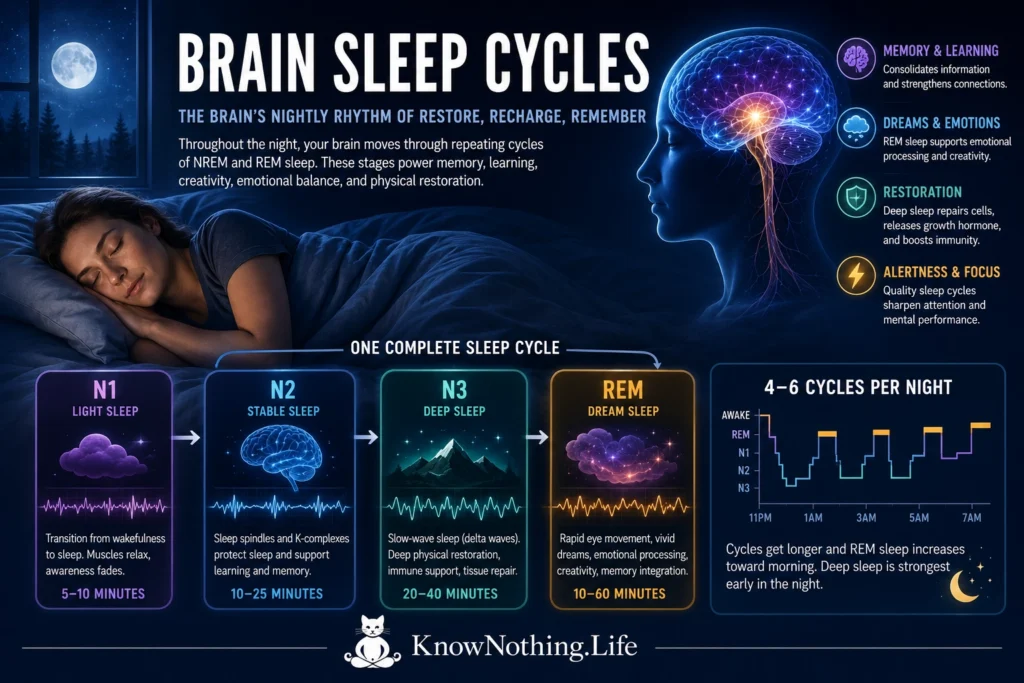
Sleep is not a uniform period in which the brain simply becomes inactive. Across the night, neural activity moves repeatedly through several distinct states, each marked by characteristic electrical patterns, muscle activity, eye movements, sensory responsiveness, and internal physiology. These states are organized into non-rapid eye movement sleep, commonly divided into stages N1, N2, and N3, and rapid eye movement sleep, or REM. A complete cycle usually progresses from lighter NREM sleep into deeper slow-wave sleep, returns toward lighter sleep, and then enters REM. The sequence repeats several times, but its duration is not fixed. A laboratory analysis of 369 people found substantial differences among individuals and across the night, demonstrating that the familiar “90-minute sleep cycle” is a useful approximation rather than a biological rule.
The discovery of REM sleep transformed the scientific understanding of these cycles. In their landmark 1953 paper, “Regularly Occurring Periods of Eye Motility, and Concomitant Phenomena, During Sleep,” Eugene Aserinsky and Nathaniel Kleitman reported recurring episodes of rapid eye movement accompanied by distinctive physiological changes. Their observations revealed that sleep contained active, repeating phases rather than one continuous descent into unconsciousness. Follow-up work distinguished rapid eye movements from slower ocular activity and helped establish REM as a recurring state closely associated with dreaming. This discovery laid the foundation for modern sleep laboratories, where electroencephalography, eye-movement recordings, muscle activity, breathing, and heart rhythm are combined to create a visual record known as a hypnogram.
N1 and the Transition Into Sleep
Stage N1 is the transitional period between wakefulness and established sleep. As a person drifts into this stage, awareness of the external environment becomes less stable, voluntary thought becomes more fragmented, and the organized alpha activity commonly associated with relaxed wakefulness gives way to slower, mixed-frequency activity. Muscle tone begins to decrease, although brief contractions known as hypnic jerks may occur. Because N1 is light and unstable, a person awakened from it may report having been awake rather than asleep. The brain is beginning to disconnect from the environment, but sensory information can still produce relatively strong responses and quickly restore wakefulness.
N1 is usually brief during an uninterrupted night, but it may reappear after awakenings or transitions between deeper states. Its importance lies less in how much time it occupies than in its function as a gateway. Sleep does not begin when every brain region shuts down simultaneously. Different neural systems change at different rates as arousal networks reduce their activity, thalamic processing changes, and cortical networks become less responsive to ordinary sensory input. The gradual nature of this transition helps explain why people sometimes experience drifting imagery, distorted thoughts, sensations of falling, or brief dreamlike experiences before they recognize that they have fallen asleep.
N2, Sleep Spindles, and Sensory Protection
Stage N2 represents a more stable form of NREM sleep and is distinguished by two prominent electrical events: sleep spindles and K-complexes. Sleep spindles are short bursts of rhythmic activity produced through interactions between the thalamus and cerebral cortex. K-complexes are large, isolated waves that may occur spontaneously or in response to external stimulation. Research by Florin Amzica and Mircea Steriade connected K-complexes to a slower cortical oscillation generated during sleep, showing that they are not random electrical disturbances. Together, spindles and K-complexes reflect the brain’s changing relationship with the outside world, allowing some information to be processed while reducing the likelihood that unimportant stimulation will produce a complete awakening.
N2 also appears to participate in learning and neural plasticity. Steffen Gais and colleagues found that people who completed a declarative learning task showed an increase in sleep-spindle density during the following night compared with a control condition. Other experiments have reported learning-related changes in spindle density after motor training, with some changes associated with later performance. These findings support the idea that spindles help coordinate communication between cortical and subcortical systems while recently acquired information is being stabilized. The relationship is not perfectly simple: spindle characteristics vary across individuals, brain regions, ages, and learning tasks. Nevertheless, their responsiveness to prior experience shows that sleep architecture is shaped by what the brain did while awake.
N3 and Slow-Wave Sleep
Stage N3, commonly called slow-wave or deep sleep, is characterized by large, synchronized waves of low-frequency cortical activity. At the cellular level, many cortical neurons alternate between active “up” states and quieter “down” states. These coordinated transitions produce the slow oscillations visible in the electroencephalogram. Deep sleep is generally concentrated in the first part of the night, when homeostatic sleep pressure is strongest. After extended wakefulness, the brain usually produces more intense slow-wave activity, while this activity declines as sleep continues and accumulated pressure is relieved.
Slow-wave sleep provides conditions that appear particularly favorable for the reorganization of recently formed memories. Lisa Marshall and colleagues applied weak electrical stimulation timed to strengthen slow oscillations during sleep and found improved retention of previously learned information, providing causal evidence that these rhythms contribute to memory processing. Björn Rasch and colleagues used a different method by pairing a learning task with an odor and presenting the same odor again during slow-wave sleep. Re-exposure improved later recall of hippocampus-dependent material and altered hippocampal activity. These studies suggest that deep sleep is not simply restorative inactivity. Its organized rhythms can coordinate communication between the hippocampus and neocortex, helping selected experiences become more stable long-term memories.
REM Sleep and the Activated Sleeping Brain
REM sleep presents an unusual combination of physiological features. Brain activity becomes faster and less synchronized, resembling some aspects of wakefulness, while rapid eye movements appear and most skeletal muscles become strongly inhibited. Breathing and heart rate may become less regular, and vivid, emotionally intense dreams are frequently reported when people are awakened from this state. Early REM periods are often relatively short, while later cycles generally contain more REM and less deep NREM sleep. The sleeping brain therefore changes its priorities across the night: slow-wave activity is strongest early, while REM becomes increasingly prominent toward morning.
REM sleep has been associated with emotional and procedural memory, but claims that it serves one exclusive function remain controversial. Ursula Wagner and colleagues found that late-night sleep rich in REM supported emotional memory formation, while Matthew Nishida and colleagues linked emotional memory improvement to prefrontal theta activity during REM. Selective REM-deprivation research has also found effects on the consolidation of emotional material. However, other researchers have argued that evidence for a simple REM-specific memory function is inconsistent, particularly when stress, total sleep loss, and changes in other sleep stages are not adequately controlled. The strongest interpretation is that REM contributes to certain forms of memory and emotional processing as one component of the full sleep cycle rather than acting as the brain’s only memory-consolidation state.
What Controls the Cycling of Sleep
Alexander Borbély’s two-process model remains one of the most influential explanations of when sleep begins and how its intensity changes. The model proposes that a homeostatic process, called Process S, builds during wakefulness and declines during sleep. A circadian process, called Process C, is controlled by the biological clock and changes according to internal time. Sleep becomes more likely when homeostatic pressure is high and the circadian system is no longer strongly promoting wakefulness. The interaction explains why sleep deprivation increases deep slow-wave activity, why people usually sleep at a particular time of day, and why someone may briefly feel more alert in the morning despite having remained awake all night.
The two-process model explains the timing and pressure of sleep, but shorter ultradian mechanisms organize the repeating NREM–REM cycles within the night. These transitions emerge through interactions among wake-promoting neurons, NREM-promoting circuits, REM-generating brainstem networks, the thalamus, and the cerebral cortex. The duration of cycles changes according to prior sleep, circadian phase, age, environmental conditions, and individual biology. Contemporary evidence indicates that cycles should not be imagined as identical blocks moving mechanically from N1 through REM. People may bypass a stage, briefly awaken, return to N2 after REM, or move between NREM depths several times. Healthy sleep is structured, but it is also flexible.
Memory, Restoration, and Brain Maintenance
The alternation of NREM and REM may be important because the brain performs complementary operations in different states. NREM slow oscillations, spindles, and hippocampal activity can coordinate the reactivation and redistribution of recently acquired information. REM may then support additional integration, emotional processing, abstraction, or modification of memory. Research on ordered NREM–REM naps found that spindle activity was associated with memory consolidation when NREM was followed by REM, supporting the possibility that the sequence itself matters. Sleep may therefore benefit cognition not through one “memory stage,” but through the repeated movement of information across several neural environments.
Sleep has also been investigated as a period of metabolic maintenance. Lulu Xie and colleagues reported in mice that sleep was associated with expanded interstitial space and increased movement of cerebrospinal fluid through brain tissue, accompanied by faster clearance of injected beta-amyloid. The experiment inspired widespread interest in the glymphatic system. More recent work by Andawei Miao and colleagues used different measurement methods and concluded that brain clearance was reduced rather than increased during sleep and anesthesia. These findings are not necessarily the final word, but they demonstrate why claims that sleep simply “washes toxins from the brain” should be treated cautiously. Sleep clearly changes fluid movement, metabolism, and extracellular conditions, yet the mechanisms and their significance in humans remain under active investigation.
Why Complete Sleep Cycles Matter
The value of sleep cannot be judged only by the number of hours spent in bed. Repeated awakenings, breathing disturbances, pain, environmental noise, alcohol, medications, and irregular schedules can fragment the normal progression through NREM and REM. A person may obtain a seemingly adequate sleep duration while receiving less consolidated slow-wave sleep, fewer stable spindles, disrupted REM periods, or poorly timed transitions. Because the stages support different but interacting processes, chronic fragmentation can leave attention, memory, emotional regulation, and physical restoration impaired even when total sleep time appears acceptable.
Brain sleep cycles reveal that sleep is an active biological program rather than a nightly absence of consciousness. The brain repeatedly changes its electrical rhythms, chemistry, connectivity, and responsiveness, creating conditions suited to sensory disconnection, neural restoration, memory reorganization, dreaming, and eventual awakening. No single stage explains every function of sleep, and many proposed mechanisms remain debated. What is clear is that healthy sleep depends on the coordinated sequence of states. The sleeping brain does not stop working; it changes the kind of work it performs.