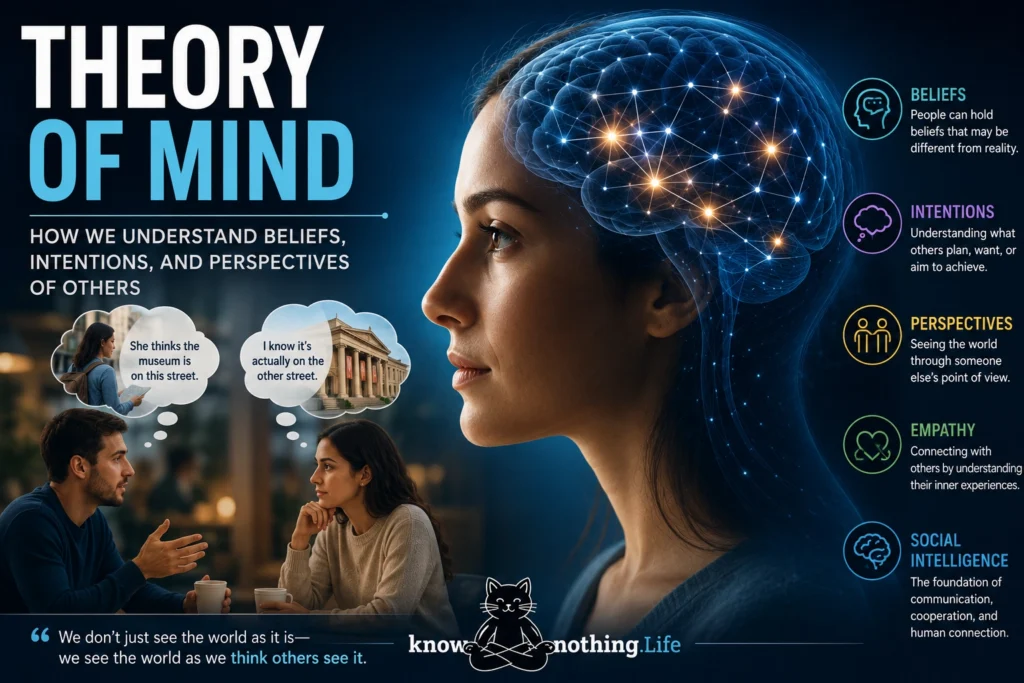
Theory of mind is the capacity to understand that other people possess thoughts, beliefs, desires, intentions, emotions, and knowledge that may differ from one’s own. It allows a person to predict behavior by considering not only what is objectively true, but also what someone else thinks is true. During conversation, cooperation, conflict, deception, teaching, humor, and caregiving, people continually make inferences about what others know, expect, want, or misunderstand. The term became prominent after David Premack and Guy Woodruff asked, “Does the chimpanzee have a theory of mind?” in their influential 1978 paper. They argued that attributing unobservable mental states resembles constructing a theory because those inferences are used to explain and predict behavior.
Theory of mind is not the same as empathy. A person may understand another individual’s beliefs and intentions without sharing that individual’s emotions or caring about the outcome. Empathy concerns emotional understanding and concern, while theory of mind focuses more broadly on representing another perspective. The ability also extends beyond recognizing feelings. It includes understanding ignorance, knowledge, uncertainty, pretense, deception, sarcasm, hidden intentions, and false beliefs. These skills usually operate together in everyday social life, but psychological and neurological evidence indicates that they rely on several interacting processes rather than one unified mental faculty.
False Beliefs and the Classic Tests
Heinz Wimmer and Josef Perner created one of the most influential ways to test theory of mind in their 1983 study of children’s understanding of false belief. In a typical false-belief task, one character places an object in one location and leaves. A second character moves the object while the first is absent. The child is then asked where the first character will search upon returning. To answer correctly, the child must set aside personal knowledge of the object’s current position and predict behavior from the character’s outdated belief. Wimmer and Perner found substantial developmental change in children’s ability to solve such problems.
Simon Baron-Cohen, Alan Leslie, and Uta Frith adapted this logic in the 1985 Sally–Anne task. Sally places a marble in a basket and leaves the scene; Anne moves it to another location. Children are asked where Sally will look. In the original experiment, most typically developing children and children with Down syndrome answered according to Sally’s false belief, while many autistic children answered according to the marble’s actual location. The study became foundational to the theory-of-mind account of autism, although later research has shown that autistic social cognition is highly varied and cannot be reduced to performance on one task.
How Theory of Mind Develops
Success on conventional verbal false-belief tasks typically becomes more reliable during the preschool years. A major meta-analysis by Henry Wellman, David Cross, and Julanne Watson combined 178 studies and found a consistent age-related shift rather than results caused solely by one experimental procedure. Younger children commonly answered according to reality, whereas older preschoolers increasingly represented what another person believed. The transition reflects more than memorizing a correct response. Children become better at separating their own knowledge from another perspective, keeping competing representations in mind, and understanding that mental representations can be inaccurate.
Some nonverbal experiments suggest that sensitivity to others’ beliefs may appear much earlier than success on explicit questions. Kristine Onishi and Renée Baillargeon reported that 15-month-old infants looked longer when an actor searched for a toy in a location inconsistent with what the actor should believe. Ágnes Kovács and colleagues later found that another person’s belief could influence the responses of both infants and adults even when that belief was irrelevant to their task. These findings have inspired proposals that early, spontaneous belief tracking precedes more deliberate reasoning, although researchers continue to debate exactly what infant looking behavior demonstrates and whether implicit and explicit tasks measure the same capacity.
Language, Conversation, and Cognitive Control
Language gives children tools for discussing invisible mental states. Words such as “think,” “know,” “guess,” and “remember” make differences in perspective easier to describe. Sentence structures such as “Maria thinks the toy is in the box” also allow one proposition to be represented inside another, even when the embedded statement is false. In a longitudinal study, Jill de Villiers and Jennie Pyers found that children’s understanding of complex complement sentences was closely connected with later false-belief performance. Language may therefore support theory of mind by helping children hold reality and another person’s representation of reality in mind at the same time.
Social conversation is equally important. Candida Peterson and Michael Siegal found that many prelingually deaf children born to hearing parents showed delayed false-belief understanding, despite normal nonverbal intelligence. The proposed explanation was not deafness itself but reduced early access to fluent conversations about thoughts, intentions, mistakes, and feelings. Deaf children raised in signing families with early access to a shared language often perform more successfully. Theory of mind is therefore shaped by opportunities to participate in meaningful communication, not simply by biological maturation. Executive functions also contribute because a person must inhibit personal knowledge, retain another perspective, and shift between competing interpretations.
The Brain’s Theory-of-Mind Network
Neuroscience has identified a distributed network that becomes active when people reason about mental states. Rebecca Saxe and Nancy Kanwisher found that a region near the temporoparietal junction responded more strongly when adults considered a character’s beliefs than when they read stories about physical representations such as outdated photographs or maps. The right temporoparietal junction is now strongly associated with representing another person’s beliefs and perspectives. Other frequently involved areas include the medial prefrontal cortex, posterior cingulate cortex, precuneus, temporal poles, and superior temporal sulcus.
No region acts as an isolated mind-reading center. The temporoparietal junction contributes to distinguishing perspectives and representing beliefs, while medial prefrontal regions help evaluate people, intentions, traits, and social meaning. Posterior midline areas contribute memory and internally constructed scenes, and superior temporal regions help interpret gaze and biological movement. Neuropsychological research by Ian Apperly and colleagues found that damage to temporoparietal or frontal systems can produce different kinds of belief-reasoning errors. The results indicate that successful theory of mind requires both specialized mental-state representations and broader capacities such as inhibition, memory, language, and cognitive control.
Theory of Mind and Autism
The theory-of-mind hypothesis transformed autism research by offering a cognitive explanation for difficulties involving indirect communication, deception, irony, pretend play, and interpreting unspoken intentions. However, the original claim that autistic people simply lack a theory of mind is now considered too broad. Autistic individuals differ greatly in language, development, experience, compensatory strategies, and social motivation. Many autistic adolescents and adults pass standard false-belief tasks, especially when the problem is clearly explained, yet they may still find fast, ambiguous, or emotionally demanding interactions difficult.
Atsushi Senju and colleagues examined this difference using eye tracking. Neurotypical adults spontaneously looked toward the location where an actor with a false belief was expected to search. Adults with Asperger syndrome passed explicit verbal theory-of-mind tests but did not show the same anticipatory eye movements in the nonverbal task. The researchers proposed that some autistic people may develop deliberate strategies for reasoning about beliefs without automatically tracking mental states in the same way during rapidly unfolding situations. This does not imply an absence of caring or empathy. It suggests that explicit social reasoning and spontaneous social prediction can follow different developmental paths.
Theory of Mind in Morality and Relationships
Understanding mental states influences moral judgment because people usually distinguish intentional harm from accidental harm. Liane Young, Fiery Cushman, Marc Hauser, and Rebecca Saxe presented participants with situations in which an agent’s belief and the actual outcome varied independently. Activity in the right temporoparietal junction increased when participants evaluated what the agent believed, while moral judgments reflected an interaction between intentions and consequences. Someone who knowingly attempts harm may be judged harshly even when no damage occurs, whereas a person who causes harm accidentally is usually judged differently because the harmful outcome was not intended.
Theory of mind also enables cooperation, teaching, negotiation, humor, persuasion, and deception. A teacher estimates what a student does not yet understand. A speaker adjusts an explanation to the listener’s knowledge. Friends interpret indirect remarks using shared history, while negotiators anticipate goals that may not be openly stated. Yet mind-reading is never perfect. People often project their own beliefs onto others, misinterpret silence, confuse confidence with knowledge, or invent explanations for ambiguous behavior. Mature social understanding therefore requires more than making mental-state inferences. It requires checking assumptions, listening to correction, and accepting that another person’s inner experience may remain partly unknown.
A Foundation of Human Social Intelligence
Theory of mind is one of the foundations of human social intelligence because it allows behavior to be interpreted in relation to invisible mental causes. Its development depends on early social attention, language, memory, cognitive control, conversation, and repeated opportunities to encounter perspectives different from one’s own. Brain imaging and lesion studies show that the ability emerges from a network rather than a single region, while developmental research demonstrates that explicit reasoning and spontaneous sensitivity may not mature at the same time.
The concept has reshaped research on childhood, autism, morality, communication, primate cognition, and artificial intelligence. Its deepest lesson is that people do not respond only to the world as it exists. They respond to the world as they believe, remember, fear, hope, or imagine it to be. Understanding another person therefore requires representing a reality that may differ from one’s own. Theory of mind makes that achievement possible, while humility about its limits keeps interpretation from becoming assumption.