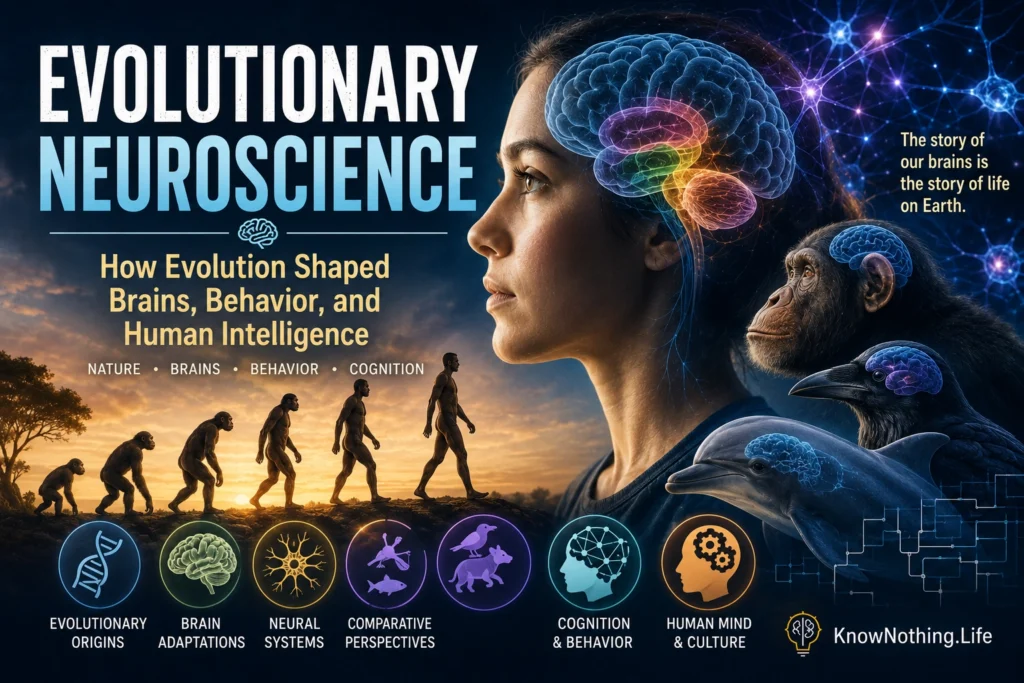
Evolutionary neuroscience studies how nervous systems arose, diversified, and adapted across the history of life. It combines comparative neuroanatomy, evolutionary biology, genetics, developmental neuroscience, paleontology, animal behavior, and cognitive science. Rather than arranging species on a ladder from “simple” to “advanced,” it reconstructs branching histories. A bee, octopus, crow, bat, and human represent different evolutionary solutions to navigation, communication, learning, predation, and social coordination.
The field asks which neural features came from common ancestors, which brain regions changed together because development links them, and which changed independently under specialized selection. It also examines the constraints that limit possible evolutionary changes. Neural tissue requires substantial energy, long-range connections require space and biological support, and prolonged development increases dependence on caregivers. Brain evolution is therefore not a steady march toward greater size. It is a history of modifications constrained by bodies, developmental programs, life cycles, and environments.
Conserved Plans and Developmental Constraints
Comparisons across vertebrates reveal extensive continuity. Major forebrain, midbrain, hindbrain, sensory, motor, and neuromodulatory systems can often be related across species even when their proportions differ. Evolution usually modifies existing developmental programs rather than constructing entirely new nervous systems from nothing. Barbara Finlay and Richard Darlington’s influential 1995 analysis found strong regularities in how mammalian brain components scale together. Regions generated later in development tended to expand disproportionately as total brain size increased, suggesting that changes in developmental schedules can produce coordinated anatomical evolution.
Coordinated growth is not the whole story. Robert Barton and Paul Harvey’s 2000 comparative study showed that mammalian brains also evolve in a mosaic fashion. The neocortex differed among taxonomic groups even after overall scaling was considered, and anatomically connected structures within visual, olfactory, and other systems showed correlated evolutionary change. Development constrains what variations are readily produced, while natural selection can emphasize particular functional systems. Brain regions are therefore neither completely independent modules nor passive parts of one uniformly enlarging organ.
Brain Size, Neuron Number, and Architecture
Brain size can be informative, but it is an imperfect measure of neural capacity. Comparisons must account for body size, neuron density, regional distribution, and network organization. Jeroen Smaers and colleagues analyzed living and fossil mammals and found repeated shifts in the relationship between brain and body size across approximately 150 million years. In some lineages, relative brain enlargement reflected increased brain size; in others, it partly reflected reduced body size. The study challenged the assumption that one stable brain-to-body formula can rank intelligence across mammals.
Cell counts reveal differences hidden by mass alone. Suzana Herculano-Houzel and colleagues found that primate brains add neurons according to different scaling rules from rodent brains, allowing primates to place more neurons into a given volume. Later work showed that the human brain broadly follows primate cellular scaling rules rather than representing a complete anatomical exception. Birds demonstrate an independent solution: Seweryn Olkowicz and colleagues reported that parrots and corvids possess exceptionally dense forebrains, with neuron numbers comparable to those of some primates with much larger brains. Complex cognition can emerge through different combinations of brain size, neuronal density, and circuit organization.
Ecology, Specialization, and Convergence
Natural selection does not enlarge every brain component equally. Sensory demands, diet, movement, habitat, social organization, and life history can favor changes in particular neural systems. Later primate research supported a mosaic pattern involving combinations of sensory and cognitive specialization. Another large comparative study found stronger support for diet than for common measures of sociality in predicting primate brain size. Fruit-eating species tended to possess larger brains than leaf-eating species after body size and evolutionary relationships were considered, possibly because locating and processing fruit places particular demands on memory, movement, and flexible foraging. These results illustrate why single-cause stories about brain evolution are rarely sufficient.
Convergent evolution shows that similar behavioral capacities need not depend on identical anatomy. Corvids and parrots can solve flexible problems and learn socially despite possessing a pallial organization different from the mammalian neocortex. Their high forebrain neuron densities suggest that compact architectures can support substantial computational capacity. Across species, spatial memory can become more important under demanding foraging conditions, sensory pathways can specialize for ecologically important signals, and motor circuits can adapt to distinctive bodies. Evolution selects systems that function effectively within a particular ecological niche, not one universal blueprint for intelligence.
The Evolution of the Human Brain
Humans have an unusually large and neuron-rich cerebral cortex, prolonged development, extensive cultural learning, and elaborated language and social behavior. Yet human evolution did not simply add a new brain above an ancient animal core. Katerina Semendeferi and colleagues found that the human frontal cortex is not disproportionately large compared with that of great apes, challenging a popular explanation of human uniqueness. Other research found disproportionate expansion of prefrontal white matter, suggesting that elaborated connectivity may be as important as relative cortical gray-matter volume.
Human specializations may instead involve developmental timing, cellular composition, long-range connections, microcircuitry, and the organization of distributed networks. Genevieve Konopka and colleagues compared human, chimpanzee, and macaque brains and identified human-specific gene coexpression networks in the frontal cortex, including differences involving neuronal morphology and RNA splicing. Such findings support a systems-level view: human cognitive traits emerged through many changes acting within an inherited primate architecture and were then amplified through language, teaching, cooperation, and cumulative culture.
Genes and Developmental Innovation
Changes in protein-coding genes can influence neural evolution, but regulatory and structural changes are equally important. Wolfgang Enard and colleagues reported evidence of accelerated evolution in FOXP2, a transcription factor associated with speech and language development. FOXP2 is not a single “language gene,” however, because it regulates wider developmental networks and is found in many vertebrates. Katherine Pollard and colleagues identified HAR1, a rapidly changed human genomic region expressed in neurons involved in early cortical organization. Both studies show how alterations in developmental regulation can modify existing biological pathways without directly encoding complex abilities.
Gene duplication can also provide material for evolutionary innovation. Cécile Charrier and colleagues found that the human-specific SRGAP2C paralog delayed dendritic-spine maturation and increased spine density when expressed in mouse neurons, producing an extension of development known as neoteny. In 2018, studies of human-specific NOTCH2NL genes showed that they can prolong cortical progenitor activity and increase neuronal output. These experiments identify plausible mechanisms that may have contributed to human cortical development, but no single duplication explains the human brain. Evolutionary change emerges from interactions among many variants, developmental contexts, and selective pressures.
Reconstructing Evolutionary Change
Evolutionary neuroscientists cannot record neural activity from extinct species, so they combine indirect forms of evidence. Fossil endocasts reveal approximate brain shape, comparative anatomy identifies homologous structures, phylogenetic models estimate ancestral traits, and genomics reconstructs changes in coding and regulatory sequences. Single-cell transcriptomics can now compare specific brain-cell populations across primate species, revealing extensive conservation alongside human-specific differences in gene regulation. Brain organoids allow researchers to test how selected genetic variants may influence early developmental processes. Each method captures only part of the story and depends on assumptions that must be checked against other evidence.
Cleber Trujillo and colleagues used gene editing to replace the modern human version of NOVA1 with an archaic variant found in Neanderthals and Denisovans in human-derived cortical organoids. They reported changes in organoid morphology, gene expression, RNA splicing, and synaptic development. The experiment demonstrated a method for studying one evolutionary variant; it did not recreate a Neanderthal brain or mind. Organoids lack the complete cellular diversity, sensory experience, vascular systems, bodies, and cultural environments of developing humans. Evolutionary neuroscience is strongest when genetic experiments, anatomy, behavior, fossils, and comparative evidence converge.
Why Evolutionary Neuroscience Matters
Evolutionary neuroscience explains both shared biology and species diversity. Conservation is one reason animal research can illuminate human vision, memory, movement, emotion, and neurological disease. Divergence explains why findings from one species do not always transfer directly to another. The field also shows that learning, attachment, communication, and decision-making have deep evolutionary histories. These capacities were modified from mechanisms present in earlier lineages rather than appearing suddenly with modern humans.
Its central lesson is that evolution produces neither perfection nor a hierarchy of minds. Brains are compromises shaped by ancestry, development, energy, ecology, and reproduction. A larger brain is not automatically a better brain, and a human-like cortex is not the only route to flexible cognition. By examining how neural systems are conserved, reorganized, enlarged, and independently reinvented, evolutionary neuroscience replaces simplistic stories of progress with a richer account of adaptation. The human brain is exceptional in important ways, but it remains one branch of a much older and more varied history of nervous systems.