Few figures in ancient philosophy embody the transformative power of thought as profoundly as Epictetus. Born into slavery and rising to become one of the most influential teachers of Stoicism, his life stands as a living argument for the philosophy he taught. Unlike many philosophers whose ideas remained abstract or elite, Epictetus spoke directly to the human condition—suffering, control, fear, and the pursuit of inner freedom. His teachings were not theoretical exercises but practical tools forged through hardship.
What distinguishes Epictetus is not only the clarity of his ideas but the authority behind them. He did not write philosophical treatises himself; instead, his teachings were preserved by his student Arrian, who recorded them in works that would later shape both ancient and modern thought. Through these writings, Epictetus became a guiding voice for individuals seeking resilience, discipline, and peace in uncertain worlds.
Early Life and Background
Epictetus was born around 50 CE in Hierapolis, a city in what is now modern-day Turkey, during the height of the Roman Empire. His early life was defined by servitude, as he was owned by Epaphroditus, a powerful freedman serving the Roman emperor Nero. Despite his status as a slave, Epictetus was exposed to philosophical education, an unusual opportunity that would shape his future trajectory.
His physical condition—he was lame, possibly due to mistreatment or illness—did not hinder his intellectual development. Instead, it became part of the foundation for his philosophy. He learned early that external circumstances, including pain and limitation, could not dictate the state of one’s inner life. This insight would later become central to his teaching: that freedom lies not in changing the world, but in mastering one’s response to it.
Eventually, Epictetus was granted freedom. After his emancipation, he began teaching philosophy in Rome, attracting students who were drawn to his practical wisdom. However, during the reign of Domitian, philosophers were expelled from the city. Epictetus relocated to Nicopolis in Greece, where he established a school that would become one of the most respected centers of Stoic learning.
Philosophical Foundations
At the core of Epictetus’s philosophy lies a deceptively simple distinction: the division between what is within our control and what is not. This idea, foundational to Stoicism, was articulated with unmatched clarity in his teachings. According to Epictetus, our opinions, desires, and actions are within our control, while external events—wealth, reputation, health, and even life itself—are not.
This distinction was not merely theoretical; it served as a guide for living. By focusing only on what can be controlled, individuals free themselves from anxiety, frustration, and despair. Epictetus argued that suffering arises when we attempt to control what is inherently uncontrollable. In this sense, emotional distress is not caused by events themselves, but by our judgments about them.
His teachings emphasized discipline of thought, urging students to examine their beliefs and challenge irrational assumptions. Rather than seeking happiness through external achievements, Epictetus encouraged the cultivation of virtue—wisdom, courage, justice, and temperance—as the true source of fulfillment. In doing so, he aligned himself with earlier Stoics while refining their ideas into a highly practical system.
The Enchiridion and Discourses
The teachings of Epictetus survive primarily through two works recorded by Arrian: the Discourses and the Enchiridion. The Discourses are a collection of informal lectures, capturing the dynamic and often confrontational style of his teaching. In these texts, Epictetus engages with students, challenges misconceptions, and illustrates philosophical principles through vivid examples.
The Enchiridion, meaning “handbook,” is a condensed summary of his philosophy. It distills complex ideas into concise, actionable guidance, making it one of the most accessible introductions to Stoic thought. Its enduring popularity lies in its practicality; readers can apply its lessons immediately to everyday life.
One of the most famous passages from the Enchiridion states: “Some things are up to us and some things are not.” This opening line encapsulates the essence of his philosophy. By internalizing this principle, individuals can achieve a state of tranquility regardless of external circumstances. The work has influenced thinkers across centuries, from Roman emperors to modern psychologists.
Key Teachings and Quotes
Epictetus’s philosophy is best understood through his own words, which combine clarity with moral urgency. His teachings consistently emphasize responsibility, self-discipline, and the power of perception. He believed that individuals are not passive victims of fate but active participants in shaping their inner lives.
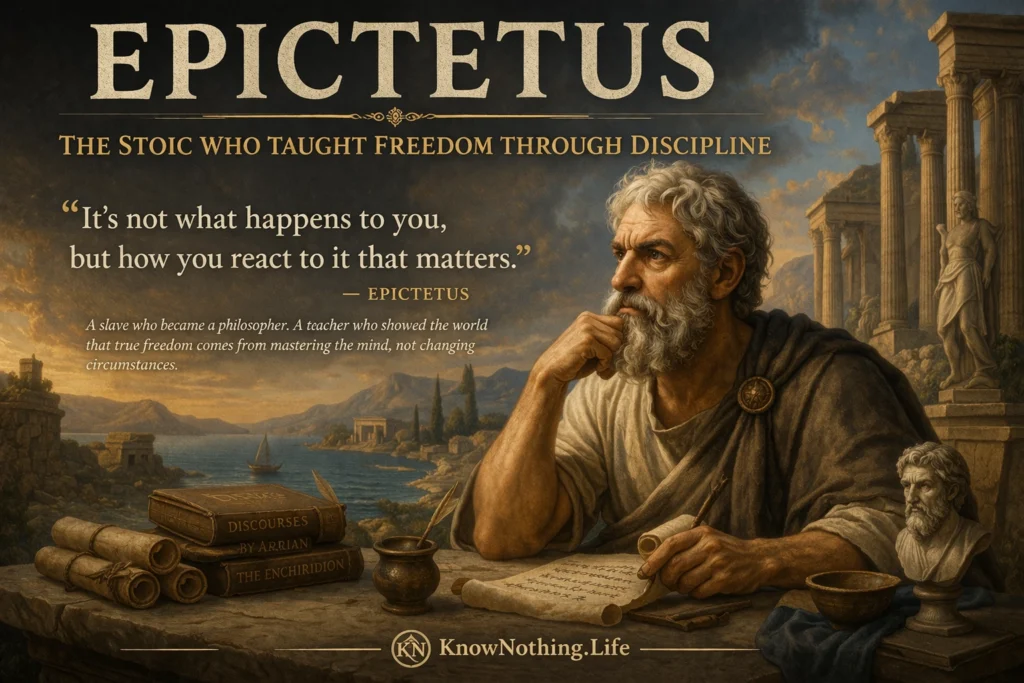
One of his most cited insights is: “It’s not what happens to you, but how you react to it that matters.” This statement captures the Stoic belief that external events are neutral; it is our interpretation that gives them meaning. By mastering our reactions, we gain control over our emotional experiences.
Another powerful teaching is: “No man is free who is not master of himself.” For Epictetus, freedom was not political or social but internal. A person enslaved by fear, desire, or anger is not truly free, regardless of their external status. Conversely, someone who governs their thoughts and actions can achieve freedom even under oppressive conditions.
He also warned against attachment to external things: “Wealth consists not in having great possessions, but in having few wants.” This idea challenges conventional notions of success, suggesting that contentment arises from simplicity rather than accumulation. Such teachings remain relevant in modern societies driven by consumption and comparison.
Influence on Stoicism and Later Thinkers
The impact of Epictetus extends far beyond his own lifetime. His teachings played a crucial role in shaping the philosophy of Marcus Aurelius, whose Meditations reflect many of the same principles. Aurelius frequently echoed the idea that inner discipline is the key to resilience, a concept he likely absorbed from Epictetus’s teachings.
Epictetus also influenced later philosophical and religious traditions. Early Christian thinkers found parallels between Stoic ethics and their own teachings on humility, self-control, and acceptance of divine will. In modern times, his ideas have been integrated into cognitive behavioral therapy (CBT), a psychological approach that emphasizes the role of thought patterns in emotional well-being.
The enduring appeal of Epictetus lies in the universality of his message. His philosophy does not depend on cultural or historical context; it speaks directly to fundamental human concerns. Whether facing personal hardship, societal pressure, or existential uncertainty, his teachings offer a framework for maintaining stability and clarity.
Legacy and Relevance Today
In a world characterized by rapid change, constant distraction, and widespread anxiety, the philosophy of Epictetus remains remarkably relevant. His emphasis on focusing only on what can be controlled provides a powerful antidote to modern stress, which often arises from overexposure to uncontrollable events. From global crises to social media pressures, individuals today face challenges that mirror the uncertainties of ancient life.
Epictetus’s teachings encourage a shift in perspective. Rather than attempting to dominate external circumstances, individuals are urged to cultivate inner resilience. This approach does not promote passivity but rather a strategic allocation of energy toward what truly matters. By mastering one’s thoughts and actions, it becomes possible to navigate even the most chaotic environments with composure.
His philosophy also challenges contemporary definitions of success. In a culture that often equates worth with achievement, wealth, or recognition, Epictetus offers a different view: character. According to him, true success lies in living in accordance with reason and virtue. This perspective invites a reevaluation of priorities, encouraging individuals to seek fulfillment through integrity rather than external validation.
Conclusion
The life and teachings of Epictetus demonstrate that philosophy is not merely an intellectual pursuit but a way of living. From his beginnings as a slave to his role as a revered teacher, he embodied the principles he taught. His message—that freedom comes from within—continues to resonate across cultures and centuries.
Through works like the Enchiridion and the Discourses, Epictetus has left a legacy that transcends time. His insights into control, perception, and self-mastery provide practical guidance for navigating life’s challenges. In a world where external conditions are often unpredictable, his philosophy offers a stable foundation rooted in inner discipline and clarity.
Ultimately, Epictetus reminds us that while we may not control the events of our lives, we always retain the power to shape our responses. In that space between event and reaction lies the possibility of freedom—a freedom that no circumstance can take away.