Among the rulers of the ancient world, few have left behind a legacy as intellectually profound and personally revealing as Marcus Aurelius. Known both as a Roman emperor and a devoted student of Stoicism, he occupies a rare position in history—one where political power and philosophical reflection intersect. His life was not defined solely by conquest or governance, but by an ongoing internal dialogue about duty, mortality, and the nature of a virtuous life.
What sets Marcus Aurelius apart is the deeply personal nature of his philosophy. Unlike many thinkers who wrote for an audience, his reflections were private, composed in moments of solitude amid the demands of ruling the vast Roman Empire. These writings, later compiled as the Meditations, reveal a man striving not for perfection, but for alignment with reason, discipline, and moral clarity. Through them, he has become one of the most accessible and enduring voices of ancient philosophy.
Early Life and Rise to Power
Marcus Aurelius was born in 121 CE into a wealthy and politically connected Roman family. From an early age, he was recognized for his seriousness of character and intellectual curiosity. His upbringing was shaped by a rigorous education in rhetoric, philosophy, and law, preparing him for a future in public service. However, what distinguished him was not merely his education, but his early commitment to Stoic principles—a commitment that would guide him throughout his life.
His path to the throne was not typical. Emperor Hadrian selected Antoninus Pius as his successor on the condition that he adopt both Marcus Aurelius and Lucius Verus. This decision placed Marcus within a carefully constructed line of succession, ensuring continuity in leadership. When Antoninus Pius died in 161 CE, Marcus ascended to the throne, choosing to rule jointly with Lucius Verus—an unusual arrangement that reflected both political necessity and a philosophical inclination toward shared responsibility.
Despite his imperial status, Marcus Aurelius maintained a disciplined and modest lifestyle. He resisted the excesses often associated with Roman elites, focusing instead on his duties as a leader. His reign was marked by significant challenges, including military conflicts along the empire’s borders and internal crises such as the Antonine Plague. These difficulties tested not only his political skill but also his philosophical convictions.
The Influence of Stoicism
Stoicism was not merely an intellectual interest for Marcus Aurelius; it was the framework through which he interpreted every aspect of his life. Influenced by earlier Stoics such as Epictetus, whose teachings he studied extensively, Marcus embraced the idea that virtue is the highest good and that external events are beyond our control. This perspective allowed him to navigate the immense pressures of leadership with a sense of inner stability.
Central to his Stoic practice was the concept of living in accordance with nature. For Marcus, this meant aligning one’s actions with reason and accepting the natural order of the world. He viewed himself not as a figure above others, but as a part of a larger whole, bound by the same universal laws. This sense of interconnectedness informed his approach to governance, emphasizing fairness, duty, and compassion.
His writings reveal a constant effort to apply Stoic principles in real time. He reminded himself to remain patient with others, to avoid anger, and to focus on what truly matters. Rather than seeking to escape hardship, he saw it as an opportunity to practice virtue. In this way, Stoicism became not just a philosophy he studied, but a discipline he lived.
The Meditations and Philosophical Works
The enduring legacy of Marcus Aurelius rests largely on his Meditations, a collection of personal writings composed during his military campaigns. Written in Greek, these reflections were never intended for publication. They functioned as a form of self-guidance, a way for Marcus to reinforce his philosophical commitments in the face of daily challenges.
The Meditations are not organized as a systematic treatise. Instead, they consist of fragmented thoughts, reminders, and observations. This structure gives the work an immediacy and authenticity that resonates with readers. Marcus addresses himself directly, urging discipline, humility, and acceptance. He frequently reflects on the transient nature of life, reminding himself that both praise and criticism are fleeting.
Although the Meditations is his only surviving work, its influence is immense. It has been read and studied for centuries, offering insights into leadership, resilience, and ethical living. The text serves as both a philosophical guide and a historical document, providing a glimpse into the mind of a ruler who sought to govern not only an empire, but also himself.
Key Teachings and Quotes
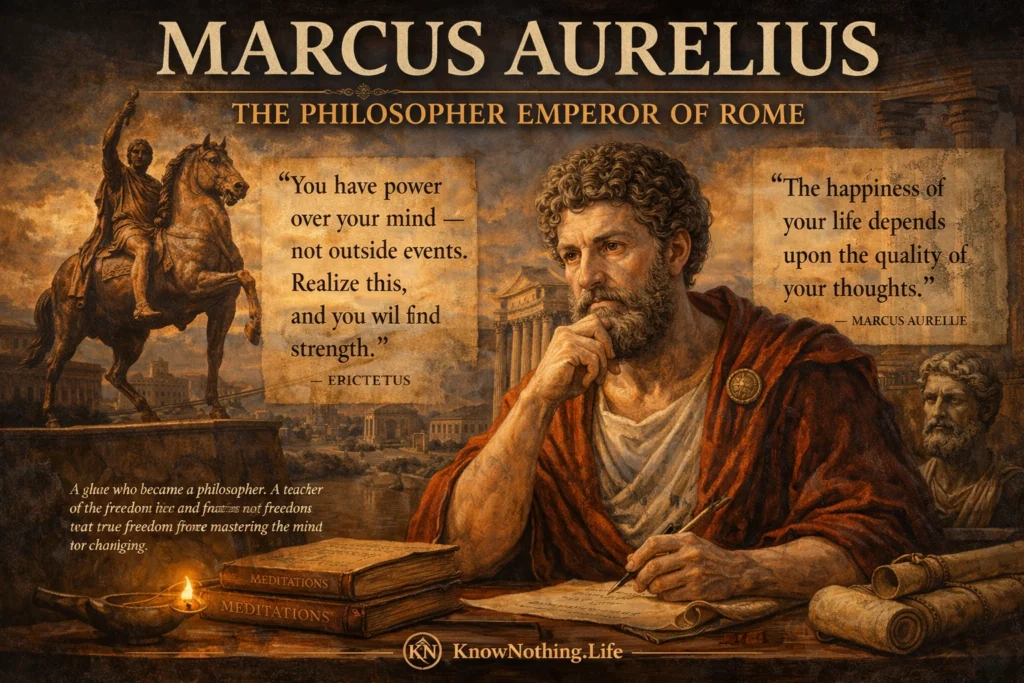
Marcus Aurelius’s philosophy is best understood through his own words, which combine introspection with practical wisdom. One of his most well-known reflections states: “You have power over your mind—not outside events. Realize this, and you will find strength.” This statement encapsulates the Stoic emphasis on internal control and the futility of resisting external circumstances.
Another powerful insight is: “The happiness of your life depends upon the quality of your thoughts.” Here, Marcus highlights the importance of mental discipline, suggesting that well-being is not determined by external success, but by the way we perceive and interpret our experiences. This idea aligns closely with modern psychological approaches that emphasize cognitive awareness.
He also reflects on the nature of human relationships: “Whenever you are about to find fault with someone, ask yourself the following question: What fault of mine most nearly resembles the one I am about to criticize?” This teaching encourages humility and self-examination, reminding individuals to look inward before judging others. Such reflections demonstrate his commitment to ethical consistency and personal accountability.
Leadership and Challenges
The reign of Marcus Aurelius was marked by significant adversity, including prolonged military campaigns against Germanic tribes and the devastating impact of the Antonine Plague. These challenges required not only strategic leadership but also emotional resilience. Marcus approached these difficulties with a Stoic mindset, viewing them as part of the natural order rather than as injustices.
His leadership style reflected his philosophical values. He emphasized duty over personal gain, striving to act in the best interests of the empire. Unlike many rulers who sought glory or domination, Marcus focused on maintaining stability and justice. His decisions were guided by reason rather than impulse, demonstrating the practical application of Stoic principles in governance.
Despite his efforts, his reign was not without criticism. The decision to appoint his son, Commodus, as his successor would later be viewed as a misstep, leading to a decline in the empire’s stability. However, this aspect of his legacy does not diminish the integrity with which he approached his role. Rather, it highlights the complexity of leadership and the limits of even the most disciplined individuals.
Legacy and Modern Relevance
The influence of Marcus Aurelius extends far beyond the boundaries of the ancient world. His writings continue to inspire readers across cultures and disciplines, from philosophy and psychology to leadership and personal development. The principles he articulated—self-control, acceptance, and moral responsibility—remain relevant in addressing contemporary challenges.
In modern society, where individuals are often overwhelmed by external pressures and constant change, the Stoic teachings of Marcus Aurelius offer a framework for maintaining clarity and balance. His emphasis on focusing on what can be controlled provides a practical approach to managing stress and uncertainty. By cultivating awareness and discipline, individuals can navigate complex environments with greater resilience.
Moreover, his reflections on mortality and impermanence encourage a deeper appreciation for the present moment. Rather than fearing change or loss, Marcus advocates for acceptance and engagement with life as it unfolds. This perspective fosters a sense of purpose grounded not in external achievements, but in the consistent practice of virtue.
Conclusion
Marcus Aurelius stands as a unique figure in history—a ruler who sought not only to govern an empire, but to master his own mind. Through his life and writings, he demonstrated that true power lies not in authority over others, but in control over oneself. His commitment to Stoicism provided him with the tools to navigate the complexities of leadership and the inevitabilities of human existence.
The Meditations remain a testament to his enduring legacy, offering guidance that transcends time and circumstance. In a world where external conditions are often unpredictable, his philosophy provides a stable foundation rooted in reason and discipline. Marcus Aurelius reminds us that while we cannot control the events of our lives, we can always choose how we respond. In that choice lies the essence of freedom—a freedom that no title, status, or circumstance can grant or take away.