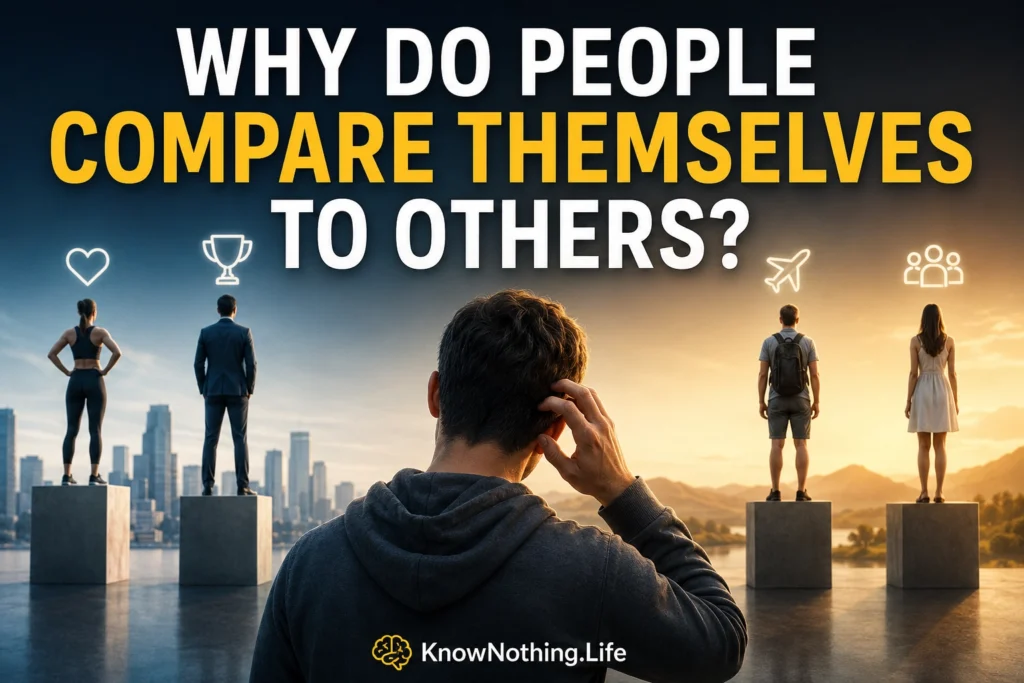
People compare themselves with others because the mind rarely evaluates personal qualities in isolation. Intelligence, attractiveness, success, popularity, wealth, fitness, and even happiness are difficult to judge without a reference point. A person may feel satisfied with an income until learning that a coworker earns more, or proud of completing a race until seeing someone of the same age finish much faster. The comparison changes nothing about the original achievement, yet it changes what that achievement appears to mean.
This tendency is not simply vanity or insecurity. Social comparison helps people locate themselves within groups, judge whether their beliefs are reasonable, identify possible goals, and learn what behavior is expected. It can support motivation and self-knowledge, but it can also produce envy, shame, resentment, and chronic dissatisfaction. Its effects depend on whom people choose as a standard, how important the domain is, and whether another person’s advantage seems attainable.
Comparison Helps People Understand Themselves
Leon Festinger gave the first major psychological account of this tendency in his 1954 paper “A Theory of Social Comparison Processes.” He proposed that people are driven to evaluate their opinions and abilities. When objective measures are missing or unclear, they turn to other people. A new employee may not know whether their performance is strong until they observe coworkers or learn how their results compare with the group. Social comparison answers a basic question: “How am I doing?”
Festinger also argued that people usually prefer comparisons with others who seem similar. Comparing oneself with a world champion, billionaire, or celebrated genius often provides little practical information because the gap is too large. A peer with a similar age, background, job, or level of experience offers a more meaningful standard. This is why the success of a sibling, friend, or colleague can feel more psychologically significant than the far greater success of a stranger.
Other People Become Standards of Value
Comparison does more than measure ability; it helps establish what counts as desirable. People learn which careers are respected, what possessions signal success, which bodies are considered attractive, and when major life events are “supposed” to happen by watching others. Someone may begin to feel behind not because life has objectively worsened, but because friends are buying homes, getting married, advancing professionally, or displaying visible evidence of progress. The people around us do not merely show us what is possible; they also influence what we believe we should want.
People differ in how strongly they depend on these signals. Frederick Gibbons and Bram Buunk developed the Iowa–Netherlands Comparison Orientation Measure to study stable differences in the tendency to compare opinions and abilities. After administering the measure to thousands of American and Dutch participants, they found that comparison is widespread but not equally intense in everyone. People who are uncertain about themselves, sensitive to evaluation, or highly attentive to social information may be especially likely to monitor where they stand.
Upward Comparison Can Inspire or Wound
An upward comparison occurs when people compare themselves with someone they see as better off or more capable. These comparisons can provide information, role models, and motivation. Penelope Lockwood and Ziva Kunda found that exceptional people can inspire self-improvement when their success appears relevant and attainable. A beginning writer may feel energized by an accomplished author whose path seems understandable because the comparison reveals what disciplined effort might eventually make possible.
The same example can be discouraging when the gap appears permanent. If another person’s advantage seems unreachable, comparison may communicate inferiority rather than possibility. Research by Niels van de Ven, Marcel Zeelenberg, and Rik Pieters distinguishes benign envy, which can motivate people to improve their own position, from malicious envy, which is associated with wanting the superior person to lose an advantage. The emotional outcome therefore depends partly on whether comparison creates a believable route forward or makes improvement seem impossible.
Downward Comparison Protects Self-Esteem
People also compare themselves with those who appear worse off. Thomas Wills’s theory of downward comparison proposed that individuals experiencing threat or negative emotion may improve their subjective well-being by focusing on people in less favorable circumstances. Someone coping with a setback may consider others facing greater hardships and feel relief, gratitude, or renewed perspective. This strategy can temporarily restore a damaged sense of competence or security.
Downward comparison does not always involve pleasure in another person’s suffering. It may regulate emotion by reminding people that their situation is survivable or less severe than it initially appeared. However, it can become defensive when it is used to avoid honest self-assessment, dismiss another person’s difficulties, or preserve a sense of superiority. Comparison may protect self-esteem without addressing the underlying problem that made psychological protection necessary.
Closeness Makes Comparison More Emotional
The success of close others can produce both pride and discomfort. Abraham Tesser’s self-evaluation maintenance model explains why the same accomplishment may feel wonderful in one context and threatening in another. People can enjoy the achievements of friends and relatives when those achievements occur in areas that are not central to their own identities. Someone who does not care about music may feel uncomplicated pride when a sibling becomes an outstanding musician.
The reaction changes when the domain is personally important. An aspiring musician may find that sibling’s success painful because closeness makes the comparison more relevant. Tesser’s work suggests that tension depends on the other person’s performance, the closeness of the relationship, and the importance of the activity to one’s identity. People may respond by working harder, distancing themselves, reducing the activity’s importance, or subtly devaluing the successful person. Comparison can therefore strain relationships even when affection is genuine.
Social Media Creates Constant Comparison
Social media did not invent comparison, but it increased its frequency, speed, and range. Earlier generations mostly compared themselves with relatives, neighbors, coworkers, and public figures encountered through limited media. Contemporary users can compare appearance, relationships, travel, parenting, productivity, wealth, and popularity with hundreds of people in minutes. The comparison is often unbalanced because one person’s private experience is being measured against another person’s selected public display.
In a 2014 series of studies, Erin Vogel and her colleagues found that frequent Facebook use was associated with lower trait self-esteem through greater exposure to upward social comparison. Their experiment also showed that viewing profiles designed to invite upward comparison could reduce momentary self-evaluation. A systematic review of research on envy, social comparison, and depression similarly identified upward comparison as a recurring mechanism through which social-network use may affect well-being, while cautioning that social media should not be treated as uniformly harmful. Outcomes depend on the platform, the individual, and whether use is passive, interactive, supportive, or comparison-focused.
Comparison Can Create Relative Deprivation
People judge fairness partly through relative position, not only absolute circumstances. Personal relative deprivation describes dissatisfaction and resentment arising from the belief that one has received less than comparable others and deserves better. A person may possess adequate resources yet feel deprived after discovering that peers receive higher pay, greater recognition, or better opportunities. The emotional force comes from the perceived gap and the belief that the gap is unjust.
This is why objective improvement does not always produce satisfaction. A raise may feel disappointing if coworkers receive larger raises, and career progress may feel like failure when peers advance faster. Relative comparison can reveal genuine inequality and motivate legitimate demands for fairness, but it can also turn life into a ranking system in which another person’s success appears to reduce the value of one’s own. Instead of asking whether life is becoming better, the person asks whether it is improving quickly enough to maintain status.
When Comparison Becomes Part of Identity
Comparison becomes especially painful when self-worth depends heavily on outperforming others. Under these conditions, achievement provides only temporary relief because every success creates a new standard. Being admired is not enough if someone else receives more attention, and improvement feels inadequate when another person improves faster. The individual becomes trapped on a moving ladder whose meaning depends on remaining above somebody else.
Frequent comparison can also narrow identity. A person may begin interpreting every encounter as evidence about intelligence, attractiveness, popularity, or status. Friends become competitors, admirable people become threats, and ordinary differences become verdicts about personal value. Because there will almost always be someone richer, younger, more skilled, more attractive, or more publicly successful, a self-concept built entirely on relative rank remains permanently vulnerable.
Healthier Comparison Requires Better Questions
The goal is not to eliminate comparison, which would be unrealistic and sometimes undesirable. A healthier approach is to make comparisons specific, fair, and informative. Rather than asking, “Am I as successful as this person?” someone can ask, “What behavior contributed to this result, and is it relevant to my goals?” Comparing processes instead of identities turns another person from a verdict into a source of information. Comparing oneself across time can also reveal progress that disappears when attention remains fixed on exceptional peers.
Self-compassion can make upward comparison less threatening. In four experiments, Juliana Breines and Serena Chen found that responding compassionately to personal weaknesses increased motivation to improve, including willingness to seek upward comparison after failure. Accepting imperfection did not make participants passive; it made useful information easier to tolerate. People compare themselves because they need orientation, belonging, and standards. The habit becomes destructive when every comparison is treated as a judgment of worth rather than information that can be examined, questioned, and placed in perspective.