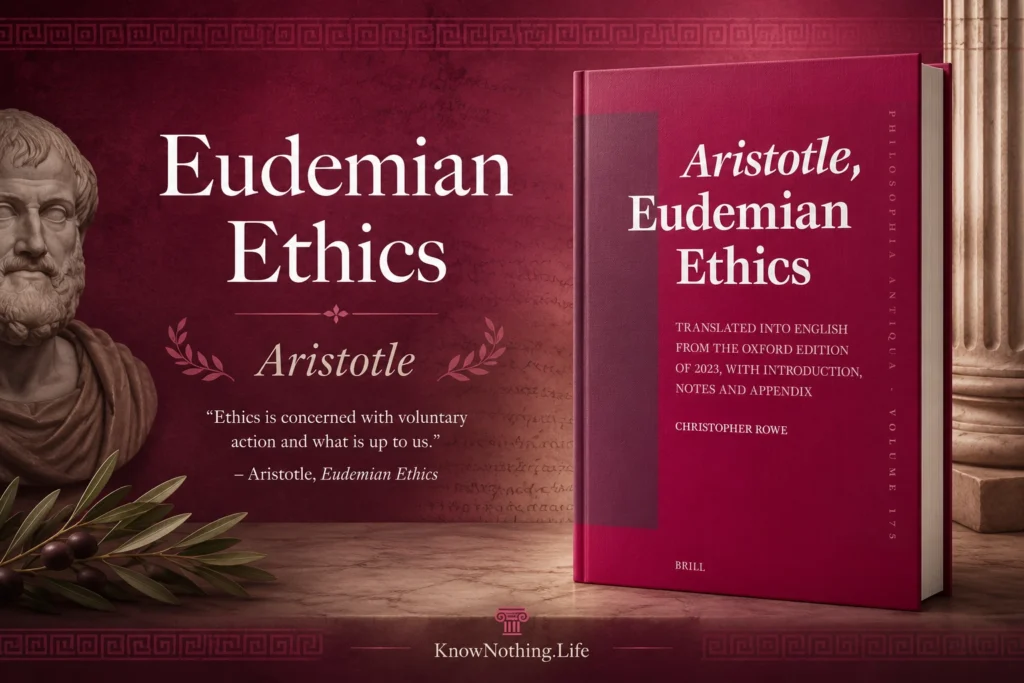
Aristotle’s Eudemian Ethics occupies an unusual place in the history of philosophy. It covers much of the same territory as the more famous Nicomachean Ethics—happiness, virtue, choice, friendship, pleasure, practical wisdom, and human flourishing—yet it is not merely an early draft or abbreviated version of that work. Modern scholarship increasingly treats it as an independent and complete account of the good human life. The traditional title associates the work with Aristotle’s student Eudemus of Rhodes, although precisely how the title originated remains uncertain. Its chronology relative to the Nicomachean Ethics is also debated, with some scholars regarding the Eudemian Ethics as the earlier treatment. Three books are shared by the two ethical works: Books IV–VI of the Eudemian Ethics correspond to Books V–VII of the Nicomachean Ethics, covering justice, intellectual virtue, and weakness of will.
The differences between the two works are philosophically important. The Eudemian Ethics gives particular attention to the relation among goodness, nobility, and pleasure, explores deliberate choice in distinctive ways, develops an unusually rich account of friendship and self-knowledge, and ends with the concept of kalokagathia—a unified nobility and goodness connected to the proper organization of an entire life. Cambridge scholars Brad Inwood and Raphael Woolf emphasize that the work deserves to be read as a complete investigation of happiness rather than as a secondary appendix to Aristotle’s better-known ethics. Read on its own terms, the Eudemian Ethics asks an intensely practical question: What arrangement of character, action, relationships, pleasure, and thought allows a human being to live genuinely well?
Happiness as the Activity of a Complete Life
The book opens by challenging an inscription associated with the sanctuary of Leto at Delos, which separates the noblest, best, and most pleasant things. Aristotle argues instead that genuine happiness brings these qualities together. Happiness, or eudaimonia, is not merely good; correctly understood, it is also noble and deeply pleasant. This beginning immediately gives the Eudemian Ethics a distinctive emphasis. Aristotle does not imagine the morally admirable life as one in which virtue requires perpetual sacrifice of happiness. The fulfilled person should eventually experience goodness and healthy pleasure as belonging together.
Aristotle then develops his familiar but powerful idea that flourishing consists in activity rather than possession. Virtue is a condition of the soul, but simply possessing a good disposition is insufficient. A capacity fulfills itself through exercise. Seeing actualizes sight; understanding actualizes intellectual ability; virtuous action actualizes character. He therefore concludes that happiness is activity across a complete life in accordance with complete virtue. Modern psychology has adopted a related distinction between hedonic well-being—centered more on pleasure and positive affect—and eudaimonic approaches concerned with meaningful functioning, development, and realization of human capacities. Richard Ryan and Edward Deci’s influential review of well-being research explicitly traced this distinction back to ancient debates about what constitutes a good life.
Virtue, Character, and the Mean
Virtue in the Eudemian Ethics is not obedience to a catalog of rules. Aristotle is interested in durable qualities of character that enable a person to respond appropriately across changing circumstances. Courage, temperance, generosity, dignity, friendliness, and other virtues regulate emotions and actions that can go wrong through either excess or deficiency. Courage, for example, is not the absence of fear but an appropriate relation to fear and confidence. Temperance regulates bodily pleasures without requiring their complete rejection. Generosity concerns giving and acquiring resources in the right manner and for appropriate purposes. Aristotle repeatedly describes the virtuous condition as a mean between poorly calibrated extremes, but this mean is relative to the situation rather than a mathematical midpoint.
Character therefore develops through an interaction among judgment, desire, repeated action, and emotional education. This is one reason Aristotelian virtue cannot be reduced to personality traits in the modern psychological sense. A person may naturally be bold, sociable, or restrained without thereby possessing courage, friendliness, or temperance. Virtue involves acting appropriately for the right reasons. Still, modern research on habit provides an illuminating comparison. Phillippa Lally and colleagues followed people attempting to establish everyday behaviors and found that repeated performance in stable contexts gradually increased behavioral automaticity, rather than producing instant transformation. Aristotle’s theory of character is much richer than habit automaticity, but the psychological principle is similar: repeated action gradually changes the ease and regularity with which behavior is performed.
Deliberate Choice and Moral Responsibility
One of the most interesting portions of Eudemian Ethics concerns prohairesis, usually translated as deliberate choice or decision. Aristotle distinguishes choice from simple desire, appetite, wish, or spontaneous voluntary action. People can wish for outcomes outside their control, but deliberate choice concerns courses of action that they believe they can actually pursue. Choice therefore emerges from deliberation: we consider alternatives, investigate possible means, and select one course rather than another. Aristotle even plays on the structure of the Greek term, suggesting that prohairesis involves choosing one thing before another.
This gives Aristotle’s ethics an important psychological dimension. Moral character cannot be judged entirely by outward behavior, because intention and deliberation matter. Two people may perform exactly the same action for radically different reasons. Someone may give money because of generosity, fear of criticism, expectation of reward, or an attempt at manipulation. For Aristotle, the ethical quality of an action therefore depends partly on the structure of motivation behind it. Virtue correctly establishes the end toward which a person acts, while deliberative reasoning helps determine the means by which that end can be realized. In Book II he remarks that the end functions as the starting point of practical thinking, while the conclusion of deliberation becomes the beginning of action. Ethics consequently becomes a study not only of behavior but of how desires, judgments, and decisions combine to produce behavior.
Pleasure Is Not the Enemy of Virtue
The prominence of pleasure distinguishes the Eudemian Ethics from stereotypical interpretations of ancient morality. Aristotle does not think ethical maturity consists in suppressing every desire until virtue becomes unpleasant duty. The truly virtuous person increasingly finds appropriate actions pleasant because character and desire have become harmonized. The introduction to Anthony Kenny’s translation notes that, for Aristotle’s virtuous person, what is good and what is pleasant ultimately coincide in application; when someone recognizes what is good but persistently experiences the opposite course as more attractive, the person has not yet achieved fully integrated virtue.
This makes Aristotle’s moral psychology more demanding than simple behavioral self-control. Someone who continually performs the correct action while desperately wishing to do the opposite may deserve praise for restraint, but Aristotle thinks a superior condition is possible. Ethical development changes what a person takes pleasure in. Modern motivational psychology offers a useful comparison. Research reviewed by Ryan and Deci suggests that well-being is closely connected to activities experienced as autonomous, meaningful, and expressive of valued capacities rather than solely to external rewards or momentary pleasure. Aristotle would not accept every element of modern self-determination theory, but both perspectives challenge the idea that flourishing can be produced simply by forcing behavior while leaving motivation untouched.
Friendship, Flourishing, and Knowing Oneself
Book VII gives friendship a central role in human flourishing. Aristotle distinguishes different forms of friendship according to what the people involved value in one another. Some relationships exist because they are useful; others because they are pleasurable. The highest friendship is connected with character and mutual recognition of the good. Such friendships do not merely provide companionship. They create a setting in which people exercise virtues, share worthwhile activities, and participate in one another’s lives. Aristotle therefore refuses to imagine happiness as radically self-sufficient isolation. Even the person with excellent character needs friends through whom important human activities become possible.
The Eudemian Ethics contains an especially intriguing connection between friendship and self-knowledge. Philosophical analysis of Book VII has emphasized Aristotle’s suggestion that another person can help us know ourselves because a friend provides a perspective on activity and character that cannot be obtained through isolated introspection alone. Modern research cannot confirm Aristotle’s theory of friendship as a philosophical whole, but it strongly supports the broader importance of relationships to human flourishing. A major meta-analysis by Julianne Holt-Lunstad, Timothy Smith, and J. Bradley Layton examined 148 prospective studies involving more than 300,000 participants and found that people with stronger social relationships had approximately a 50 percent greater likelihood of survival during the study periods. For Aristotle, friendship is not an optional decoration added to a successful life. It belongs to the architecture of living well.
From Individual Virtues to Kalokagathia
The final book introduces one of the most distinctive concepts in the Eudemian Ethics: kalokagathia, sometimes translated as nobility-and-goodness, perfect goodness, or moral nobility. The term combines kalos, meaning noble or beautiful, with agathos, meaning good. Aristotle uses it to describe something broader than possessing a single virtue. A person may perform courageous or generous acts while still lacking the harmonious organization characteristic of the finest life. Kalokagathia represents a kind of integration in which the virtues and external goods are ordered according to a higher conception of what is genuinely worth choosing. Modern scholarship has therefore interpreted the passage as an important statement about the unity of the virtues in Aristotle’s ethical thought.
The idea also clarifies Aristotle’s treatment of external goods. Wealth, bodily health, reputation, and social resources are not worthless. Nor, however, are they the final measure of success. Their ethical value depends upon how they are used and what kinds of activity they make possible. A rich person who organizes life entirely around acquiring additional wealth may possess more external goods while moving further from flourishing. A person with fewer resources may use them in ways that support friendship, knowledge, generosity, and worthwhile activity. Aristotle’s ethics therefore rejects both the claim that external circumstances do not matter at all and the opposite assumption that prosperity itself constitutes happiness. Flourishing requires a correct ordering of goods, not simply their accumulation.
Contemplation and the Surprising Final Standard
The closing passages of Eudemian Ethics are among its most intriguing and controversial. Aristotle eventually asks what criterion should guide our possession and use of natural goods such as health, wealth, and friendship. His answer introduces contemplation of the divine. The best arrangement of external and bodily goods is the one that most supports contemplation, while arrangements characterized by excess or deficiency that obstruct this higher activity are inferior. This gives the conclusion a more explicitly theological tone than readers of the Nicomachean Ethics might expect.
Yet Aristotle does not simply abandon moral life in favor of detached contemplation. Anthony Kenny’s analysis emphasizes that the Eudemian picture incorporates moral virtues, intellectual activity, appropriate pleasure, natural goods, and contemplation within a single vision of happiness. The ideal life therefore attempts to reconcile dimensions that are often treated as competitors: action and thought, character and pleasure, friendship and independence, bodily goods and intellectual fulfillment. Aristotle’s final standard asks whether the various elements of life have been arranged so that lower goods support rather than displace higher forms of human activity.
Why Eudemian Ethics Still Matters
Modern psychology has developed its own language of flourishing, character, motivation, relationships, and well-being, but several Aristotelian questions remain remarkably recognizable. Contemporary eudaimonic research distinguishes living well from simply feeling good; habit studies show that repeated behavior gradually becomes easier and more automatic; research on character strengths examines associations between valued traits and well-being; and large-scale studies of social relationships demonstrate that connection with others is associated with consequential psychological and physical outcomes. These findings do not scientifically validate Aristotle’s ethical conclusions. What they show is that many variables Aristotle treated as components of flourishing—activity, character, motivation, relationships, and meaningful goals—remain central objects of empirical investigation.
The enduring strength of Eudemian Ethics is its refusal to define happiness as a passing emotional state. A good life is an organized life. Actions must reflect worthwhile ends, desires must increasingly harmonize with judgment, friendships must contribute to mutual flourishing, external goods must serve rather than dominate life, and intellectual activity must orient a person toward realities worth understanding. Aristotle’s answer is demanding because happiness cannot be acquired through a single decision, possession, or pleasurable experience. It is built through an entire pattern of living. Read beside the Nicomachean Ethics, Politics, On the Soul, and Metaphysics, the Eudemian Ethics reveals Aristotle pursuing one of philosophy’s most persistent questions from a distinctive angle: not merely what makes us happy, but what must we become, choose, enjoy, and value if our lives as a whole are to count as genuinely good.