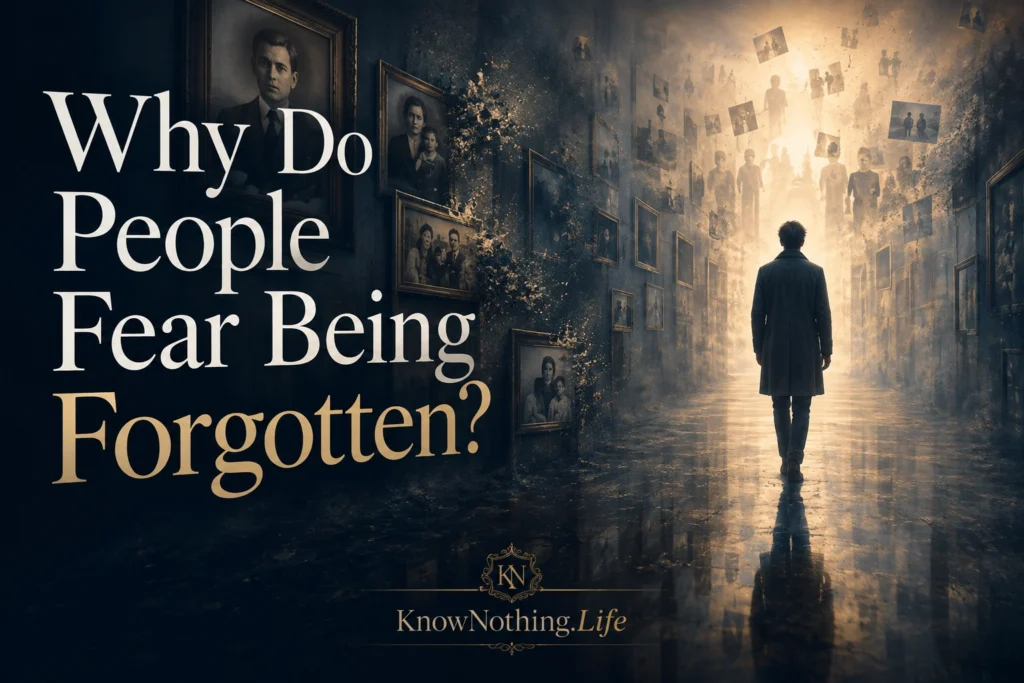
Most people understand that they will eventually die, but for many, an equally unsettling thought is what happens afterward: the world continues, relationships change, memories fade, and eventually even a once-familiar name may disappear from conversation. Photographs can lose their context, personal possessions pass to strangers or descendants, and within a few generations, even someone who was deeply loved may survive only as a vague story or a name on a family tree. The fear of being forgotten grows from this possibility. It is not simply a fear of death, but a fear that one’s life may eventually leave no recognizable trace—that the experiences, relationships, struggles, and choices that once felt intensely important could one day vanish from human memory.
Psychology offers several ways of understanding why this possibility can feel so disturbing. Human beings do not experience themselves only as biological organisms living in the present. We construct identities stretching backward into memory and forward into imagined futures. We want to belong to other people’s lives, contribute to something beyond ourselves, and believe that our existence has mattered. Research on mortality awareness, symbolic immortality, belonging, self-continuity, and legacy motivation suggests that the wish to be remembered is part of a broader human effort to give life permanence in the face of impermanence. The fear of being forgotten may therefore reveal something fundamental about human consciousness: we know that our lives are temporary, yet we possess minds capable of imagining worlds that continue after we are gone.
Being Forgotten Feels Like a Second Kind of Death
Death ends biological life, but being forgotten represents something psychologically different: the disappearance of the social self. Much of who we believe ourselves to be exists partly in relation to other people. We are someone’s child, parent, sibling, friend, partner, colleague, teacher, neighbor, rival, mentor, or influence. Our identities are reinforced when others remember experiences involving us, tell stories about us, value our contributions, or recognize our place in their lives. To imagine being completely forgotten is therefore to imagine not only bodily death but the eventual disappearance of these relational identities.
This helps explain why people often care intensely about what others will say about them after they die, even though they will never personally hear those judgments. The concern seems irrational if human motivation is understood only in terms of immediate reward. It makes considerably more sense if identity includes an imagined continuation beyond one’s own lifespan. Psychologist Robert Jay Lifton developed the idea of symbolic immortality to describe the human capacity to experience continuity through children, creativity, nature, religion, social groups, or other forms that outlast an individual life. His work on death and continuity suggested that people seek symbolic connections between their finite existence and ongoing human life. Being forgotten threatens that connection. If nothing remains—not memories, consequences, relationships, creations, or influence—it can feel as though one’s entire existence has been erased rather than merely completed.
Ernest Becker and the Desire to Transcend Death
One of the most influential modern accounts of this problem came from cultural anthropologist Ernest Becker. In his Pulitzer Prize-winning 1973 book The Denial of Death, Becker argued that human beings face an extraordinary psychological contradiction. Like other animals, humans possess a powerful instinct for self-preservation. Unlike other animals, however, we are capable of understanding that death is inevitable. We can imagine our own absence years before it occurs. According to Becker, much of human culture can be understood partly as an attempt to cope with this uncomfortable awareness.
Becker believed people construct what he called systems of heroism: cultural frameworks that allow individuals to feel valuable within something larger and more permanent than themselves. A person might pursue achievement, raise children, create art, build a business, serve a religion, defend a nation, advance science, contribute to a community, or become part of a historical movement. These activities serve many ordinary purposes, of course, but they can also provide a sense that some piece of the person will continue after biological death. Becker’s work later inspired psychologists Jeff Greenberg, Sheldon Solomon, and Tom Pyszczynski to develop terror management theory, which argues that cultural worldviews and self-esteem help humans manage the anxiety generated by awareness of mortality. Their research program has found that reminders of death can strengthen people’s attachment to the beliefs, identities, and values that make their lives feel meaningful and enduring.
From this perspective, the desire to be remembered is not necessarily vanity. Fame is only one possible strategy for obtaining symbolic continuity. A parent who hopes grandchildren will tell stories about them, a scientist who wants an idea to survive, an artist who hopes a painting will outlive its creator, and someone who simply wants friends to remember that they were kind may all be expressing variations of the same psychological motive: the wish for existence to extend beyond the boundaries of the body.
Research on Symbolic Immortality and Being Remembered
The connection between mortality, self-worth, and remembrance is not merely philosophical. A large 2021 investigation published in Personality and Individual Differences examined symbolic immortality across seven samples totaling 7,404 participants. Researchers directly measured the extent to which people believed they would be remembered and would continue to have an impact after death. Higher self-esteem was associated with a stronger sense of symbolic immortality. People who felt that they would live on symbolically also tended to report less loneliness and existential isolation, as well as lower accessibility of death-related thoughts.
These findings help explain why being forgotten can feel like evidence that one never truly mattered. Self-esteem is often described as feeling good about oneself, but terror management theory proposes a deeper function: self-esteem signals that a person is a valuable participant in a meaningful cultural world. If your life has value, then it should have consequences. Someone should be different because you existed. Something should remain. The fear of being forgotten challenges precisely this assumption. It raises an uncomfortable question: if absolutely nothing about the world is different after I am gone, how significant was my life?
This question can become especially powerful when people confront mortality, aging, major transitions, or the loss of people who once remembered earlier versions of them. The concern is not always conscious. A person may instead feel an increasing urge to preserve photographs, document family history, write memoirs, establish traditions, mentor younger people, have children, create enduring work, or attach their name to something lasting. These behaviors have many motivations, but the research on symbolic immortality suggests that some may also help protect the feeling that one’s existence extends beyond immediate consciousness.
We Want to Remain in Other People’s Minds Because We Need to Belong
Fear of being forgotten is also connected to one of psychology’s most extensively studied human motivations: the need to belong. In their landmark 1995 Psychological Bulletin review, Roy Baumeister and Mark Leary argued that humans possess a fundamental need to form and maintain stable interpersonal bonds. Their review found evidence that belonging affects emotional well-being, cognition, health, and behavior and that people strongly resist the dissolution of meaningful relationships.
Being remembered can be understood as belonging extended through time. When someone remembers us, part of our relationship continues inside that person’s mental world. A deceased parent’s saying may influence an adult child decades later. A teacher’s encouragement may shape a student’s decisions long after the teacher is gone. A friend’s humor may become embedded in the stories a social group continues to tell. Memory allows relationships to exert influence even when direct interaction is no longer possible.
The opposite possibility—being forgotten—resembles an extreme and permanent form of social exclusion. Research by Wendi Gardner, Cynthia Pickett, and Marilynn Brewer showed that threatened belonging can alter attention and memory for social information, suggesting that humans become particularly sensitive to relational cues when social connection is endangered. If belonging is a fundamental psychological need while alive, it is unsurprising that people may also imagine a future version of belonging in which they remain present through memory. Wanting to be remembered is, in this sense, a desire to remain connected to humanity even after direct participation has ended.
Memory Helps Create the Story of Who We Are
Humans experience identity as a story extending across time. We remember childhood, reinterpret past experiences, imagine future selves, and attempt to understand how different stages of life belong to the same person. Psychologists call part of this experience self-continuity. Constantine Sedikides, Emily Hong, and Tim Wildschut describe self-continuity as the subjective connection among one’s past, present, and future selves. Their review in the Annual Review of Psychology shows that this sense of continuity is associated with motivation, decision-making, identity regulation, and psychological well-being.
The fear of being forgotten can be viewed as the ultimate rupture in self-continuity. Throughout life, memory allows yesterday’s self to remain psychologically connected with today’s self. Other people also participate in maintaining this continuity. Family members remember stories from childhood. Old friends remember versions of us that no longer exist. Photographs, journals, objects, traditions, and familiar places help anchor personal identity across decades. Research on nostalgia has similarly found that recalling emotionally significant past experiences can strengthen the sense that one’s past, present, and future form a coherent whole. In five studies involving more than 1,000 participants, researchers found that nostalgia increased global self-continuity partly by connecting present identity to autobiographical narratives and associations with the past.
Death creates an unavoidable break in personal experience, but memory appears to promise a partial solution. If one’s story continues to be told by others, then the narrative seems to extend beyond the narrator. This is why forgotten names on old photographs can provoke such a strange sadness. The people pictured once possessed complicated relationships, ambitions, fears, jokes, routines, and entire private worlds. Yet when no one remembers who they were, the richness of those lives becomes almost inaccessible. Looking at such photographs can remind us that the same fate may eventually await our own stories.
Legacy Connects Us to People Who Do Not Yet Exist
Humans do something psychologically unusual: we make sacrifices for people we will never meet. Parents save for descendants. Scientists contribute knowledge they know may become useful only decades later. People plant trees whose mature shade they will never experience. Communities build institutions designed to survive their founders. These behaviors reveal another important aspect of the fear of being forgotten—the human desire to participate in a future beyond one’s personal lifespan.
Duke University researcher Kimberly Wade-Benzoni has studied what she calls legacy motivation, particularly in decisions involving future generations. Her work argues that intergenerational situations can activate concerns about how one’s life will affect people who come later. Legacy motives can encourage people to act for future generations even when there is no direct material reward for doing so. She has also connected mortality awareness with the desire to belong to enduring groups and future generations, suggesting that contributing to people who will live after us can provide a form of symbolic continuity.
This helps explain why legacy becomes increasingly important for many people as they age. Psychologist Erik Erikson described generativity versus stagnation as a major developmental challenge of adulthood. Generativity involves investing in people, projects, ideas, or institutions that will continue beyond oneself. Raising children is one expression, but teaching, mentoring, creating, caregiving, volunteering, building organizations, and preserving knowledge can serve similar functions. The underlying psychological movement is from asking “What can life give me?” toward “What can I leave behind?”
Fame Is Only One Way to Avoid Being Forgotten
Modern culture can make the desire to be remembered look like a desire for fame. Social media followers, public recognition, books, monuments, awards, named buildings, viral content, and historical reputation all promise measurable evidence that one’s existence has attracted attention. The internet has intensified this possibility because ordinary people now leave enormous digital archives—photographs, messages, videos, opinions, profiles, creative work, and records that may persist long after the circumstances that produced them have disappeared.
Yet remembrance does not have to be broad to be psychologically meaningful. Terror management theory emphasizes belonging to enduring systems of meaning, not necessarily becoming universally famous. Someone remembered warmly by three people may achieve a stronger sense of symbolic continuity than someone whose name is recognized by millions but whose relationships feel empty. People can also survive anonymously through consequences rather than names. A teacher’s influence may pass from student to student until nobody remembers the original teacher. A person’s generosity may change a family pattern for generations without descendants knowing who initiated the change.
This reveals a paradox at the center of legacy. Impact can survive after identity disappears. Humanity contains countless ideas, traditions, habits, expressions, discoveries, and acts of kindness whose original sources are forgotten. The fact that a person’s name disappears does not mean the causal effects of that person’s life disappear. Every relationship changes the people involved, who subsequently change other people. From this perspective, human influence resembles a chain rather than a monument.
Learning to Accept That We May Eventually Be Forgotten
No strategy can guarantee permanent remembrance. Even the most famous historical figures will only be remembered as long as there are minds and cultures capable of remembering them. Civilizations disappear. Languages vanish. Records are destroyed. Names change meaning. From a sufficiently long perspective, trying to secure literal permanence through reputation is an impossible project. The existential philosophers confronted this reality directly. Martin Heidegger regarded awareness of mortality as essential to authentic existence, while Albert Camus argued in The Myth of Sisyphus that meaning need not depend on discovering some permanent cosmic justification for life.
Viktor Frankl offered another approach in Man’s Search for Meaning. Rather than defining meaning as fame or permanence, Frankl emphasized responsibility—to work, love, experience, and the stance one takes toward circumstances. This shifts the question from “Will people remember me?” to “How am I affecting life while I am here?” Those questions can lead to dramatically different priorities. The first invites endless comparison with other people’s visibility. The second directs attention toward relationships, values, and actions available in the present.
The fear of being forgotten may never disappear completely because it grows from several deep human needs at once: the need to belong, the desire for self-continuity, awareness of mortality, and the hope that our lives have significance. But the psychological research on legacy suggests that the answer may not be to make oneself unforgettable. A more attainable form of symbolic immortality comes from participation in things that continue—relationships, knowledge, communities, traditions, creativity, nature, values, and future generations.
Why Being Remembered Matters So Much
People fear being forgotten because human beings are meaning-making creatures who can imagine their own absence. We do not simply want to survive biologically; we want our lives to fit into a story that extends beyond the present moment. Ernest Becker described culture as one response to mortality. Terror management researchers have shown how self-esteem and meaningful worldviews buffer existential anxiety. Baumeister and Leary demonstrated the fundamental power of belonging. Research on self-continuity shows how strongly identity depends on connections across time, while work on legacy motivation demonstrates that people are capable of investing deeply in futures they will never personally experience.
The desire to be remembered is therefore not merely narcissism. At its deepest level, it expresses the wish to know that one’s existence mattered—that because we were here, someone loved differently, understood something new, avoided some suffering, discovered an idea, inherited a story, continued a tradition, or experienced a moment that otherwise would never have existed.
Eventually, even those memories may fade. But perhaps permanence is not the only measure of significance. A song does not become meaningless because it ends. A conversation does not become worthless because no one records it. A person’s influence does not vanish simply because future generations no longer know the name attached to it. We may not be able to ensure that the world remembers us forever. We can, however, live in such a way that the world is different because we were here.