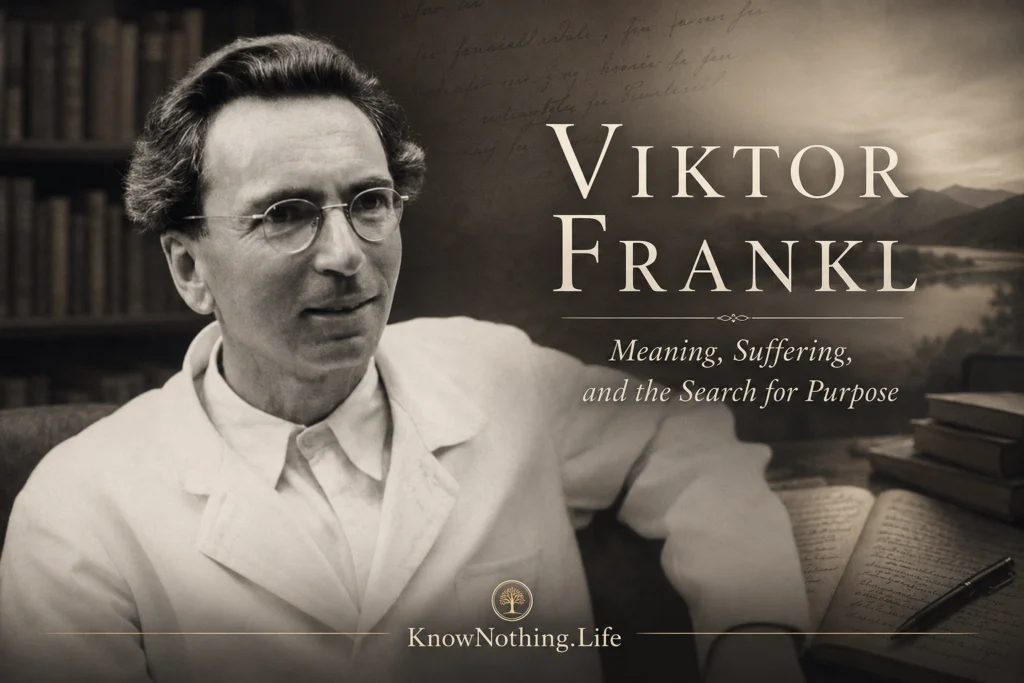
Viktor Frankl was an Austrian neurologist, psychiatrist, philosopher, and Holocaust survivor who made the search for meaning a central subject in modern psychology. He founded logotherapy and existential analysis, an approach based on the idea that people are motivated not only by pleasure or power but by a “will to meaning.” Frankl did not promise that purpose eliminates pain or that every tragedy can be explained. His more demanding claim was that life can retain meaning under every condition and that people remain responsible for how they answer the situations placed before them. This union of realism, freedom, and responsibility gave his psychology an appeal extending far beyond clinical practice.
Frankl is best known for Man’s Search for Meaning, his account of imprisonment in Nazi camps and introduction to logotherapy. Yet his system began before the Holocaust and expanded through books, lectures, clinical work, and teaching. The Doctor and the Soul, The Will to Meaning, The Unconscious God, and The Unheard Cry for Meaning presented the person as capable of conscience, love, creativity, humor, and self-transcendence. His legacy rests not simply on surviving catastrophe, but on creating a psychotherapy that asked what a patient could still live for.
Early Life and Psychological Formation
Viktor Emil Frankl was born in Vienna on March 26, 1905, the second of three children in a Jewish family. His father, Gabriel, worked in government social service, while his mother, Elsa, came from Prague. Frankl became interested in philosophy and psychology as an adolescent. He corresponded with Sigmund Freud and later participated in Alfred Adler’s circle. Although he learned from both traditions, he rejected explanations that reduced human motivation to sexual gratification or the pursuit of superiority. He wanted a psychology that treated values, moral choice, and orientation toward the future as genuine dimensions of human life.
Frankl studied medicine at the University of Vienna and earned his medical degree in 1930, specializing in neurology and psychiatry. During the late 1920s, he organized youth counseling centers for students facing emotional crises. He later treated suicidal women at Vienna’s Steinhof psychiatric hospital and headed the neurological department at the Rothschild Hospital, which served Jewish patients under Nazi rule. These roles gave him extensive experience with despair and suicide. By 1926, he was already using the term logotherapy, showing that the theory was not invented retrospectively from his imprisonment.
Deportation, Imprisonment, and Loss
Frankl married Tilly Grosser in 1941. In September 1942, he, his wife, and his parents were deported to Theresienstadt. His father died there, while Frankl worked when possible as a physician and psychological helper. In October 1944, Frankl, Tilly, and his mother were transported to Auschwitz. His mother was murdered there, Tilly was sent to Bergen-Belsen and died, and his brother Walter was also killed. Frankl was transferred after a short period at Auschwitz to Kaufering and later Türkheim, both subcamps of Dachau. American troops liberated Türkheim on April 27, 1945.
The Holocaust did not prove that the “right attitude” guarantees survival. Chance, violence, selections, illness, and material conditions determined life and death beyond personal control. Frankl’s testimony concerned the limited but morally significant freedom that might remain after external liberty had been destroyed. In Man’s Search for Meaning, he called this “the last of the human freedoms”—the ability “to choose one’s attitude in any given set of circumstances.” He witnessed cruelty, but also prisoners who comforted others or shared scarce food. Such acts could not cancel suffering; they revealed what kind of person someone might still choose to be within it.
Man’s Search for Meaning
After returning to Vienna, Frankl learned the extent of his family’s deaths and reconstructed a manuscript on logotherapy that had been confiscated during deportation. In 1946, he published the German work later known in English as Man’s Search for Meaning. The book combines an account of camp psychology with an explanation of logotherapy. Rather than offering a detailed chronological memoir, it considers recurring stages: shock upon arrival, emotional numbing during confinement, and the disorientation that could follow liberation. Frankl examined how imagined futures, unfinished work, religious faith, memories of love, and responsibility toward others could help preserve an inner direction.
A central theme is self-transcendence—the capacity to reach beyond preoccupation with oneself toward a person to love or a task to complete. Remembering his wife, whose fate he did not know, Frankl concluded that “the salvation of man is through love and in love.” Love was not merely comfort, but a way of perceiving another person’s uniqueness and possibility. Meaning could also be discovered through creative work and through the attitude adopted toward unavoidable suffering. Frankl did not glorify pain: suffering that can be removed should be removed, while unavoidable suffering presents a different question about dignity and response.
Logotherapy and the Will to Meaning
Logotherapy takes its name from logos, used here to mean meaning. Frankl argued that the primary concern of life is not simply attaining pleasure or avoiding discomfort, but discovering and fulfilling concrete meanings. Meaning is not a universal formula. It changes from person to person and moment to moment, arising through responsibilities only a particular individual can answer. Reversing the usual question, Frankl maintained that people should not merely ask what they expect from life; they must consider what life is asking of them. Freedom becomes mature only when joined to responsibility.
Frankl developed techniques including paradoxical intention and dereflection. Paradoxical intention invites a patient to wish for or humorously exaggerate a feared reaction, weakening the anticipatory anxiety that helps produce it. Dereflection redirects excessive self-observation toward meaningful work, relationships, or commitments. These methods reflected his conviction that people cannot be reduced entirely to symptoms, drives, or conditioning. Biological and social circumstances impose real limits, but a person may still take a position toward them. As Frankl wrote, “When we are no longer able to change a situation, we are challenged to change ourselves.”
Major Works, Career, and Legacy
Frankl became director of the Vienna Neurological Policlinic in 1946 and remained there for roughly twenty-five years. He earned a doctorate in philosophy in 1948 and became a professor of neurology and psychiatry at the University of Vienna. His international career included lectures and visiting appointments, while logotherapy became known as the Third Viennese School of Psychotherapy after Freud’s psychoanalysis and Adler’s individual psychology. In 1947, Frankl married Eleonore Schwindt, who became his lifelong partner as his work gained international recognition.
His major books expanded logotherapy beyond the memoir. The Doctor and the Soul presented psychotherapy oriented toward meaning and responsibility. The Will to Meaning explained logotherapy’s foundations and clinical uses, while The Unconscious God explored conscience and spirituality. The Unheard Cry for Meaning challenged reductionist psychologies that neglected the human dimension, and Man’s Search for Ultimate Meaning revisited psychotherapy’s relationship with spiritual life. His autobiography, Viktor Frankl: Recollections, traced his development and postwar career.
Frankl died in Vienna on September 2, 1997, at age ninety-two. His ideas influenced existential therapy, humanistic psychology, pastoral counseling, medicine, education, and research on purpose and resilience. His concept of tragic optimism described the possibility of affirming life despite pain, guilt, and death—not through denial, but through meaningful response. His popularity also produced misquotations: the sentence beginning “Between stimulus and response there is a space” is frequently attributed to him, but the Viktor Frankl Institute says its authorship is unresolved. Frankl did not teach that positive thinking controls fate or that suffering automatically ennobles. He taught that freedom is limited but real, and that life continually asks each person for a responsible answer.