William James was born on January 11, 1842, in New York City, into a family that stood at the intersection of intellectual ambition and cultural refinement. His father, Henry James Sr., was a theologian and philosopher deeply engaged with religious and metaphysical questions, while his brother, Henry James, would become one of the most celebrated writers of his generation. The James household encouraged curiosity, travel, and exposure to diverse intellectual traditions, shaping William’s lifelong openness to multiple perspectives.
James’s early education was unconventional, spanning Europe and the United States, and exposing him to a broad range of scientific and philosophical ideas. He initially pursued painting before turning to science, enrolling at Harvard to study chemistry and later medicine. However, his intellectual journey was marked by periods of personal crisis, including bouts of depression that led him to question the foundations of knowledge and belief. These struggles were not merely biographical details but became central to his philosophical outlook, grounding his later emphasis on lived experience and the psychological dimensions of thought.
The Birth of American Psychology
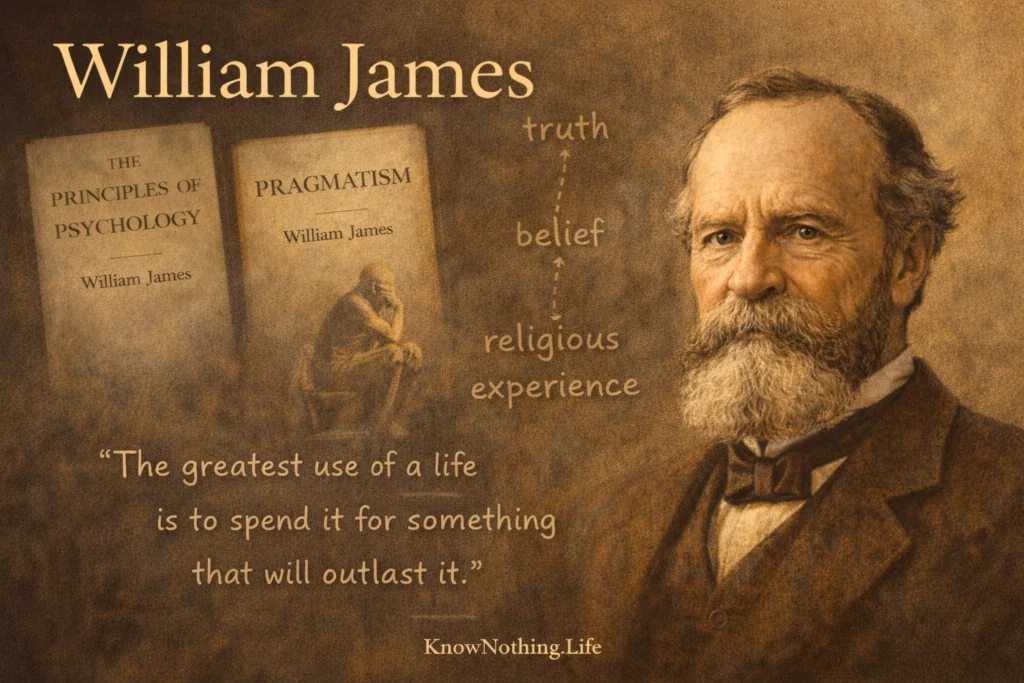
William James is often regarded as one of the founding figures of modern psychology, particularly in the United States. His landmark work, The Principles of Psychology, remains one of the most influential texts in the history of the discipline. In this monumental volume, James approached the mind not as a static entity but as a dynamic process, introducing the concept of the “stream of consciousness” to describe the continuous flow of thoughts and sensations that characterize human experience.
Rejecting the rigid structuralism that dominated early psychological thought, James emphasized the functional role of consciousness, asking not just what mental states are, but what they do. This perspective laid the groundwork for functionalism, a school of thought that would influence later developments in psychology, including behaviorism and cognitive science. James’s approach was deeply empirical, yet it retained a sensitivity to the richness of subjective experience, bridging the gap between scientific analysis and introspective understanding.
His contributions extended beyond theory into the institutional development of psychology as a discipline. At Harvard, James established one of the first psychology laboratories in the United States, helping to legitimize the field as a scientific endeavor. Yet he remained wary of reducing human experience to purely mechanical explanations, insisting that psychology must account for the complexity and individuality of consciousness. This balance between scientific rigor and philosophical depth became a hallmark of his work.
Pragmatism and the Meaning of Truth
James’s philosophical legacy is most closely associated with pragmatism, a movement that redefined the nature of truth and meaning. Building on ideas developed by Charles Sanders Peirce, James popularized pragmatism through lectures and writings that emphasized its practical implications. In works such as Pragmatism, he argued that the truth of an idea lies not in its correspondence to an abstract reality but in its practical consequences and usefulness in experience.
For James, truth was not a fixed property but a process, something that becomes true through its verification in lived experience. This view challenged traditional notions of objective, immutable truth, suggesting instead that beliefs must be evaluated in terms of their effects on human life. “Truth happens to an idea,” he famously wrote, “it becomes true, is made true by events.” This dynamic conception of truth reflected his broader commitment to a philosophy grounded in experience rather than abstraction.
Pragmatism also offered a method for resolving philosophical disputes by examining their practical implications. Rather than engaging in endless debates about metaphysical principles, James proposed that philosophers should ask what difference a belief makes in practice. This approach not only clarified philosophical problems but also made philosophy more relevant to everyday life, aligning it with the concerns of ordinary people rather than confining it to academic speculation.
The Will to Believe and Religious Experience
One of James’s most distinctive contributions lies in his exploration of belief, particularly in the context of religion. In his essay The Will to Believe, he defended the legitimacy of holding beliefs in the absence of sufficient evidence, provided that those beliefs address genuine, unavoidable choices. James argued that in certain situations—what he called “forced, live, and momentous options”—it is not only permissible but necessary to let our “passional nature” guide our decisions.
This perspective was closely tied to his broader interest in religious experience, which he explored in depth in The Varieties of Religious Experience. In this work, James approached religion not as a system of doctrines but as a set of personal experiences that reveal the psychological and existential dimensions of belief. He examined a wide range of religious phenomena, from mystical experiences to conversion narratives, seeking to understand their significance without reducing them to mere illusions.
James’s approach to religion was both sympathetic and critical, recognizing its profound impact on human life while maintaining a commitment to empirical inquiry. He famously described religion as “the feelings, acts, and experiences of individual men in their solitude,” emphasizing its personal and experiential nature. This perspective allowed him to bridge the gap between scientific skepticism and religious faith, offering a nuanced account that continues to influence contemporary discussions in philosophy and psychology.
Radical Empiricism and the Nature of Experience
In his later work, James developed a philosophical position known as radical empiricism, which sought to expand the scope of empirical inquiry to include not only discrete sensations but also the relationships between them. Unlike traditional empiricism, which often treated experiences as isolated data points, James argued that relations—such as continuity, causation, and similarity—are themselves directly experienced and should be included in any comprehensive account of reality.
Radical empiricism reflects James’s broader commitment to understanding experience in its fullness, without imposing artificial divisions between subject and object, mind and world. He proposed that reality consists of a “pure experience” that precedes these distinctions, a continuous field from which both mental and physical phenomena emerge. This idea challenged dualistic frameworks and offered a more integrated view of reality, one that resonated with developments in both philosophy and science.
Although radical empiricism was less widely adopted than pragmatism, it represents a significant contribution to metaphysics and epistemology. It underscores James’s willingness to push beyond established boundaries, exploring new ways of thinking about the relationship between experience and reality. His work in this area continues to inspire philosophers who seek to reconcile empirical methods with a richer understanding of human experience.
Legacy and Enduring Influence
William James’s influence extends across multiple disciplines, including philosophy, psychology, education, and religious studies. As a founder of pragmatism and a pioneer of modern psychology, he helped to shape the intellectual landscape of the twentieth century, offering new tools for understanding truth, belief, and experience. His emphasis on practicality, individuality, and the richness of human life continues to resonate in contemporary thought.
James’s writing style, characterized by clarity, wit, and a deep engagement with lived experience, made his ideas accessible to a broad audience. He believed that philosophy should address real problems and speak to the concerns of ordinary people, a conviction that guided both his teaching and his writing. His lectures were renowned for their energy and insight, attracting students and scholars from diverse backgrounds.
Perhaps most importantly, James’s work embodies a spirit of openness and intellectual humility. He rejected rigid systems in favor of a pluralistic approach that acknowledges the complexity and diversity of human experience. “The greatest use of a life,” he wrote, “is to spend it for something that will outlast it,” a sentiment that captures the enduring significance of his contributions.
William James died on August 26, 1910, but his ideas continue to shape the way we think about mind, truth, and belief. His philosophy invites us to engage with the world not as detached observers but as active participants, whose beliefs and actions contribute to the ongoing creation of meaning. In this sense, James remains a vital figure in the history of thought, a philosopher whose insights continue to illuminate the human condition.