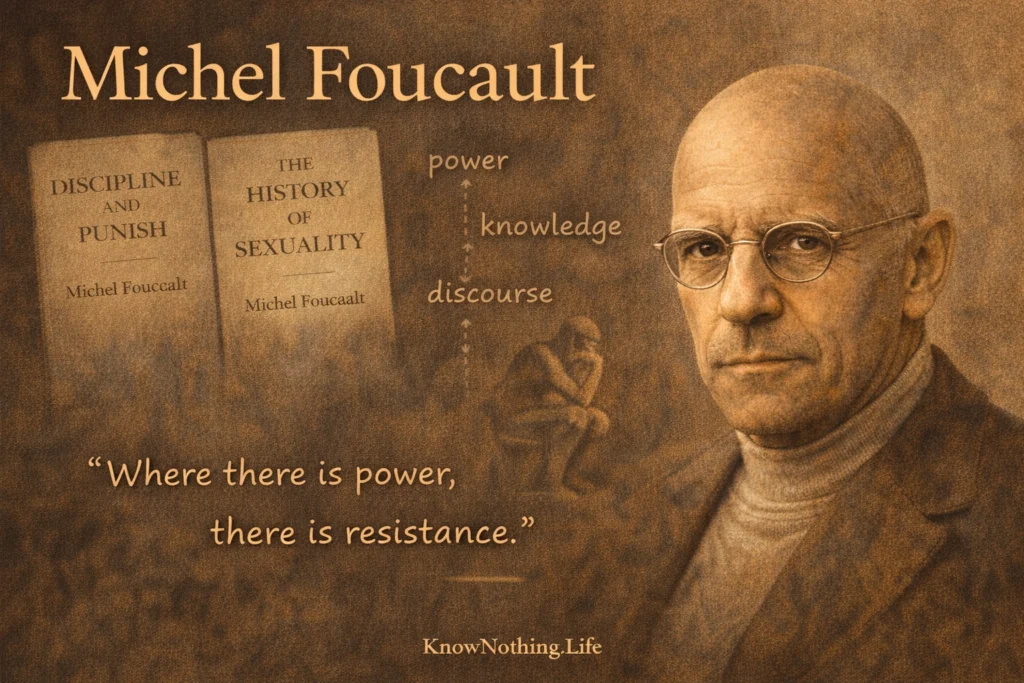
Michel Foucault was born on October 15, 1926, in Poitiers, France, into a family of surgeons whose expectations initially pointed him toward a medical career. Yet from an early age, Foucault displayed an intense intellectual curiosity and a deeply introspective temperament that set him apart from conventional academic paths. His formative years were shaped by the cultural and political upheavals of mid-twentieth-century Europe, including the aftermath of World War II, which left a lasting imprint on his thinking about institutions, authority, and the structures of power.
Foucault entered the prestigious École Normale Supérieure in Paris, where he was exposed to a rich intellectual environment that included the influence of Jean-Paul Sartre and Georges Canguilhem. Although initially drawn to existentialism, Foucault gradually distanced himself from its focus on individual subjectivity, turning instead toward historical and structural analyses of knowledge. His academic training in philosophy, psychology, and the history of science equipped him with a multidisciplinary perspective that would define his later work. These early experiences laid the groundwork for a thinker who would challenge the very foundations of how knowledge and truth are constructed.
Madness, Medicine, and the Birth of Institutions
Foucault’s early work focused on the history of mental illness and the institutions that define and regulate it. In Madness and Civilization, he traced the changing attitudes toward madness from the Renaissance to the modern era, arguing that what society defines as “madness” is not a fixed biological reality but a product of historical and cultural forces. He introduced the idea that institutions such as asylums do not merely treat mental illness but actively shape its meaning, reinforcing social norms and boundaries.
This approach reflects Foucault’s broader method of “archaeology,” which seeks to uncover the underlying structures that govern what can be said, thought, and known in a given period. Rather than focusing on individual thinkers or linear progress, he examined the conditions that make certain forms of knowledge possible while excluding others. In doing so, he challenged the assumption that modern institutions represent a straightforward advancement over the past, revealing instead the complex interplay between knowledge and power.
Foucault’s analysis of madness extended beyond psychiatry to encompass the broader mechanisms of social control. He argued that modern societies regulate behavior not only through explicit laws but also through subtle forms of normalization, defining what is considered “normal” and “abnormal.” This insight would become central to his later work, as he explored the ways in which institutions shape human experience and identity.
Knowledge, Power, and the Human Sciences
Foucault’s most influential contributions lie in his analysis of the relationship between knowledge and power. In The Order of Things, he examined the historical development of the human sciences, arguing that disciplines such as biology, economics, and linguistics are shaped by underlying “epistemes”—frameworks that define what counts as knowledge in a particular era. These epistemes are not consciously chosen but emerge from complex historical processes, shaping the way individuals understand themselves and the world.
One of Foucault’s most famous assertions captures this perspective: “Knowledge is not for knowing: knowledge is for cutting.” By this, he meant that knowledge organizes and divides reality, creating categories that both enable understanding and impose limitations. This insight challenges the traditional view of knowledge as neutral or objective, suggesting instead that it is deeply intertwined with power relations. Knowledge, in Foucault’s analysis, does not merely describe the world; it actively participates in shaping it.
This idea is further developed in his concept of “power/knowledge,” which emphasizes that power is not simply repressive but productive. Power operates through networks of relationships, producing knowledge, shaping discourse, and influencing behavior. Rather than being concentrated in a single authority, power is diffuse, embedded in institutions, practices, and everyday interactions. This reconceptualization of power has had a profound impact on fields ranging from sociology to political theory, transforming the way scholars analyze social structures.
Discipline, Surveillance, and Modern Society
In Discipline and Punish, Foucault turned his attention to the evolution of punishment and the emergence of modern disciplinary systems. He traced the shift from public spectacles of punishment, such as executions, to more subtle forms of control embodied in prisons, schools, and hospitals. This transformation reflects a broader change in the exercise of power, from overt displays of authority to continuous surveillance and normalization.
Central to this analysis is the concept of the “panopticon,” a theoretical model of surveillance in which individuals are constantly visible to an unseen observer. Inspired by the architectural design proposed by Jeremy Bentham, the panopticon serves as a metaphor for modern forms of power, where individuals internalize surveillance and regulate their own behavior. “Visibility is a trap,” Foucault observed, highlighting the psychological dimension of control in modern societies.
Foucault’s examination of disciplinary power reveals how institutions shape individuals not through coercion alone but through the creation of norms and expectations. Schools, for example, do not merely impart knowledge but also produce disciplined subjects who conform to societal standards. This insight underscores the pervasive nature of power, which operates at the level of everyday practices and interactions. By uncovering these mechanisms, Foucault challenged conventional notions of freedom and autonomy, revealing the subtle ways in which individuals are shaped by their environments.
Sexuality, Identity, and the Self
In his later work, particularly The History of Sexuality, Foucault explored the relationship between power, knowledge, and identity. He challenged the widely held belief that modern societies repress sexuality, arguing instead that they produce and regulate it through discourse. By encouraging individuals to speak about their desires, institutions such as medicine and psychology create categories of identity that define what it means to be “normal” or “deviant.”
Foucault’s analysis of sexuality extends to the broader question of how individuals constitute themselves as subjects. He introduced the concept of “technologies of the self,” practices through which individuals shape their own identities and behaviors. This perspective shifts the focus from external forms of control to the ways in which individuals participate in their own subject formation. It reflects a more nuanced understanding of power, one that acknowledges both constraint and agency.
In exploring these themes, Foucault moved beyond his earlier focus on institutions to consider the ethical dimensions of selfhood. He became interested in how individuals might resist dominant forms of power and create alternative ways of living. This emphasis on self-formation and ethical practice represents a significant evolution in his thought, highlighting the possibility of freedom within the constraints of social structures.
Legacy and Enduring Influence
Michel Foucault’s influence extends across a wide range of disciplines, including philosophy, sociology, history, cultural studies, and political theory. His work has fundamentally reshaped the way scholars understand power, knowledge, and identity, challenging traditional assumptions and opening new avenues for analysis. By emphasizing the historical and contingent nature of social structures, Foucault encouraged a critical approach to institutions that continues to resonate in contemporary thought.
Foucault’s writing style, characterized by its depth and complexity, reflects the richness of his ideas. While his work can be demanding, it offers profound insights into the mechanisms that shape modern life. His willingness to question established truths and explore unconventional perspectives has made him one of the most influential and debated thinkers of the twentieth century.
He died on June 25, 1984, but his intellectual legacy remains vibrant and contested. Foucault’s work invites us to reconsider the foundations of knowledge and the dynamics of power, challenging us to think critically about the structures that govern our lives. As he once remarked, “Where there is power, there is resistance,” a statement that encapsulates both his analysis of social systems and his belief in the possibility of transformation.
Through his exploration of institutions, discourse, and the self, Michel Foucault redefined the scope of philosophy, demonstrating that the study of ideas cannot be separated from the conditions in which they arise. His work continues to inspire scholars and thinkers who seek to understand the complexities of modern society, making him a central figure in the ongoing effort to interrogate the relationship between knowledge, power, and human experience.