Jacques Derrida was born on July 15, 1930, in El Biar, Algeria, then a French colonial territory. Growing up in a Jewish family during a period marked by political instability and discrimination, Derrida experienced exclusion firsthand, particularly under the Vichy regime’s anti-Jewish laws. These early encounters with marginalization left a lasting impression on his intellectual development, shaping his sensitivity to questions of identity, belonging, and the structures that define inclusion and exclusion.
Derrida’s academic journey led him to Paris, where he studied at the École Normale Supérieure, one of France’s most prestigious institutions. There, he engaged deeply with the philosophical traditions of Edmund Husserl and Martin Heidegger, whose work on phenomenology and ontology profoundly influenced his thinking. At the same time, Derrida absorbed the structuralist ideas circulating in mid-twentieth-century French thought, yet he would later challenge their underlying assumptions. His intellectual formation was thus marked by both inheritance and critique, positioning him as a thinker who would interrogate the very foundations of Western philosophy.
The Emergence of Deconstruction
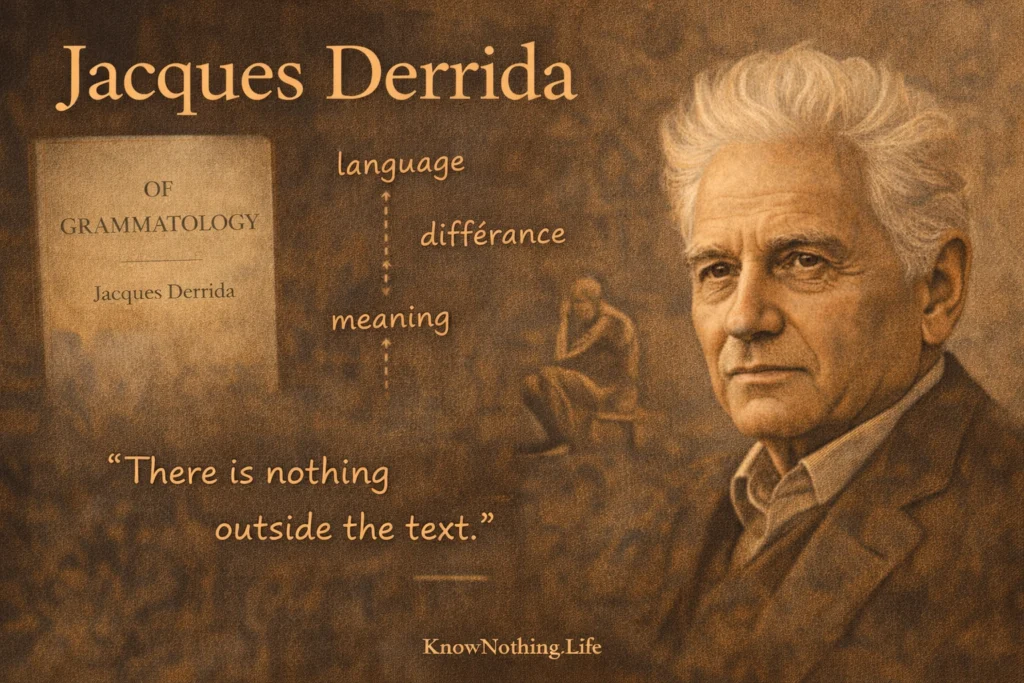
Derrida first gained international recognition with the publication of Of Grammatology, a work that introduced his method of deconstruction. This approach does not aim to destroy texts or ideas but to reveal the internal tensions and contradictions that undermine their apparent coherence. Derrida argued that Western philosophy has historically privileged speech over writing, presence over absence, and certainty over ambiguity—a tendency he described as “logocentrism.”
Through deconstruction, Derrida sought to expose how these hierarchies are unstable, showing that meaning is never fixed but always deferred. One of his most famous concepts, “différance,” captures this idea: meaning arises through differences between signs and is continually postponed, never fully present. “There is nothing outside the text,” Derrida famously wrote, a statement often misunderstood as denying reality but better interpreted as emphasizing that our access to reality is always mediated through language.
Derrida’s work challenged the assumption that texts have a single, authoritative meaning, opening the door to new forms of interpretation. His approach had a profound impact not only on philosophy but also on literary theory, cultural studies, and the humanities more broadly. By questioning the stability of meaning, Derrida transformed the way scholars read and analyze texts, encouraging a more critical and reflective engagement with language.
Language, Writing, and the Critique of Presence
Central to Derrida’s philosophy is a critique of what he called the “metaphysics of presence,” the belief that meaning and truth are grounded in immediate, self-evident presence. Derrida argued that this assumption overlooks the role of absence, difference, and mediation in the production of meaning. Writing, traditionally seen as secondary to speech, becomes in his work a key site for understanding how meaning is constructed and destabilized.
In essays such as “Structure, Sign, and Play in the Discourse of the Human Sciences,” Derrida challenged the structuralist idea that systems of meaning are governed by stable centers. Instead, he proposed that structures are characterized by a constant “play” of differences, in which no element has a fixed or privileged position. This insight undermines the notion of a definitive foundation for knowledge, suggesting that all systems of meaning are inherently open and dynamic.
Derrida’s analysis of language reveals the limits of traditional philosophical concepts, which often rely on binary oppositions such as presence/absence, speech/writing, and truth/error. By deconstructing these binaries, he showed that each term depends on the other for its meaning, blurring the distinctions that sustain philosophical systems. “The center is not the center,” he observed, capturing the paradoxical nature of structures that appear stable but are in fact fluid and contingent.
Ethics, Politics, and Responsibility
Although Derrida is often associated with abstract theoretical work, his later writings engage deeply with ethical and political questions. He explored themes such as justice, hospitality, and responsibility, seeking to understand how deconstruction might inform practical concerns. In works like Specters of Marx, Derrida revisited the legacy of Marxism, arguing that even after the decline of traditional Marxist movements, the issues it addressed—inequality, exploitation, and social justice—continue to haunt contemporary society.
Derrida’s concept of justice is particularly significant, as he distinguished it from law. While laws are finite, structured, and subject to interpretation, justice, he argued, is infinite and incalculable, always exceeding the frameworks that attempt to contain it. This distinction reflects his broader philosophical commitment to openness and responsibility, emphasizing that ethical decisions cannot be reduced to fixed rules or principles. “Justice is what gives us the impulse, the drive, or the movement to improve the law,” he wrote.
His reflections on hospitality and the “other” further illustrate his ethical concerns. Derrida argued that true hospitality requires an openness to the unfamiliar and the unknown, a willingness to welcome the other without imposing conditions. This ideal, while impossible to fully realize, serves as a guiding principle for ethical and political life. In this way, Derrida’s later work extends his earlier critique of fixed meanings into the realm of human relationships and social practice.
Influence and Intellectual Legacy
Derrida’s influence extends across a wide range of disciplines, including philosophy, literature, law, architecture, and political theory. His work played a central role in the development of post-structuralism, a movement that challenged the assumptions of structuralism and emphasized the instability of meaning and the complexity of interpretation. While his ideas have often been controversial, they have also been extraordinarily productive, inspiring new approaches to reading, writing, and thinking.
Critics have sometimes accused Derrida of obscurity or relativism, arguing that his emphasis on the instability of meaning undermines the possibility of truth. However, defenders of his work contend that deconstruction does not deny truth but rather complicates our understanding of it, encouraging a more nuanced and critical approach. Derrida himself resisted simple characterizations, insisting that his work was not a doctrine but a practice of questioning and analysis.
Throughout his career, Derrida remained deeply engaged with the philosophical tradition, even as he challenged its foundations. He read widely and wrote extensively on figures ranging from Plato to Friedrich Nietzsche, demonstrating a commitment to dialogue and reinterpretation. His work exemplifies a form of philosophy that is both critical and creative, opening new possibilities for thought while remaining grounded in rigorous analysis.
Final Years and Enduring Significance
In his later years, Derrida continued to write and lecture, addressing contemporary issues such as globalization, democracy, and human rights. Despite declining health, he remained intellectually active, producing works that reflected both continuity and evolution in his thinking. His ability to engage with pressing social and political concerns while maintaining philosophical depth underscores the breadth of his intellectual vision.
Derrida died on October 9, 2004, leaving behind a body of work that continues to shape contemporary thought. His philosophy challenges us to reconsider the assumptions that underlie our understanding of language, meaning, and truth, revealing the complexity and ambiguity that characterize human experience. By exposing the limits of certainty, he invites us to embrace a more open and reflective approach to knowledge.
The enduring significance of Derrida lies in his ability to transform the way we think about thinking itself. Deconstruction is not merely a method but a way of engaging with the world, one that emphasizes attentiveness to difference, sensitivity to context, and a willingness to question established norms. In this sense, Derrida’s work remains a vital resource for those seeking to navigate the complexities of modern life, offering tools for critical inquiry and ethical reflection.
Through his exploration of language, philosophy, and society, Jacques Derrida redefined the possibilities of intellectual inquiry. His legacy is not a set of fixed conclusions but an ongoing process of questioning, one that continues to inspire and challenge thinkers across disciplines.