Peter Singer is one of the most influential and controversial moral philosophers of the modern era, known for reshaping how people think about ethics, animals, global poverty, and human responsibility. His work challenges deeply held intuitions and cultural norms, urging individuals to reconsider the boundaries of moral concern. Singer’s philosophy is not abstract in the traditional sense; it is intensely practical, aimed at transforming how we live, consume, and relate to others.
Born on July 6, 1946, in Melbourne, Australia, Singer emerged as a central figure in contemporary Applied Ethics. His arguments have sparked widespread debate, particularly regarding animal rights, effective altruism, and bioethics. Whether praised as a visionary or criticized as provocative, Singer’s influence is undeniable. He has consistently pushed the question: if we can reduce suffering, why wouldn’t we?
Early Life and Intellectual Formation
Singer was raised in a family shaped by the traumas of the twentieth century. His parents were Jewish refugees who fled Austria during the rise of Nazism, while many of his relatives perished in the Holocaust. This historical backdrop played a crucial role in shaping his ethical outlook, instilling a sensitivity to suffering, injustice, and the consequences of moral indifference. The awareness of human vulnerability and cruelty would later inform his philosophical commitments.
He studied at the University of Melbourne before pursuing graduate work at the University of Oxford, where he was influenced by utilitarian thinkers such as R. M. Hare. Hare’s emphasis on universalizability—the idea that moral judgments must apply consistently across similar cases—became a foundational element in Singer’s thinking. During his time at Oxford, Singer began to develop the ideas that would later define his career, particularly his concern with extending moral consideration beyond traditional boundaries.
Singer’s intellectual formation was also shaped by engagement with classical utilitarianism, especially the work of Jeremy Bentham. Bentham’s famous question—“The question is not, Can they reason? nor, Can they talk? but, Can they suffer?”—resonated deeply with Singer and became a cornerstone of his approach to ethics. This principle would guide his later arguments about animals, poverty, and global responsibility.
Animal Liberation and the Ethics of Speciesism
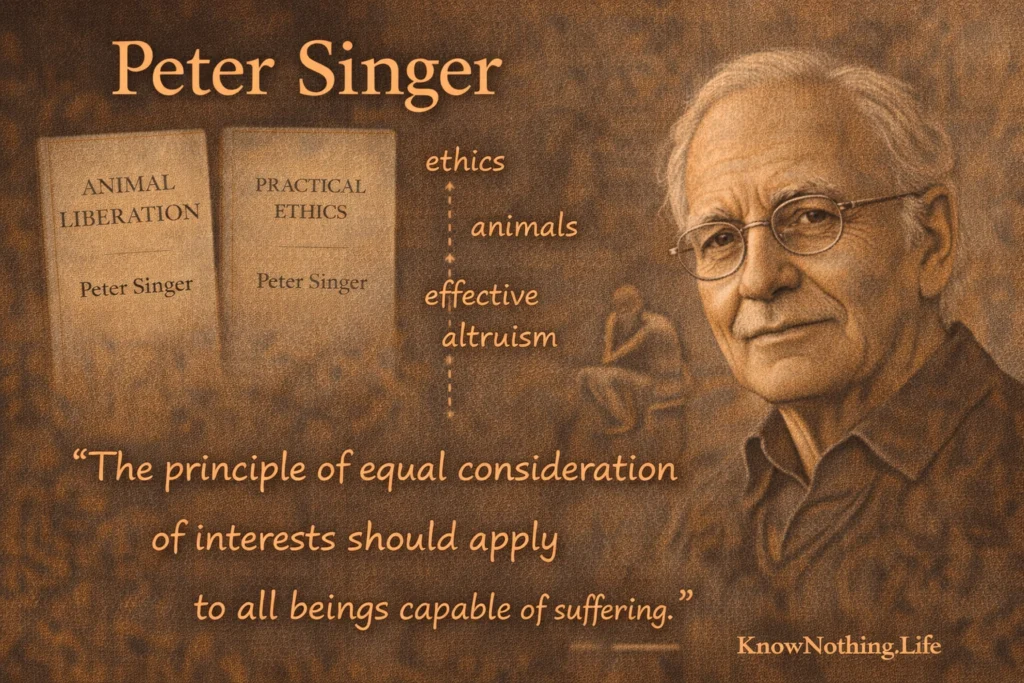
Singer rose to international prominence with the publication of Animal Liberation in 1975, a work that is widely credited with launching the modern animal rights movement. In this book, he introduced the concept of “speciesism,” a term used to describe the unjustified privileging of human interests over those of other animals. Drawing parallels to racism and sexism, Singer argued that discrimination based on species membership is morally indefensible.
At the heart of his argument is the principle of equal consideration of interests. Singer does not claim that all beings are equal in every respect, but rather that their suffering deserves equal weight. If an animal can experience pain, that pain matters morally, regardless of the species to which the animal belongs. This perspective challenges many common practices, including factory farming, animal experimentation, and other forms of exploitation. As Singer wrote, “The basic principle of equality does not require equal or identical treatment; it requires equal consideration.”
His work forced a reevaluation of everyday choices, particularly dietary habits. By exposing the conditions of industrial animal agriculture, Singer brought ethical scrutiny to practices that had long been normalized. His arguments continue to influence movements advocating for vegetarianism, veganism, and animal welfare, making Animal Liberation one of the most impactful ethical texts of the twentieth century.
Effective Altruism and Global Ethics
Beyond animal ethics, Singer is a leading voice in the movement known as effective altruism, which seeks to use reason and evidence to maximize the positive impact of charitable actions. His essay “Famine, Affluence, and Morality” presents a simple but powerful argument: if we can prevent suffering without sacrificing something of comparable importance, we are morally obligated to do so. This idea has had profound implications for how individuals think about wealth, charity, and global inequality.
Singer challenges the notion that charitable giving is optional or supererogatory. Instead, he frames it as a moral duty. He often uses thought experiments to illustrate his point, such as the example of a child drowning in a shallow pond. If we would wade in to save the child at minimal cost to ourselves, why would we not also help those suffering from poverty and disease across the globe? The distance between us and those in need, he argues, does not diminish our responsibility.
This line of reasoning has inspired a new generation of philanthropists and activists who seek to allocate resources in the most effective way possible. Singer himself has committed to donating a significant portion of his income to highly effective charities. His work in this area has helped redefine what it means to live an ethical life in an interconnected world, emphasizing action over mere intention.
Bioethics and Controversy
Singer’s work in bioethics has been among the most controversial aspects of his career. In books such as Practical Ethics, he addresses difficult questions about life, death, and moral status. He has argued that the moral value of life depends on certain capacities, such as self-awareness and the ability to have preferences about the future. These views have led him to controversial positions on issues like euthanasia, abortion, and the treatment of individuals with severe disabilities.
Critics have accused Singer of undermining the intrinsic value of human life, while supporters argue that he is simply applying consistent ethical reasoning to complex issues. Singer maintains that ethical decisions must be guided by careful consideration of suffering and well-being, rather than by rigid adherence to tradition or intuition. “Ethics is not an ideal system that is noble in theory but no good in practice,” he wrote. “It is a guide to what we ought to do.”
These debates highlight the provocative nature of Singer’s philosophy. He does not shy away from challenging deeply held beliefs, even when doing so invites criticism. His willingness to engage with uncomfortable questions has made him a central figure in contemporary ethical discourse, though not without significant opposition.
The Expanding Circle and Moral Progress
One of Singer’s most influential ideas is the concept of the “expanding circle,” which he explores in his book The Expanding Circle: Ethics and Sociobiology. According to this idea, human moral concern has gradually expanded over time—from family and tribe to nation, and potentially to all sentient beings. Singer argues that reason plays a crucial role in this process, pushing us to extend our ethical considerations beyond narrow self-interest.
This framework provides a hopeful vision of moral progress. It suggests that ethical development is not arbitrary but driven by rational reflection and increased awareness. As societies become more interconnected and informed, the circle of moral concern can continue to grow. Singer sees this as both a descriptive account of history and a normative guide for the future.
He emphasizes that this expansion is not automatic; it requires conscious effort and critical thinking. By questioning assumptions and examining the consequences of our actions, individuals can contribute to a more inclusive and compassionate ethical framework. This idea ties together many strands of Singer’s work, from animal rights to global poverty, under a unified vision of moral progress.
Legacy and Influence
Peter Singer’s influence extends far beyond academic philosophy. His ideas have shaped public debates, inspired social movements, and influenced policy discussions around the world. He has held positions at prestigious institutions, including Princeton University, where he has continued to teach and write on ethics and public policy.
His work has also played a significant role in the rise of movements focused on animal welfare, effective giving, and global justice. Organizations inspired by his ideas have directed billions of dollars toward interventions aimed at reducing suffering and improving lives. Singer’s emphasis on measurable impact has introduced a new level of rigor to ethical decision-making in both personal and institutional contexts.
Despite ongoing controversy, Singer remains a central figure in contemporary thought. His philosophy challenges individuals to align their actions with their values and to take responsibility for the consequences of their choices. Whether one agrees with his conclusions or not, engaging with his work demands serious reflection on what it means to live an ethical life.
Conclusion
Peter Singer’s philosophy represents a radical yet deeply rational approach to ethics, grounded in the principle of reducing suffering and expanding moral concern. From his groundbreaking work on animal rights to his advocacy for effective altruism, he has consistently pushed the boundaries of ethical thinking. His arguments challenge complacency and call for a more thoughtful, compassionate approach to the world.
His legacy lies not only in the ideas he has developed but in the questions he has forced society to confront. How far does our moral responsibility extend? What obligations do we have to others, both human and non-human? And how should we live in a world where suffering is both pervasive and, in many cases, preventable?
As Singer himself has suggested, “If we can prevent something bad without sacrificing anything of comparable significance, we ought to do it.” This principle captures the essence of his philosophy—a call to action grounded in reason, empathy, and a commitment to making the world better.