G.I. Gurdjieff stands as one of the most enigmatic and influential spiritual teachers of the 20th century. A philosopher, mystic, and master of esoteric traditions, Gurdjieff introduced a radical vision of human existence centered on the idea that most people live in a state of sleep—unaware of their true potential. His teachings, often referred to as the “Fourth Way,” aimed to awaken individuals to higher levels of consciousness through disciplined inner work carried out within ordinary life.
Unlike traditional religious or philosophical systems, Gurdjieff’s approach did not rely on belief or dogma. Instead, it emphasized direct experience, self-observation, and intentional effort. His ideas challenged deeply held assumptions about identity, free will, and awareness, offering a framework for understanding the fragmented nature of the human psyche. Through his teachings and writings, Gurdjieff left a lasting imprint on philosophy, psychology, and spiritual practice.
Early Life and Search for Knowledge
George Ivanovich Gurdjieff was born around 1866 in Alexandropol (modern-day Gyumri, Armenia), within the Russian Empire. His early life remains shrouded in mystery, partly due to his own tendency to mythologize his experiences. Raised in a culturally diverse region influenced by Armenian, Greek, and Russian traditions, Gurdjieff was exposed to a wide array of religious and philosophical ideas from an early age.
As a young man, Gurdjieff became dissatisfied with conventional explanations of existence and embarked on a series of travels across the Middle East, Central Asia, and North Africa. He claimed to have sought out ancient brotherhoods and hidden schools of knowledge, studying practices that aimed to develop human consciousness. While the historical details of these journeys are difficult to verify, they form a central part of his narrative and the foundation of his teachings.
These formative experiences shaped Gurdjieff’s conviction that humanity had lost access to deeper knowledge once preserved in ancient traditions. He believed that fragments of this wisdom still existed, scattered across cultures, and that it was possible to reconstruct a system capable of awakening modern individuals. This belief would guide his life’s work and teaching.
The Fourth Way and Core Teachings
Gurdjieff’s most significant contribution is the formulation of the Fourth Way, a path of inner development distinct from traditional spiritual disciplines. He described three conventional ways: the way of the fakir (physical discipline), the way of the monk (emotional devotion), and the way of the yogi (intellectual development). Each of these paths focuses on a single aspect of human nature and often requires withdrawal from ordinary life.
The Fourth Way, by contrast, integrates all three aspects—body, emotion, and mind—while allowing individuals to remain engaged in the world. It emphasizes conscious effort in everyday situations, transforming ordinary experiences into opportunities for self-awareness. Central to this approach is the practice of self-observation, through which individuals become aware of their mechanical patterns and habitual reactions.
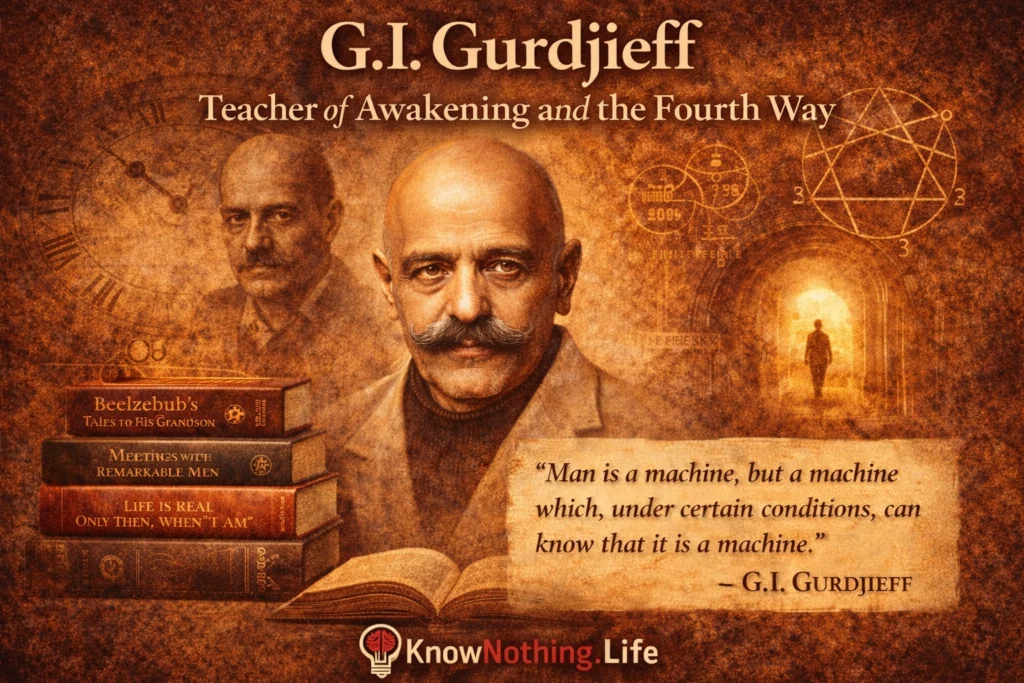
Gurdjieff taught that human beings are not unified but composed of multiple, often conflicting “selves.” This fragmentation leads to a lack of true will and consistency. As he famously stated, “Man is a machine, but a machine which, under certain conditions, can know that it is a machine.” Recognizing this mechanical nature is the first step toward awakening, as it allows individuals to begin the process of conscious transformation.
Major Works and Literary Contributions
Gurdjieff’s teachings are preserved in a series of complex and often challenging texts. His most important work, Beelzebub’s Tales to His Grandson, is a dense and allegorical narrative that explores the nature of human existence and the possibility of transformation. Written in a deliberately difficult style, the book is intended not only to convey ideas but to engage the reader in active effort and reflection.
Another key text, Meetings with Remarkable Men, offers a more accessible account of his early life and travels. Through a series of vivid stories, Gurdjieff describes his encounters with individuals who played a role in his search for knowledge. This work provides valuable insight into the origins of his ideas and the experiences that shaped his philosophy.
His teachings are also preserved in Life Is Real Only Then, When ‘I Am’, which reflects his later efforts to articulate the principles of conscious existence. Although incomplete, this text offers a glimpse into his evolving understanding of self-awareness and being. Together, these works form a unique body of literature that continues to challenge and inspire readers.
Consciousness, Self-Remembering, and Inner Work
At the heart of Gurdjieff’s teaching lies the concept of consciousness. He argued that what people commonly consider awareness is, in fact, a state of sleep characterized by automatic thoughts and behaviors. True consciousness, according to Gurdjieff, requires sustained attention and effort, something rarely achieved without deliberate practice.
One of his central practices is “self-remembering,” a state in which an individual is simultaneously aware of themselves and their surroundings. This dual awareness creates a sense of presence that transcends ordinary perception. Gurdjieff believed that through repeated efforts at self-remembering, individuals could gradually awaken from their habitual state of unconsciousness.
Inner work, in this context, involves confronting one’s own limitations and contradictions. Gurdjieff emphasized the importance of struggle, suggesting that growth arises from the tension between opposing forces within the self. As he stated, “Without struggle, no progress and no result. Every breaking of habit produces a change in the machine.” This process requires discipline, honesty, and a willingness to question deeply ingrained patterns.
Influence, Students, and Legacy
Gurdjieff’s influence extends far beyond his immediate circle of students. Among those most significantly impacted by his teachings was P.D. Ouspensky, who played a crucial role in introducing the Fourth Way to a wider audience. Ouspensky’s writings helped systematize and disseminate Gurdjieff’s ideas, ensuring their continued relevance.
Other notable figures, including writers, psychologists, and spiritual seekers, have drawn inspiration from Gurdjieff’s work. His emphasis on direct experience and self-awareness has influenced movements in humanistic psychology, mindfulness practices, and contemporary spirituality. Despite the esoteric nature of his teachings, their core insights resonate with universal questions about identity, freedom, and purpose.
Gurdjieff established the Institute for the Harmonious Development of Man in France, where he taught students through a combination of lectures, practical exercises, and group work. His methods often included unconventional techniques designed to disrupt habitual thinking and provoke insight. While some critics viewed his approach as unorthodox or controversial, others recognized its transformative potential.
Conclusion
G.I. Gurdjieff remains a towering figure in the landscape of modern spiritual thought. His teachings challenge individuals to confront the limitations of their own awareness and to undertake the difficult work of self-transformation. By emphasizing the importance of consciousness, effort, and integration, he offers a path that is both demanding and profoundly rewarding.
In an age characterized by distraction and fragmentation, Gurdjieff’s message carries renewed significance. His insistence that individuals must awaken from mechanical existence speaks directly to the challenges of contemporary life. Through his writings and teachings, he continues to inspire those who seek a deeper understanding of themselves and the nature of reality.
G.I. GURDJIEFF BOOKS
The Herald of Coming Good: First Appeal to Contemporary Humanity
Beelzebub’s Tales to His Grandson