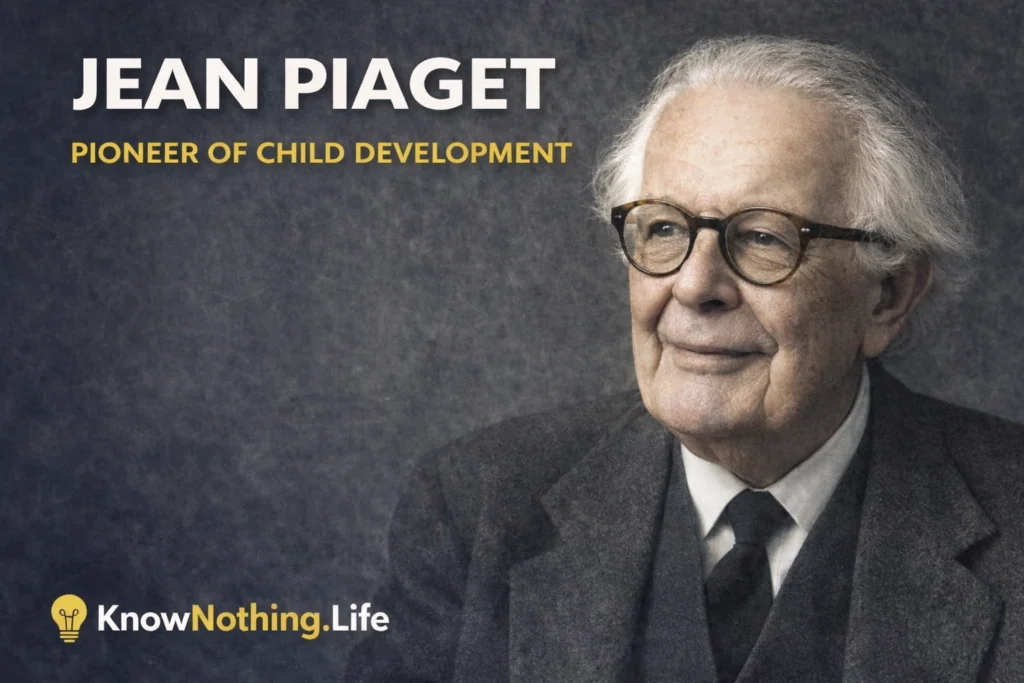
Few thinkers have reshaped our understanding of childhood and human intelligence as profoundly as Jean Piaget. Widely regarded as the father of cognitive development theory, Piaget transformed psychology by demonstrating that children do not simply think less than adults—they think differently. His work revealed that intelligence evolves through structured stages, each characterized by distinct ways of perceiving, reasoning, and interacting with the world.
Piaget’s influence extends far beyond psychology into education, philosophy, and even artificial intelligence. By focusing on how knowledge is constructed rather than passively received, he shifted the emphasis from teaching to learning. His theories challenged behaviorist models advanced by figures such as B. F. Skinner, arguing that internal cognitive processes play a central role in development. Through decades of meticulous observation and experimentation, Piaget built a framework that continues to shape how we understand human growth and learning.
Early Life and Intellectual Origins
Jean Piaget was born on August 9, 1896, in Neuchâtel, Switzerland, into a family that fostered intellectual curiosity and scholarly discipline. His father was a professor of medieval literature, while his mother had a deep interest in religion and philosophy. From an early age, Piaget displayed an extraordinary passion for knowledge, publishing his first scientific paper on mollusks at just eleven years old. This early immersion in biological research would profoundly influence his later approach to psychology.
Piaget initially pursued studies in natural sciences at the University of Neuchâtel, earning a doctorate in zoology. However, his interests gradually shifted toward epistemology—the study of knowledge and how it is acquired. This transition led him to explore psychology as a means of understanding the development of human thought. His work at the Binet Laboratory in Paris, where he assisted in developing intelligence tests, proved pivotal. There, he became fascinated not with whether children answered questions correctly, but with how they reasoned through them.
This focus on reasoning marked the beginning of Piaget’s lifelong inquiry into cognitive development. Rather than viewing intelligence as a fixed quantity, he saw it as a dynamic process shaped by interaction with the environment. His interdisciplinary background in biology and philosophy allowed him to approach psychology with a unique perspective, emphasizing growth, adaptation, and structure.
The Theory of Cognitive Development
Piaget’s most enduring contribution is his theory of cognitive development, which proposes that children progress through a series of stages, each representing a qualitatively different mode of thinking. These stages—sensorimotor, preoperational, concrete operational, and formal operational—describe how children construct knowledge through interaction with their environment.
In the sensorimotor stage, infants learn through direct sensory experience and motor activity. Piaget observed that during this period, children develop object permanence—the understanding that objects continue to exist even when they are not visible. This insight demonstrated that even the earliest forms of cognition involve active construction rather than passive reception.
As children move into the preoperational and concrete operational stages, their thinking becomes increasingly symbolic and logical. However, Piaget noted that young children often struggle with concepts such as conservation and perspective-taking. It is only in the formal operational stage, typically beginning in adolescence, that individuals develop the ability to think abstractly and reason hypothetically. Piaget famously stated, “The principal goal of education is to create men who are capable of doing new things, not simply of repeating what other generations have done.” This quote encapsulates his belief in the creative and constructive nature of intelligence.
Assimilation, Accommodation, and Constructivism
Central to Piaget’s theory are the processes of assimilation and accommodation, which describe how individuals adapt to new information. Assimilation involves incorporating new experiences into existing cognitive structures, while accommodation requires modifying those structures to account for new realities. Together, these processes drive cognitive development through a dynamic balance known as equilibration.
Piaget’s constructivist approach emphasized that knowledge is not transmitted directly from teacher to student but is actively built by the learner. This perspective challenged traditional educational models that relied on rote memorization and passive instruction. Instead, Piaget argued that learning occurs through exploration, experimentation, and problem-solving.
He wrote, “To understand is to invent.” This statement reflects his conviction that true knowledge arises from active engagement with the world. By framing learning as a constructive process, Piaget laid the foundation for modern educational practices that prioritize inquiry-based and student-centered approaches.
Major Works and Intellectual Contributions
Piaget’s ideas were articulated in a series of influential works that continue to shape developmental psychology. His early book, The Language and Thought of the Child (1923), explored how children’s speech reflects their cognitive processes. In this work, Piaget introduced the concept of egocentrism, describing how young children have difficulty understanding perspectives other than their own.
In The Origins of Intelligence in Children (1952), Piaget provided a detailed account of the sensorimotor stage, demonstrating how intelligence emerges from action. This work highlighted the continuity between biological adaptation and cognitive development, reinforcing his view of intelligence as a form of adaptation.
Another major contribution, The Construction of Reality in the Child (1954), examined how children develop an understanding of the external world. Piaget’s interdisciplinary approach, combining biology, psychology, and philosophy, allowed him to address fundamental questions about knowledge and reality. His work established developmental psychology as a rigorous scientific discipline and influenced fields ranging from education to epistemology.
Influence on Education and Psychology
Piaget’s impact on education has been profound and enduring. His theories inspired a shift away from teacher-centered instruction toward approaches that emphasize active learning and discovery. Educators began to recognize the importance of aligning teaching methods with the developmental stage of the learner, ensuring that concepts are presented in ways that are cognitively appropriate.
His work also influenced other prominent psychologists, including Lev Vygotsky, who expanded on Piaget’s ideas by emphasizing the role of social interaction in cognitive development. While Piaget focused on individual construction of knowledge, Vygotsky highlighted the importance of cultural and social context, leading to a more comprehensive understanding of learning.
In psychology, Piaget’s emphasis on cognitive processes helped pave the way for the cognitive revolution, which shifted the field’s focus from behavior to mental structures and functions. His work provided a framework for studying how people think, reason, and solve problems, influencing research in areas such as memory, language, and artificial intelligence.
Criticism and Evolving Perspectives
Despite his significant contributions, Piaget’s theories have been subject to criticism. Some researchers argue that he underestimated children’s cognitive abilities, suggesting that younger children may possess more advanced reasoning skills than he believed. Advances in experimental methods have revealed that infants, for example, may demonstrate forms of understanding that Piaget did not detect.
Others have criticized the rigidity of his stage theory, arguing that cognitive development may be more continuous and variable than his model suggests. Cultural factors have also been identified as important influences on development, challenging the universality of Piaget’s stages.
Nevertheless, these critiques have not diminished Piaget’s importance. Instead, they have led to refinements and extensions of his work, contributing to a more nuanced understanding of cognitive development. His theories continue to serve as a foundation for ongoing research and debate.
Legacy and Lasting Impact
Jean Piaget’s legacy lies in his revolutionary rethinking of how humans acquire knowledge. By demonstrating that children actively construct their understanding of the world, he transformed both psychology and education. His work established cognitive development as a central area of study and provided a framework that continues to guide research and practice.
His influence can be seen in modern educational systems, which increasingly emphasize critical thinking, problem-solving, and experiential learning. Piaget’s ideas have also shaped disciplines beyond psychology, including philosophy, linguistics, and computer science. His concept of knowledge as a dynamic, evolving process resonates with contemporary approaches to learning and innovation.
Piaget once remarked, “Intelligence is what you use when you don’t know what to do.” This insight captures the essence of his work: intelligence is not merely the accumulation of facts but the ability to adapt, explore, and create. His contributions continue to inspire educators, researchers, and thinkers around the world.
Final Thoughts
To engage with the work of Jean Piaget is to encounter a profound shift in how we understand human development. His theories challenge us to see learning not as a passive process but as an active construction shaped by experience and interaction. By uncovering the stages and mechanisms of cognitive growth, Piaget provided a roadmap for understanding how we come to know the world.
His legacy endures in classrooms, research labs, and philosophical debates, reminding us that knowledge is not simply given—it is built. In redefining intelligence as a process of adaptation and invention, Piaget reshaped the foundations of psychology and left an enduring mark on how we understand the human mind.