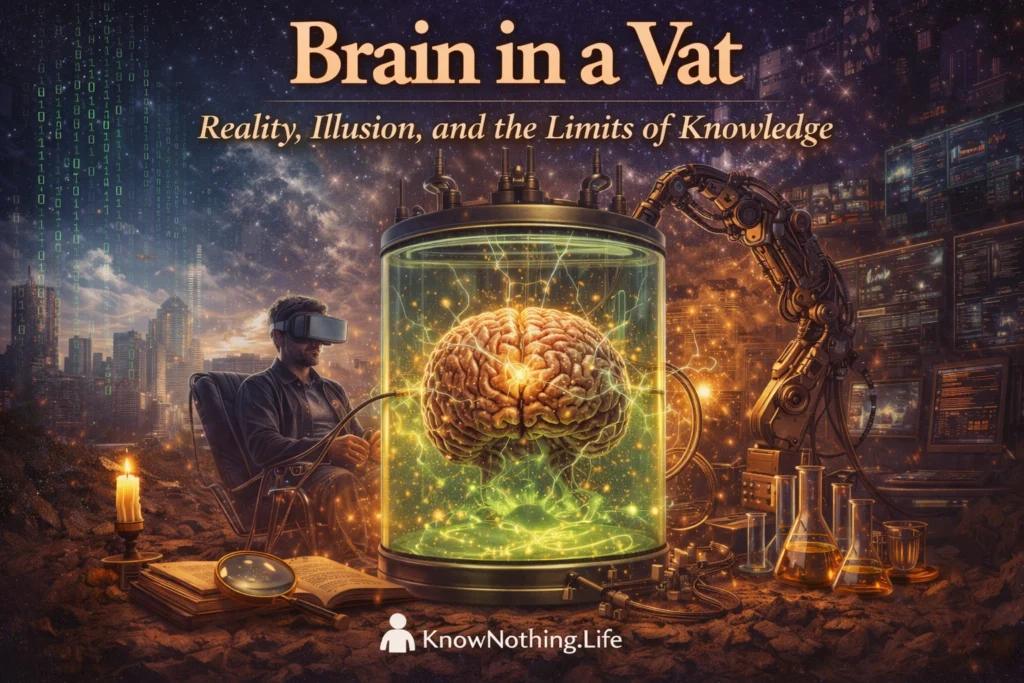
The “brain in a vat” thought experiment is one of the most striking modern expressions of philosophical skepticism. It asks us to imagine that our brains have been removed from our bodies and placed in a vat of life-sustaining fluid, connected to a computer that simulates all of our experiences. From our perspective, everything would appear normal—we would see, hear, feel, and think as usual. Yet none of these experiences would correspond to an external reality.
This scenario raises a profound epistemological question: how can we know that our experiences reflect the real world rather than an elaborate illusion? The brain in a vat problem challenges our confidence in perception, memory, and even reason, suggesting that all of our beliefs about the world could be systematically false. It is not meant to prove that we are brains in vats, but rather to demonstrate that we cannot rule out the possibility with certainty.
The idea has its roots in earlier philosophical skepticism, particularly in the work of René Descartes, and was later developed in contemporary philosophy by thinkers such as Hilary Putnam. By exploring this thought experiment, philosophers aim to understand the nature of knowledge, the reliability of perception, and the relationship between mind and reality.
Origins in Cartesian Skepticism
The brain in a vat scenario is a modern extension of the skepticism introduced by René Descartes in Meditations on First Philosophy. Descartes famously imagined the possibility of an evil demon deceiving him about everything he perceives. This hypothetical deceiver could manipulate his experiences so completely that even basic truths about the external world would be called into question.
Descartes’ method of radical doubt was designed to strip away uncertain beliefs and identify those that could withstand even the most extreme skepticism. By considering the possibility of total deception, he sought to determine whether any knowledge could be absolutely certain. His conclusion, “Cogito, ergo sum” (“I think, therefore I am”), demonstrates that even if all external experiences are false, the existence of the thinking self cannot be doubted.
The brain in a vat thought experiment builds on this foundation by replacing the evil demon with a technological mechanism. Instead of a supernatural deceiver, a computer generates the illusion of reality. This shift reflects the influence of modern science and technology on philosophical thought, while preserving the core skeptical challenge introduced by Descartes.
Hilary Putnam and Semantic Externalism
The contemporary formulation of the brain in a vat argument is most closely associated with Hilary Putnam. In his work Reason, Truth and History, Putnam explores the implications of the thought experiment for language and meaning, ultimately offering a surprising response to skepticism.
Putnam argues that if we were truly brains in vats, we would not be able to meaningfully assert that we are brains in vats. This is because the meaning of our words depends on our interaction with the external world. According to his theory of semantic externalism, terms like “brain” and “vat” refer to real objects in the world. If our experiences are entirely simulated, then these terms would not refer to actual brains or vats, but to simulated representations.
This leads to a paradoxical conclusion: if we are brains in vats, the statement “I am a brain in a vat” would be false or meaningless. Conversely, if the statement is meaningful and true, then we are not brains in vats. Putnam’s argument does not eliminate skepticism entirely, but it challenges the coherence of the brain in a vat scenario, suggesting that certain skeptical hypotheses may be self-defeating.
Perception, Reality, and Illusion
The brain in a vat thought experiment raises fundamental questions about the nature of perception. If all of our experiences can be simulated, then perception alone cannot guarantee access to reality. What we perceive may not correspond to the external world, but to a constructed illusion.
This insight challenges the assumption that perception provides direct knowledge of reality. Philosophers have long debated whether perception is reliable or whether it merely presents appearances that may or may not reflect the truth. The brain in a vat scenario intensifies this debate by showing that even perfectly coherent and consistent experiences could be entirely false.
At the same time, the thought experiment highlights the role of interpretation in perception. Our understanding of the world depends not only on sensory input but also on the concepts and frameworks we use to interpret that input. This suggests that knowledge is not simply a matter of receiving information, but of making sense of it—a process that may be vulnerable to error or deception.
Knowledge and Skepticism
The brain in a vat argument is a powerful tool for exploring the limits of knowledge. It demonstrates that we cannot achieve absolute certainty about the external world, as there is always the possibility of deception. This aligns with broader skeptical arguments that challenge the possibility of knowledge.
However, many philosophers argue that the standards imposed by such skepticism are too demanding. If knowledge requires absolute certainty, then very little—if anything—can be known. Instead, they propose that knowledge should be understood in terms of reasonable justification or practical reliability rather than infallibility.
The brain in a vat scenario thus serves as a test case for different theories of knowledge. It forces us to consider what counts as sufficient justification and whether knowledge can exist in the absence of certainty. While it does not provide definitive answers, it deepens our understanding of the challenges involved in defining knowledge.
The Brain in a Vat and Modern Thought
The influence of the brain in a vat thought experiment extends beyond philosophy into popular culture and science. It has inspired numerous works of fiction, most notably The Matrix, which depicts a world in which human experiences are generated by a simulated reality. Such portrayals bring philosophical questions about reality and illusion into a broader cultural context.
In contemporary philosophy, the brain in a vat continues to shape debates about consciousness, artificial intelligence, and virtual reality. As technology advances, the possibility of creating increasingly realistic simulations raises new questions about the nature of experience and the boundaries between reality and illusion.
The thought experiment also intersects with discussions in cognitive science and neuroscience, which examine how the brain constructs our perception of the world. These interdisciplinary connections highlight the enduring relevance of the brain in a vat scenario as a tool for exploring fundamental questions about knowledge and reality.
Responses and Philosophical Significance
Philosophers have developed various responses to the brain in a vat argument, ranging from attempts to refute it to efforts to accommodate its implications. Some, like Hilary Putnam, argue that the scenario is incoherent, while others accept its possibility but reject its skeptical conclusions.
One common response is to argue that knowledge does not require certainty but rather a reliable connection between belief and reality. From this perspective, even if we cannot rule out skeptical scenarios, we can still have knowledge based on the best available evidence. This approach reflects a shift away from the quest for absolute certainty toward a more pragmatic understanding of knowledge.
The significance of the brain in a vat thought experiment lies in its ability to challenge deeply held assumptions about reality and knowledge. By imagining a world in which all experiences are simulated, it forces us to confront the possibility that our beliefs may not correspond to reality. This challenge, while unsettling, ultimately enriches philosophical inquiry by encouraging deeper reflection on the nature of knowledge.
Conclusion
The brain in a vat thought experiment stands as one of the most powerful expressions of modern skepticism. By questioning the reliability of perception and the existence of the external world, it exposes the limits of human knowledge and the difficulty of achieving certainty.
From its roots in the philosophy of René Descartes to its development by Hilary Putnam, the idea has evolved into a central topic in contemporary epistemology. It challenges us to reconsider what it means to know something and whether our beliefs can ever be fully justified.
As unsettling as it may be, the brain in a vat scenario serves a valuable purpose. It reminds us that knowledge is not simply given, but must be carefully examined and justified. In doing so, it deepens our understanding of the relationship between mind, reality, and truth—one of the most fundamental questions in philosophy.